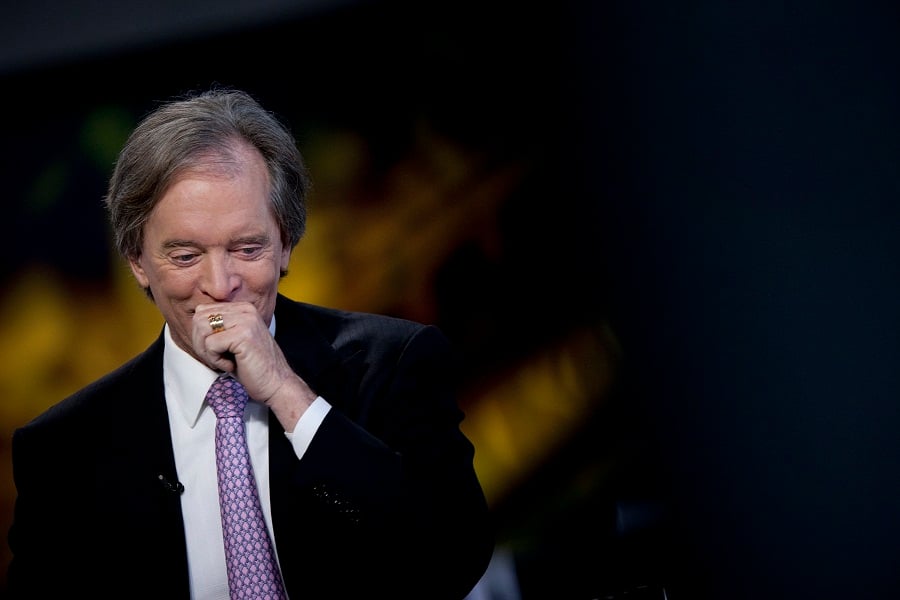
Bill Gross is
suing Pimco and its parent company Allianz for “hundreds of millions of dollars” in a complaint that mostly alleges that Mr. Gross was wrongfully pushed out as the bond giant's chief investment officer by a “cabal” of executives seeking a bigger slice of the bonus pool, but there's plenty of other meat to chew on in the full complaint.
Here are some of the most interesting tidbits straight from the document.
There's detail about just how much money Pimco executives make:
PIMCO established and provides a profit-sharing plan for its managing directors. The contours of this profit-sharing or bonus pool plan are governed by the Amended and Restated Pacific Investment Management Company LLC Non-Qualified Profit Sharing Plan dated as of January 1, 2012 (the "Plan"). A true and correct copy of that contract is attached here to as Exhibit 1. Under the Plan, Mr. Gross was entitled to receive 20% of the entire profit sharing bonus pool each year.
Thus, for example, in 2013 the profit sharing bonus pool totaled $1.3 billion and Mr. Gross received $300 million over the course of that year.
There's a jab at Dan Ivascyn, Pimco's current chief investment manager:
As these complaints and pressures kept mounting, Ivascyn hatched a plan to oust Mr. Gross from PIMCO. Doing so would remove an executive philosophically opposed to Ivascyn's high-risk, high-fee investment model, create an opening for a new Chief Investment Officer, and, most importantly to Ivascyn, free up a significant portion of the bonus pool to be allocated by the Partners Compensation Committee on which he sat.
The complaint says Mohamed El-Erian's success at Harvard was the result of risky bets during a bubble:
El-Erian received his first substantive exposure to a host of high-risk derivative asset classes while at Harvard. Through the use of these high-risk assets, El-Erian was able to witness a 23 %return on investment in his only full year at Harvard growth that came during what would soon be recognized as the market "bubble" of the mid-2000s. From this experience, El-Erian became convinced of the attractiveness of such high-risk investments, especially since he had not yet been exposed to their downside during the "Great Recession" of 2007 that was soon to follow.
It also says El-Erian, who was co-chief investment manager at Pimco, pursued a strategy similar to the Cheesecake Factory:
Mr. Gross was pleased that a succession plan was in place and, for a time, worked in alignment with El-Erian. Cracks soon began to appear in this alliance, however, as El-Erian sought to force PIMCO out of its core focus on bonds and related fixed income securities and instead become a general-purpose investment management firm offering stocks, commodities, real estate, and hedge fund-like products to investors. As time passed, Mr. Gross characterized El-Erian's plan as similar to the extensive and varied menu at a Cheesecake Factory restaurant, while his own favored approach was "bonds and burgers" a simple, laser focus on a specific type of securities that had been successful since PIMCO's founding and provided stable returns for investors. In fact, in the three years preceding his departure, Mr. Gross's flagship Total Return Fund produced returns that were almost double those of the benchmark Barclays US Aggregate Bond Index. This was not a mere philosophical difference between the two men. Mr. Gross was concerned that PIMCO's expansion into new investment fields posed a particular liability to the company and its investors should another significant event, such as the collapse of Lehman Brothers, occur. This was of particular concern because many of the new investment areas favored by El-Erian, such as the mortgages and leveraged real estate investments being led by a younger PIMCO managing director named Dan Ivascyn were under the control of portfolio managers who were, to varying degrees, independent from the PIMCO Investment Committee.
It also alleges that Pimco's Andrew Balls leaked details of El-Erian's departure to the press:
Unknown to PIMCO or Mr. Gross, less than two hours after the meeting adjourned, PIMCO managing director Andrew Balls, who was present for the announcement regarding El- Erian, placed a call to a reporter at the Financial Times, the newspaper for which Balls had previously worked. Two days later, the Financial Times broke the story, laying the fault for El-Erian's abrupt resignation at Mr. Gross's feet and portraying El-Erian's exit as the result of Mr. to Gross's personal conduct at PIMCO when in fact the reason for El-Erian's departure was Mr. Gross's suggestion that he could step down from heading a portion of PIMCO's Investment Committee after expressing his disagreement with El-Erian's favoring new investment areas such as the mortgages and leveraged real estate investments and his support for these areas remaining independent from the PIMCO Investment Committee and his anger and apprehension over the idea that he would have to bear sole responsibility (and blame) for the high-fee investments he had promoted at PIMCO. Both the initial Financial Times axticle [sic] and numerous follow-up media pieces heaped praise on El-Erian and cast criticism on Mr. Gross. Glossed over — or even left entirely unmentioned was any comment on El-Erian's abrupt departure from a company that he had been hired to eventually lead, or of El-Erian's abysmal performance on managing his PIMCO fund. Also left out was the comparative fact that in fact, in the three years preceding his departure, Mr. Gross's flagship Total Return Fund produced stellar returns returns that were almost double those of the benchmark Barclays US Aggregate Bond Index.
See the full complaint
here.
A spokesman for PIMCO declined to comment.