
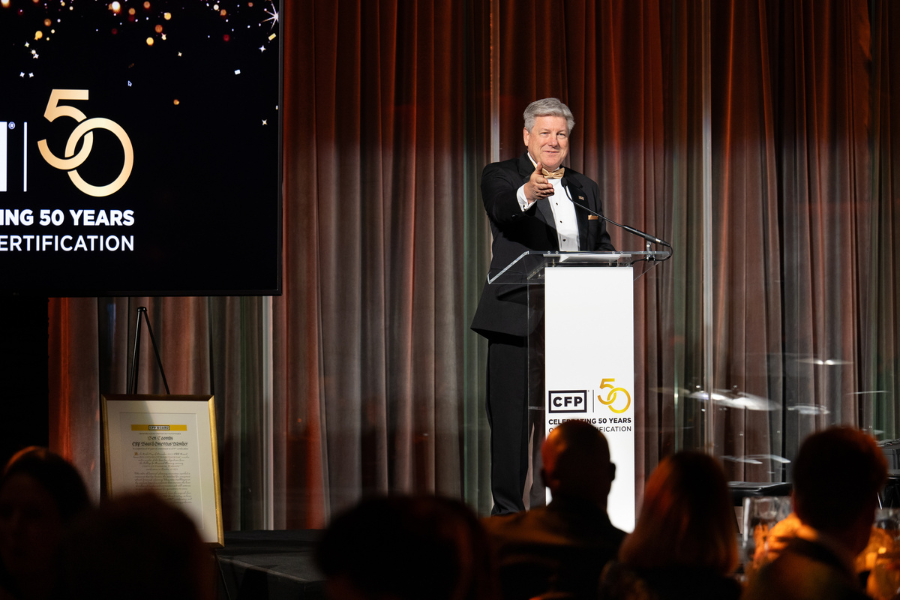
One of Daniel Moisand’s final acts as chairman of the Certified Financial Planner Board of Standards Inc. was to convey the organization’s strong support for the Department of Labor’s latest investment-advice rule proposal.
He was one of the witnesses during two days of hearings in December about the measure, which would apply the fiduciary standard of care under federal retirement law – the Employee Retirement Income Security Act – to a wider range of financial advisors making investment recommendations to retirement savers or plans.
The DOL proposal would redefine the term “fiduciary” so that it applies to investment advisors, brokers, and insurance sales professionals who are in a relationship of “trust and confidence” with investors. Of those groups, only investment advisors currently adhere to a fiduciary standard. The agency has said it is trying to establish a consistent regulatory framework to protect investors from conflicted advice.
Increasing the fiduciary reach is something that Moisand, 56, has advocated throughout his more than three-decade career as an advisor. It’s an effort that, in his view, is crucial not only to protect investors but also to establish financial planning as a profession like accounting or law.
“I don’t see how you build the profession on any standard other than the fiduciary standard,” said Moisand, partner and senior advisor at Moisand Fitzgerald Tamayo in Orlando, Florida.
Moisand served as chairman of the CFP Board in 2023. His term ended not long after his appearance at the December 13 DOL hearing. He was there to give the organization’s full-throated endorsement to the DOL proposal.
The CFP Board adopted its own fiduciary standard for the credential in 2018. It requires that CFP holders act as fiduciaries at all times when they are providing investment advice. That means that anyone holding the mark – advisors, brokers, insurance agents – is held to a fiduciary standard.
When the CFP Board was considering the fiduciary mandate, it was warned that imposing a fiduciary standard would decrease interest in the mark and result in a decline in CFPs. Instead, CFPs increased, and will exceed 100,000 at some point this year.
“The number of CFP professionals has grown by about a third … in just five years,” Moisand said at the DOL hearing. “This is across all business models, including registered representatives of broker-dealers, investment advisor representatives, and those with insurance licenses. All of these CFP professionals are providing financial advice to their clients, while committing to the CFP Board to act as a fiduciary. Our requirements have not adversely impacted their business.”
Financial industry opponents say the DOL fiduciary proposal will make advice more expensive because of additional regulatory costs and legal exposure and price it out of reach for investors with modest assets.
DOL critics question the board’s backing of the measure. Marc Cadin, CEO of Finseca, a financial industry trade association, said the organization is promoting fee-only advice. He said that advisory account minimums put them out of reach for many investors who are better served in brokerage accounts.
“The supporters of the rule are myopically focused on promoting a narrow business model, and the result will be that fewer Americans will get the advice they need to become financially secure,” Cadin said in a recent interview.
Moisand emphasized that the CFP designation is compensation-neutral, as it applies the fiduciary standard to a range of compensation models that all come with potential conflicts of interest.
“Commissions can be a problem; they don’t have to be,” he said. “Fee-only can have conflicts, too.”
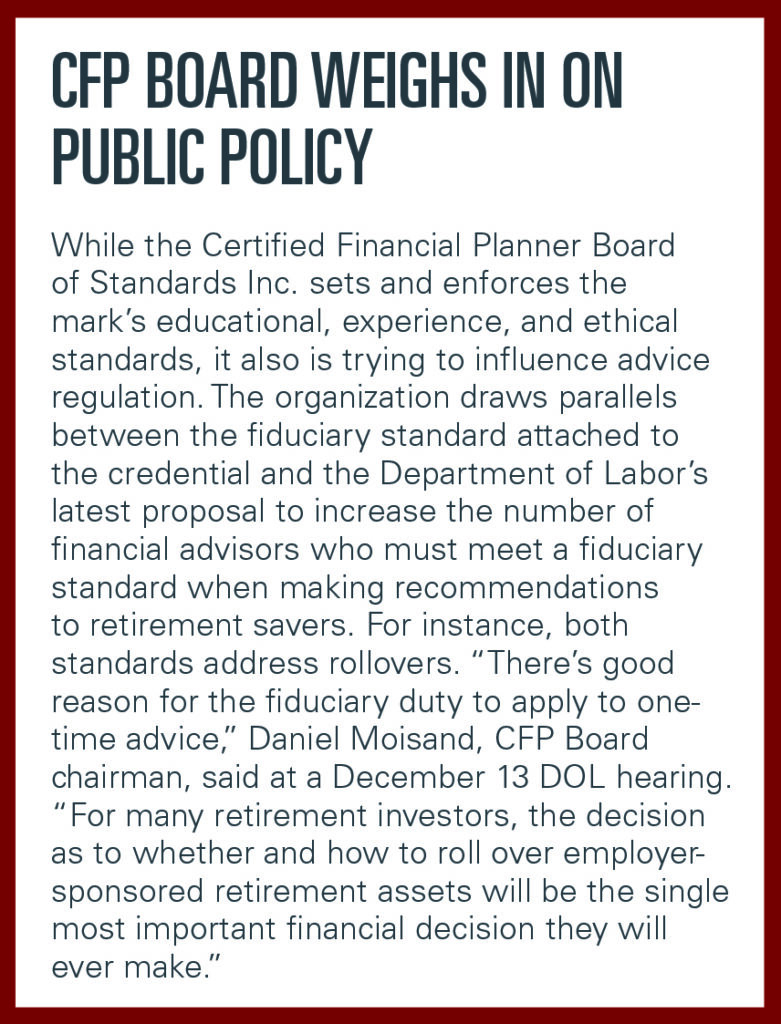
Skeptics of the CFP Board’s fiduciary standard point out that there’s no guarantee that mark holders will act as fiduciaries. Although the CFP Board does have an enforcement arm, it does not have investigatory capabilities. The board responds to complaints made by customers and clients regarding CFPs with whom they’re working.
“I am very confident that if a complaint is filed, it is not ignored,” Moisand said. “The issue is we don’t get very many complaints, so it may look like there’s not much enforcement. I’d put our disciplinary program up against any other credential in the world.”
In addition to his recent term as CFP Board chairman, Moisand has held several other leadership positions with financial planning organizations. He’s also served as president and chairman of the Financial Planning Association and is a former member of the board of the Foundation for Financial Planning, which focuses on pro bono planning.
During his testimony at the DOL hearing, Moisand helped tell the CFP Board’s story of a credential that is increasing in popularity even as the fiduciary requirement raises the bar for using the mark. He pointed out that nearly 10,000 people sat for the CFP exam last year.
“That just shows how the marks have become the standard for financial planning,” Moisand said. “Our [fiduciary] standard reflects the expectations of the public, even if the public can’t quite articulate the standard they’re looking for.”

The financial advice industry has been facing inquiries into its cash sweep programs for years now.

Investor money allegedly went to strip clubs, exotic cars, and landscaping

Procyon adds $415 million in assets under management in New Jersey while Savant picks up a $213 million Southern California planning firm

With a growing number of real estate-rich Baby Boomers aging into retirement, some advisors may be failing to consider all the options available for those clients' assets.

Cornerstone Advisors study reveals compliance bottlenecks stall campaigns weeks after customer opportunities close.
As AI makes financial information more accessible than ever, Lana Hock explains why human judgment, trust, and empathy remain the qualities clients value most in a financial advisor
Northern Trust’s Ken Lassner shows advisors how to convert volatility into after-tax portfolio gains

