
An increasing number of U.S. states are starting to push back against the anti-ESG rhetoric emanating from the Republican Party and a few of its high-profile governors. Some are moving ahead with their own rules to address sustainability concerns and lower greenhouse gas emissions.
With Congress deadlocked for at least the next two years, state governments are now at the forefront when it comes to environmental legislation. In Minnesota, Governor Tim Walz, a Democrat, signed legislation establishing a statewide carbon-free electricity standard. In New Jersey, Governor Phil Murphy, also a Democrat, announced a series of steps aimed at achieving 100% clean energy by 2035.
A few Republican-dominated states are bucking their party’s anti-ESG messaging as well. Pension plan executives in Kentucky, where the parties split control of state government, said the state treasurer’s call for them to pull funds from financial-services firms deemed “hostile” to Big Oil violated their fiduciary duty. State officials in North Dakota, a Republican-controlled state, took a similar stand.
Despite the attempts in some quarters to politicize environmental, social and governance concerns, momentum at the state level to further incorporate ESG is growing. Watch for more action in the upper Midwest and in the Northeast, said John Miller, an analyst at Cowen Inc.’s Washington Research Group.
“With a divided U.S. Congress closing the door to significant new climate legislation, it’s been our view that states would pick up the slack,” he said.
Last year’s passage of President Joe Biden’s Inflation Reduction Act will drive roughly $369 billion to climate-related initiatives, touching states and municipalities all across the country. The massive influx of money geared toward sustainable investments may be playing a role in turning state lawmakers toward more ESG-friendly policies.
Indeed, while far-right Republicans such as Governor Ron DeSantis of Florida rail against ESG, GOP politicians elsewhere have moved on, at least when it comes to its environmental aspects.
“What we’ve seen emerge from the GOP is there’s no longer opposition to renewables,” Miller said. “Their point is states just have to be thoughtful about the cost and pace of the energy transition.”
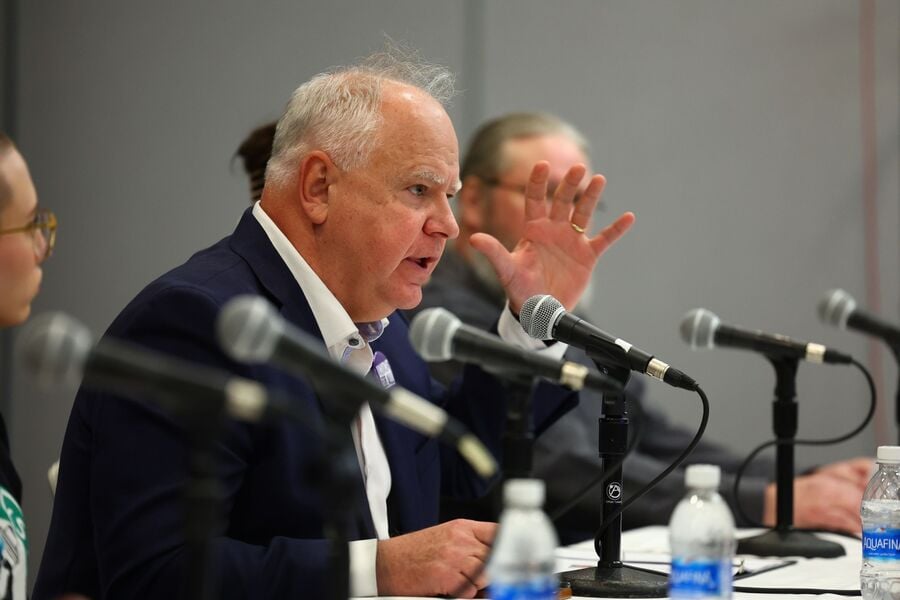
In Minnesota, Walz has been among the most outspoken advocates of environmental measures. He said earlier this month that his state is planning action to lower greenhouse gas emissions, combat the climate crisis and create new clean-energy jobs.
“We’re going to lead Minnesota to 100% clean electricity by 2040,” said Lieutenant Governor Peggy Flanagan in a statement announcing the new initiatives.
The Minnesota bill, signed earlier this month, establishes a standard for utilities to supply customers with electricity generated or procured from carbon-free resources, beginning at an amount equal to 80% of retail sales for public utility customers in 2030 and increasing every five years to reach 100% for all electric utilities by 2040. The bill also requires that, by 2035, an amount equal to at least 55% of an electric utility’s total retail electric sales be generated or procured from eligible energy technologies.
“The fact that this bill has been signed into law is really important because it means even if Walz loses the next election, it would be very difficult to undo this legislation,” Miller said.
In New Jersey, Murphy envisions the Garden State attaining 100% clean energy, in part by ensuring all new cars sold by 2035 are zero-emission. Additionally, the state is setting a target of installing zero-carbon-emission space heating and cooling systems in 400,000 homes and 20,000 commercial properties by 2030. Another measure is to enact rules that enhance flood protection in riverine and coastal areas.
“What’s happening in New Jersey could be a template for northeastern states going forward,” Miller said.

The financial advice industry has been facing inquiries into its cash sweep programs for years now.

Investor money allegedly went to strip clubs, exotic cars, and landscaping

Procyon adds $415 million in assets under management in New Jersey while Savant picks up a $213 million Southern California planning firm

With a growing number of real estate-rich Baby Boomers aging into retirement, some advisors may be failing to consider all the options available for those clients' assets.

Cornerstone Advisors study reveals compliance bottlenecks stall campaigns weeks after customer opportunities close.
As AI makes financial information more accessible than ever, Lana Hock explains why human judgment, trust, and empathy remain the qualities clients value most in a financial advisor
Northern Trust’s Ken Lassner shows advisors how to convert volatility into after-tax portfolio gains

