
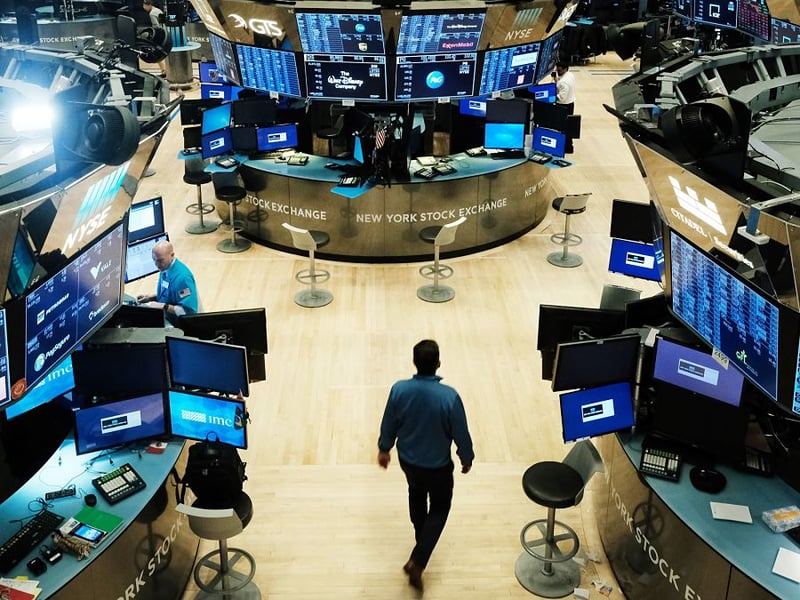
The New York Stock Exchange told New Jersey lawmakers that it’s prepared to move its operations out of the state should they impose a new tax on electronic trades via data servers.
In late September, the world’s largest exchange by market capitalization conducted a test “for a wholesale transition out of New Jersey,” Hope Jarkowski, co-head of government affairs for NYSE parent Intercontinental Exchange Inc., said during an Assembly financial institutions and insurance committee hearing conducted by video feed.
“From Sept. 28 to Oct. 2, we moved our production servers for our NYSE Chicago exchange out of New Jersey to our secondary data center,” she said. “Proximity to New York City is no longer relevant in today’s trading environment.”
Lawmakers in New Jersey, a state so fiscally damaged by the pandemic that it’s borrowing $4.5 billion to plug a budget gap, are considering charging a temporary tax of a hundredth-cent per trade, down from an earlier proposal of a quarter-cent levy. Taxing financial transactions has support from Gov. Phil Murphy, a first-term Democrat and retired Goldman Sachs Group Inc. executive.
The fee, slated to start Jan. 1 and last two years if passed, would be paid by “high-quantity processors of financial securities,” meaning firms that collect and store data. Such warehoused operations exist in Mahwah, Secaucus, Carteret and elsewhere in New Jersey, whose proximity to Wall Street makes it conducive to fast electronic trades. But evolving technology is threatening the need for short, straight data lines, potentially allowing exchanges to operate well beyond their suburban tether.
New Jersey estimates it would bring in $500 million in each of the two years on transactions involving stocks, futures, options, credit-default swaps, derivatives and other trades. But market representatives argue that such taxes enacted in France, Sweden and Italy have fallen far short of goals.
In New Jersey, they said, individual investors and middle-class retirees would shoulder the burden, via higher transaction fees and costs passed on by pension funds and other investment managers. A coalition of exchanges and trading firms have been fighting the tax, with Monday’s hearing giving them another chance to warn lawmakers that the levy will hurt the state more than help.
The strategy “will backfire,” said Terry Campbell, vice president of global relations for Nasdaq. “You will not get the revenue you predict.”
The lawmakers conducted the hearing for testimony only, and haven’t scheduled a vote.

Retiring RIA seller David Laidlaw alleges the Carnegie valued his stake on $11.7 million EBITA while pitching potential buyers on $21.3 million.

New tool gives RIAs and family offices AI help vetting private market deals, with some users reportedly halving review time.

Investors got projected returns dressed up as real ones, SEC says

Parents must still act to get the $1,000 federal seed and employer contributions, giving financial advisors a role in the rollout.

FINRA booted Rudy Anguiano from the industry for “conversion - the intentional and unauthorized taking of another person’s property.”
As AI makes financial information more accessible than ever, Lana Hock explains why human judgment, trust, and empathy remain the qualities clients value most in a financial advisor
Northern Trust’s Ken Lassner shows advisors how to convert volatility into after-tax portfolio gains

