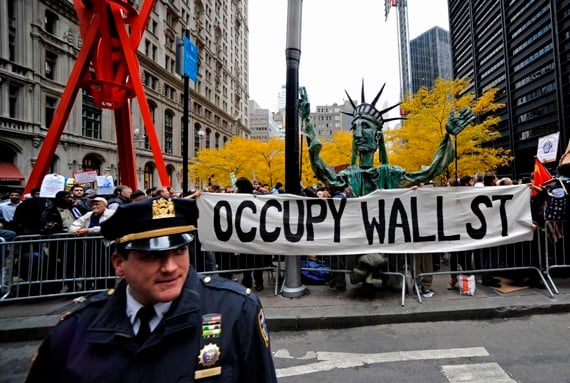
Organizer claims all participants in OWS movement are unemployed; 'no value in what they have to say'
Occupy Wall Street isn't the only political group bringing a message to the streets of New York City.
A week after 140 OWS protesters were arrested in New York, the New Jersey chapter of the Americans for Prosperity organization held a rally Thursday morning across from Radio City Music Hall in Midtown Manhattan. The event was part of the organization's national Failing Agenda Bus Tour, intended “to stand up to Occupy Wall Street extremists and call attention to President Obama's failing agenda,” according to the organization's press release.
“It's time someone stood up to the Occupy Wall Street mob,” said Steve Lonegan, New Jersey State director of the AFP. The group got a permit from the city to park its bus on Sixth Avenue. “People in the [OWS] movement are all unemployed and they're unhappy with everybody. There's no value in what they have to say.”
Mr. Lonegan's message got an enthusiastic response from a lively, if modest, crowd of about 75, many of them clad in green AFP T-shirts.
Frayda Levin, an AFP supporter, said she made the trip into the city because she's a believer in prosperity. “If we continue on the path we're on, the whole country will look like Detroit.”
Deborah DeLuca, a Tea Party organizer in New Jersey, said the political debate boils down to one key issue. “We need to limit the size and expansion of government,” she said. “The AFP focuses on economic growth and prosperity and that's a common denominator we can all get behind.”
Americans for Prosperity is an “organization of grass-roots leaders who engage citizens in the name of limited government and free markets on the local, state, and federal levels,” according to the group's website. It does not yet have a New York chapter.
“I'm sick of watching the left wing tear down people who have built great companies in this country. We want everyone to be able to become a Charles Koch in their own right,” said Mr. Lonegan, to which the crowd responded by chanting “USA.” Mr. Koch, chief executive of Koch Industries Inc., and his brother David helped found the AFP movement.
A call at 2:00 EST on Thursday to the Occupy Wall Street press office seeking comment was not immediately returned.
Mr. Lonegan's advice to supporters of Occupy Wall Street? “Get a job,” he suggested. The phrase was taken up for a few choruses by the small gathering.
“They seem more orderly than the Occupy [Wall Street] crowd,” said one of two New York City policemen watching the rally from a short distance. “We like that.”