
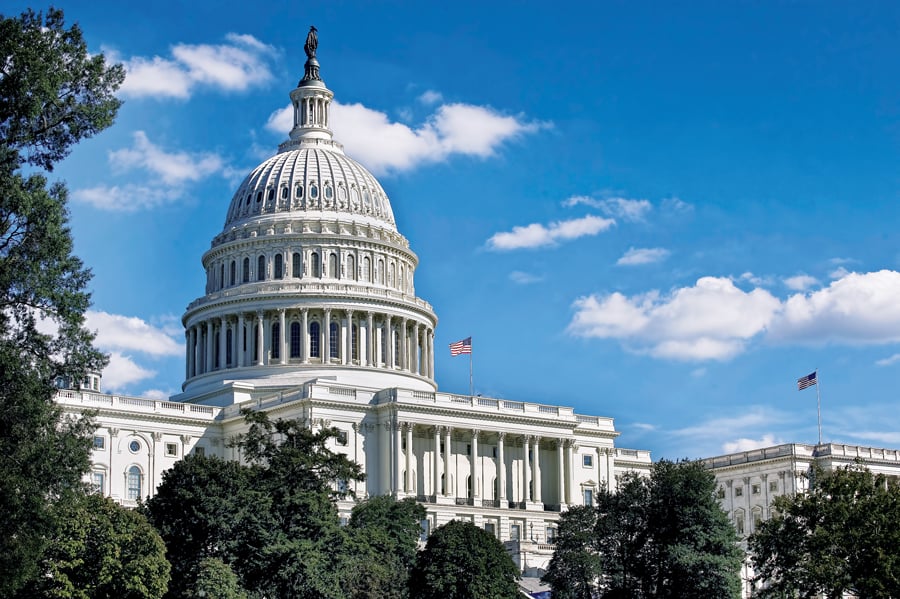
Democrats claimed both Senate seats in the Georgia runoff elections and have captured the slightest possible Senate majority, but it will still be tough for President-elect Joe Biden to get his agenda through the chamber.
The Rev. Raphael Warnock, a Democratic candidate, defeated Republican Sen. Kelly Loeffler for one of the Georgia Senate seats. Democrat Jon Ossoff won the other race, beating Republican Sen. David Perdue.
The twin wins give Democrats operational control of the Senate, which is split 50-50 between Democrats and Republicans. Democrats claim the majority because of the tie-breaking vote of Vice President-elect Kamala Harris.
The gossamer-thin Democratic majority hardly allows the party free rein to advance legislation. All Democrats will have to stand together — including those on the left, such as Sen. Elizabeth Warren, D-Mass., and moderates, such as Sens. Joe Manchin, D-W.Va., and Jon Tester, D-Mont.
“They’re going to have to carefully thread the needle in terms of what they want to accomplish,” said Jason Rosenstock, a partner at Thorn Run Partners, a government relations consultancy.
Republicans will be able to stop many bills with a filibuster, which requires 60 votes for passage and is likely to remain a parliamentary tool in the new Congress.
Democrats could turn to what is known as reconciliation to pass by a simple majority a bill focusing on tax and budget policy. They could use the process to advance tax increases on personal and capital gains rates for the wealthy.
It’s almost a certainty that Republicans will stand united against tax increases. That will put the burden completely on Democrats, who hold the House by just a handful of seats in addition to their narrow Senate majority.
“Getting 50 votes is not a foregone conclusion,” said Brian Gardner, chief Washington policy strategist at Stifel Financial and author of an analysis of the impact of the Georgia elections. “You can’t lose anybody. A tax hike is going to be done on a party-line vote. Democrats are going to have to do it on their own.”
[LISTEN: Bob Doll’s 2021 Prediction Special]
So reconciliation as a path toward tax increases remains in doubt even as Democrats are about to claim control of the Senate.
“How they view a reconciliation package will depend on what’s in it,” Rosenstock said. “It’s too early to know what they will include.”
Biden, who spent decades in the Senate before being elected vice president in 2008, is confident of his ability to strike deals with Republicans.
“But I’m also just as determined today as I was yesterday to try to work with people in both parties — at the federal, state, and local levels — to get big things done for our nation,” he said in a statement last Wednesday about the Georgia Senate results.
That approach is the only one that will work, Gardner said.
“Because of the narrow majorities, any legislation is going to have to be bipartisan to pass,” he said.

The financial advice industry has been facing inquiries into its cash sweep programs for years now.

Investor money allegedly went to strip clubs, exotic cars, and landscaping

Procyon adds $415 million in assets under management in New Jersey while Savant picks up a $213 million Southern California planning firm

With a growing number of real estate-rich Baby Boomers aging into retirement, some advisors may be failing to consider all the options available for those clients' assets.

Cornerstone Advisors study reveals compliance bottlenecks stall campaigns weeks after customer opportunities close.
As AI makes financial information more accessible than ever, Lana Hock explains why human judgment, trust, and empathy remain the qualities clients value most in a financial advisor
Northern Trust’s Ken Lassner shows advisors how to convert volatility into after-tax portfolio gains

