Between speeches that inspired deja vu and candidate entrances via helicopter, a few speakers at the Republican National Convention in Cleveland addressed issues that beat closest to the hearts of financial advisers.
These supporters have portrayed real estate mogul and reality TV star Donald J. Trump and his party as dedicated reformers of financial regulations and the nation's tax system.
“Dodd-Frank is consumer protection for billionaires,” said Donald Trump Jr. on Tuesday, saying the financial reform law Congress passed in response to the economic crisis destroys small businesses in favor of big businesses that can afford the lawyers and accountants needed to comply. “Dodd-Frank was 1,000 pages long and it's already spun off 22,000 pages in regulations. Imagine trying to digest all that before you even open your doors for business.”
The senior Mr. Trump, who became the official Republican presidential candidate Tuesday, has said he would overhaul the six-year-old regulation, without giving specifics. He will deliver his acceptance speech Thursday night, ending the convention.
Other speakers addressing the RNC, which began Monday, have stumped to edit the tax code to reward free enterprise and create jobs, and to redirect trade policies to support development in America instead of in other nations. The 58-page
Republican platform adopted Monday also supports reinstating the Glass-Steagall Act of 1933, which required financial institutions to break up into commercial and investment banking units. A spokesman for the Trump-Pence campaign told CNBC on Wednesday that it had not decided whether to support bringing back the law, which was repealed in 1999 under President Bill Clinton.
(More: With Indiana Governor Pence on ticket, advisers need to be careful with donations)
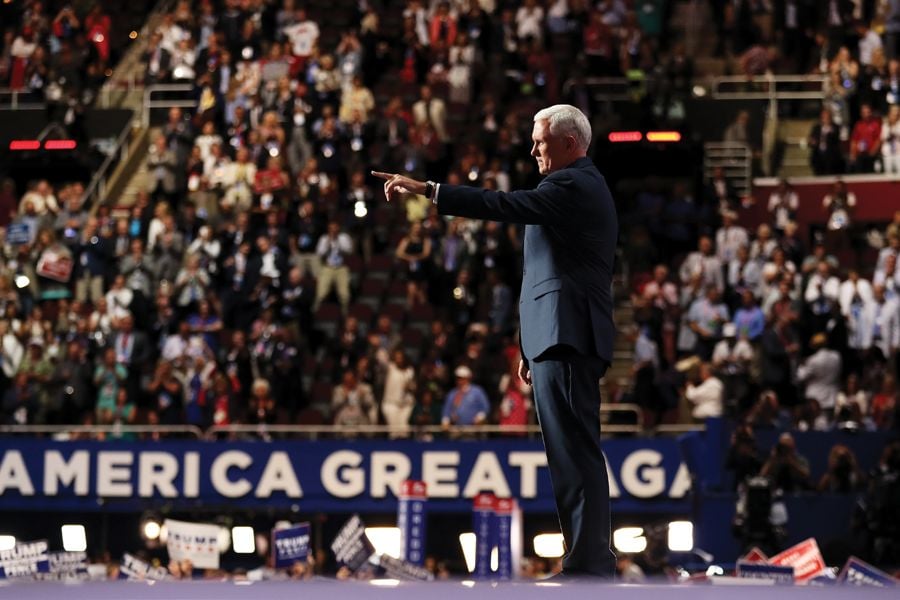
Indiana Gov. Mike Pence, the Republican vice presidential candidate, pledged Wednesday that if Mr. Trump is elected the nation's 45th president, he will cut taxes “and get this economy moving for every American.”
He also bashed Democratic presidential candidate Hillary Clinton's approach to improve the economy.
“Like the president, she thinks that the path to a growing economy is more taxes and more regulation and more government,” Mr. Pence said.
Sen. Ted Cruz, R-Texas, said his party, while not specifically mentioning Mr. Trump, offers a better vision for Americans.
“On taxes: Your freedom to provide for your family without the IRS beating down your door,” he said Wednesday night.
(More: 10 sectors to watch when Hillary Clinton or Donald Trump become president)
House Speaker Paul Ryan, R-Wis., focused a portion of his remarks on economic growth, or really, the lack of it.
“The whole economy feels stuck and for millions of Americans, middle-class security is now just a memory,” he said Tuesday.
Mr. Ryan pledged that the Republican party would support
a reformed tax code “that rewards free enterprise, instead of just enterprising lobbyists.”
House Majority Leader Kevin McCarthy, R-Calif., also speaking Tuesday, attacked Democratic policies that support globalization.
The U.S. Constitution “didn't even have an income tax,” but instead it called for tariffs to tax foreign production, not domestic output, he said.
“We tax and regulate and restrict our companies to death, then we allow foreign countries that cheat to export their goods to us tax-free,” Mr. McCarthy said.
He pledged that under a Republican president “our taxes will be fairer.”
Those attending the RNC also heard West Virginia Sen. Shelley Moore Capito describe Mr. Trump as a candidate who knows how to create jobs and grow the economy, as opposed to Ms. Clinton.
(More: Democratic platform draft includes financial transactions tax)
“We know that she will double down on an economic agenda that's led to the lowest workforce participation in decades,” Ms. Capito said in a speech Tuesday evening. “West Virginia workers are the backbone of this economy and Hillary Clinton is promising to put them out of work?”
She said Republicans understand the free market and do not attempt to control it.