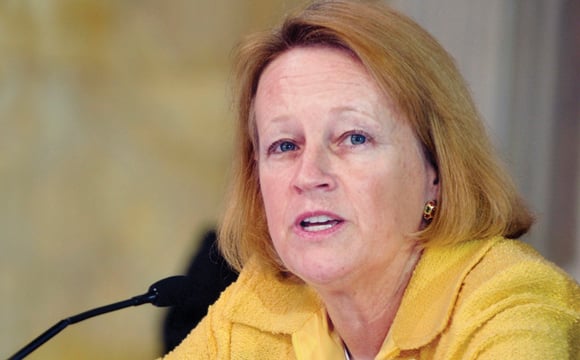
The asset-management industry scored a victory yesterday as U.S. Securities and Exchange Commission Chairman Mary Schapiro abandoned her quest to impose tougher rules on money-market mutual funds.
Three of the four other SEC commissioners didn't support a four-year effort to make money funds more stable, Schapiro said in a statement that urged other policy makers to take action. Two
Federal Reserve bank presidents, Eric Rosengren of Boston and William Dudley of New York, and Treasury Secretary Timothy Geithner had backed Schapiro's proposals, which had been opposed by fund companies including Federated Investors Inc. and
Fidelity Investments.
The announcement means the fight over how to regulate $2.6 trillion in funds used by U.S. households and companies as an alternative to bank accounts probably will move to the Financial Stability Oversight Council, a panel of regulators created by the Dodd-Frank Act. Congress charged FSOC with identifying threats to U.S. financial stability.
“The celebration by money-fund managers and investors will be brief,” Peter Crane, president of research firm Crane Data LLC in Westborough, Massachusetts, said in a telephone interview. “But this definitely reduces the odds of radical change.”
Schapiro has worked to make money funds more stable since the collapse of the $62.5 billion Reserve Primary Fund in September 2008. Its closing triggered a wider run on money funds, helping to freeze global credit markets.
'Unfinished Business'
Schapiro has argued the funds' stable share price encourages investors to flee at the first sign of trouble because it allows those who react quickly to sell their shares at $1 each even if the net asset value has dropped below that level. Her proposal would have given fund managers a choice of switching to a floating share price that reflected the market value of holdings, or establishing a capital buffer to protect against credit losses and redemption restrictions to discourage investor flight.
Three of the five commissioners told her they wouldn't support her proposal, Schapiro said yesterday. Other policy makers should address “one of the pieces of unfinished business from the financial crisis,” she said.
“The declaration by the three commissioners that they will not vote to propose reform now provides the needed clarity for other policy makers as they consider ways to address the systemic risks posed by money-market funds,” she said in the statement. “I urge them to act.”
Geithner, who chairs FSOC, has said the body could address money funds if the SEC failed to act. Other members of FSOC include Schapiro and Fed Chairman Ben S. Bernanke.
Republican Opposition
Schapiro's plan was supported by only one other commissioner, Democrat Elisse B. Walter. Republicans Troy Paredes and Daniel M. Gallagher opposed it.
Democrat Luis A. Aguilar, a former attorney for Atlanta- based fund manager
Invesco Ltd. (IVZ), had signaled he didn't support the Schapiro plan without saying whether he would at least approve that it be put out for public comment.
The announcement marks a victory for the mutual-fund industry, which has lobbied against the Schapiro proposal, saying it would destroy the attraction of funds to investors and deny companies, cities and states of a cheap source of short- term funding.
J. Christopher Donahue, chief executive officer of Pittsburgh-based Federated Investors Inc. (FII), was among the most outspoken foes of Schapiro's proposal. In January he called the options of a floating share price versus capital buffers a choice between death “by hanging or by bullet.”
Lobbying Campaign
Money-market assets in funds and separate accounts, at $265.5 billion, accounted for 75 percent of Federated's $355.9 billion in assets and 47 percent of revenue in the second quarter. At Fidelity, money funds made up 27 percent of assets as of July 31.
The 10 biggest money-fund managers and the Investment Company Institute trade group reported combined lobbying spending of $16 million in the first half of 2012 and $31.6 million last year in disclosures that reference money-market mutual funds, according to a review of documents by Bloomberg News. That compares with $16.7 million in all of 2010.
Schapiro's staff this month produced a list for Congress of more than 300 instances over the past 40 years in which fund companies have sought permission from the SEC to support funds. The list was presented as evidence that funds weren't as stable as the funds industry maintained.
'No Back-Up'
The run following the Reserve Primary failure abated only after the Treasury guaranteed money-fund holdings against default for a year and the Fed financed the purchase of fund assets at face value to help the funds raise cash to meet redemptions.
Congress has since prohibited the Treasury from acting similarly and restricted the Fed's ability to inject liquidity.
“There is no back-up plan in place if we experience another run on money-market funds because money-market funds effectively are operating without a net,” Schapiro said in yesterday's statement.
Schapiro, with cooperation from much of the industry, succeeded in enacting new rules in 2010 that required funds to meet liquidity minimums, shorten the average maturity of holdings and provide more disclosure. At the time she signaled the changes wouldn't be enough to prevent future investor runs.
A vote on the proposal was expected to happen as early as Aug. 29, though it hadn't been formally scheduled. The New York Times reported Schapiro's decision to cancel the vote earlier yesterday.
Shadow Banking
Money funds are part of the so-called shadow banking industry, pairing investors and borrowers without being subject to banking regulations, such as capital requirements or depositor insurance. Money funds represent the largest collective buyer of short-term credits in the U.S.
FSOC has two options for dealing with money funds under the Dodd-Frank Act. If it declares the industry collectively to be systemically important, it can recommend the SEC enact new rules to address that threat. Commissioners would then have to explain their resistance in writing.
Alternatively, FSOC could declare individual funds, or groups of funds run by individual companies, to be systemically important and subject them to oversight by the Fed.
Both paths are untested as FSOC hasn't yet used its authority on any institutions or activities.
“It's very unclear what FSOC and the Fed can do,” said Crane.
--Bloomberg News--