
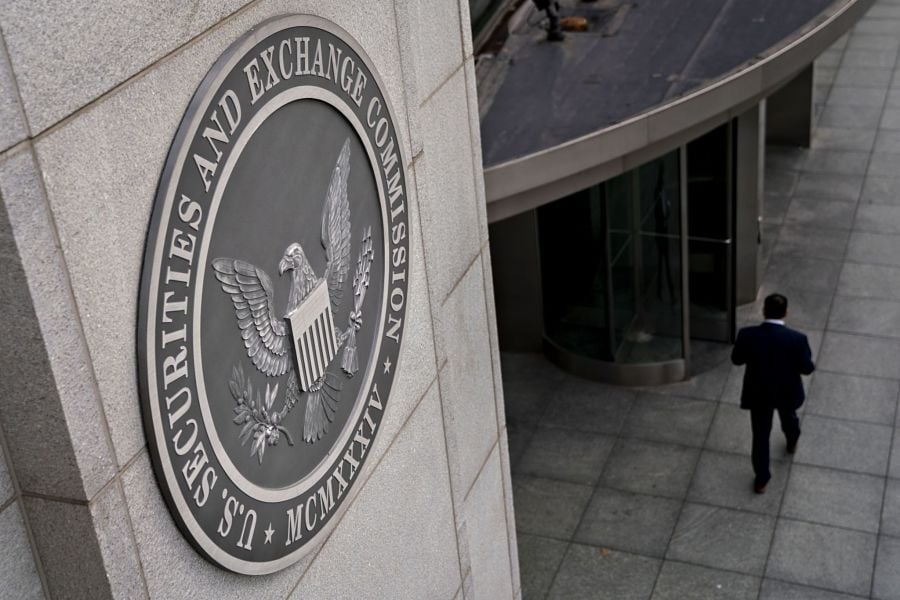
The SEC took the most enforcement actions for violations of securities laws in four years during its latest fiscal year and ordered the second-highest amount of money related to those actions in history, the agency announced Tuesday.
The Securities and Exchange Commission filed 784 enforcement actions in fiscal 2023, a 3% increase over fiscal 2022, and the highest number since fiscal 2019, when it conducted 862 enforcement actions. The agency engaged in 501 stand-alone — or original — enforcement actions, an 8% increase over fiscal 2022.
The SEC achieved the second-highest total amount of financial remedies — $5 billion — in its history in fiscal 2023. That total was eclipsed only by the $6.4 billion it obtained in fiscal 2022. The money ordered in fiscal 2023 comprised $1.6 billion in civil penalties and $3.4 billion in disgorgement. Each of those figures also was the second-highest in agency history.
The enforcement statistics represent the official tally for fiscal 2023, which was released a couple of weeks after SEC Chair Gary Gensler previewed the numbers in a speech in Washington. The agency’s fiscal year runs from Oct. 1 through Sept. 30.
“The investing public benefits from the Division of Enforcement’s work as a cop on the beat,’ Gensler said in a statement Tuesday. “Last fiscal year’s results demonstrate yet again the Division’s effectiveness — working alongside colleagues throughout the agency — in following the facts and the law wherever they lead to hold wrongdoers accountable.”
As a highlight of its enforcement year, the SEC pointed to the $400 million in civil penalties it obtained from investment advisory firms, broker-dealers and credit rating agencies to settle charges that they violated record-keeping rules by failing to monitor their employees’ use of personal devices and messaging apps to conduct business.
The SEC also touted obtaining a total of $850,000 from nine advisory firms that violated the new marketing rule in the way they portrayed hypothetical performance. It also cited a combined $1 million in a civil penalty, disgorgement and prejudgment interest it ordered from Titan Global Capital Management for failing to comply with the marketing rule.
The agency distributed $930 million to victimized investors, a decrease from $937 million in fiscal 2022. Both totals were substantially higher than those achieved in fiscal 2021 ($521 million) and fiscal 2020 ($602 million). The SEC returned $1.2 billion to investors in fiscal 2019.

Docupace also rebuilt its wealth operations platform around a single client record, while Focus Financial picks Nevis to bring AI to its advisors.

Consolidators handled 53% of deals through September as smaller sellers stalled amid market volatility, DeVoe & Company finds.

Shook Research has a new name and brand, Veritant, and will continue its coveted rankings of financial advisors.

The Supernova-powered lending line follows a Flourish Cash rollout as the insurer pushes private-bank-style tools to its 6,000-plus advisors

New Escalent research finds younger, more diverse DC plan participants are open to rollovers - but increasingly prefer outside firms.
Knighthead Life entered the market with a competitive MYGA. A strong launch earned advisor confidence and paved the way for FIAs.
As AI makes financial information more accessible than ever, Lana Hock explains why human judgment, trust, and empathy remain the qualities clients value most in a financial advisor

