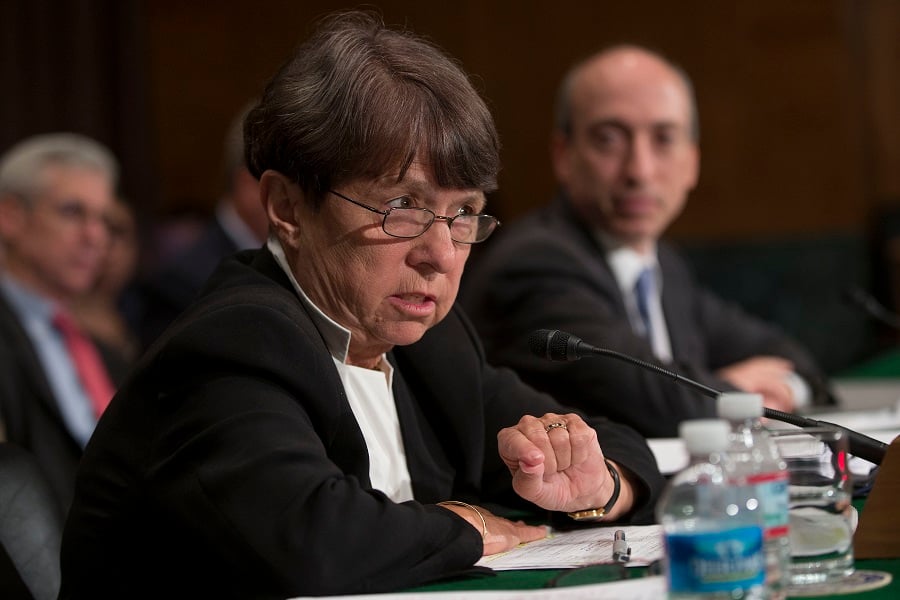
Chairwoman tells lawmakers agency will proceed at own pace, separate from DOL, on raising investment advice standards.
Securities and Exchange Commission Chairwoman Mary Jo White told lawmakers Tuesday the agency will proceed at its own pace — over a long time — to address raising investment-advice standards for brokers. It will not be influenced by a pending Department of Labor rule, she said.
In an appearance before the House Financial Services Committee, Ms. White said the SEC and DOL are talking to one another but working independently as separate agencies with separate jurisdictions and mandates. She also tempered any thought that action would be swift.
“We really are at the beginning of this process,” Ms. White said. “I've reached my own personal conclusion. But the next step is for me to be discussing in detail all the aspects of my thinking with my fellow commissioners. It's a long process, with lots of complex issues.”
She emphasized that even though she supports a fiduciary-duty rule, she still needs to get buy-in from at least two other members of the five-person commission to advance a rule. The Republican members, Daniel Gallagher Jr. and Michael Piwowar, have expressed misgivings or outright opposition to a fiduciary-duty regulation.
“It's still a 'whether' question, because it's a five-member commission,” Ms. White said. “I'm one of five votes.”
Later this spring, the DOL is expected to release for comment a rule that would require brokers to act in the best interest of their clients, or meet a fiduciary duty, when handling 401(k)s and individual retirement accounts. Last week, Ms. White told an audience at a Securities Industry and Financial Markets Association meeting she would like the SEC to proceed with its own fiduciary-duty rule for retail investment advice.
Opponents of the DOL rule want the agency to halt its rulemaking process until the SEC acts. Ms. White said the timing of one measure will not affect the other. She also said her backing of fiduciary duty was not related to the DOL activity.
“We are separate agencies, and we need to proceed separately when we think that the time is right and we have something that we think should advance,” Ms. White said.
The DOL rule is being reviewed at the Office of Management and Budget after getting the strong backing of the White House. If the OMB signs off, as expected, the DOL will put the rule out for public comment and work toward finalization.
The Dodd-Frank financial reform law gave the SEC the authority to promulgate its own fiduciary-duty rule. The agency has not acted in nearly five years.
Several lawmakers pressed Ms. White on whether a fiduciary-duty standard for retail investment advice would raise regulatory costs for brokers and force them to abandon investors with modest assets.
Rep. Steve Stivers, R-Ohio, asserted that a fiduciary-duty rule would “leave the little guy out.”
Ms. White said raising requirements for brokers to a best-interest standard, which investment advisers already meet, is good for small investors.
“It's to the benefit of retail investors,” Ms. White said. “That's who we're acting for.”
Rep. Ann Wagner, R-Mo., pressed Ms. White on whether her support of fiduciary duty was supported by findings of harm to investors by differing standards between brokers and advisers.
“Confusion is not a good thing in and of itself,” Ms. White said.
Later, Ms. White added that a fiduciary-duty rule should achieve “balance,” and that the Dodd-Frank law requires the SEC be “sensitive to existing business models.”
In her SIFMA speech, Ms. White said fiduciary-duty rulemaking should include a related effort to establish third-party examinations for investment advisers to supplement the agency's exams, which reach annually only 10% of the approximately 11,500 registered advisers.
Rep. Maxine Waters, D-Calif., ranking member of the committee, asked Ms. White how much more third-party exams would cost advisers compared to SEC oversight.
“It's hard to judge that” without a rule being fleshed out, Ms. White said.
Ms. Waters, who supports having the SEC charge advisers user fees to fund exams rather than farming them out to the private sector, pressed Ms. White on how to avoid conflicts related to third-party exams.
“That clearly needs to be addressed,” Ms. White said.