Legislation may be introduced this week that would move investment advisers from Securities and Exchange Commission oversight to a self-regulatory organization.
Or maybe a bill won't come out until next week or later. No one seems to know for sure – and the House Financial Services Committee won't confirm anything. But several lobbying organization are saying that a bill could be dropped into the hopper as early as Tuesday.
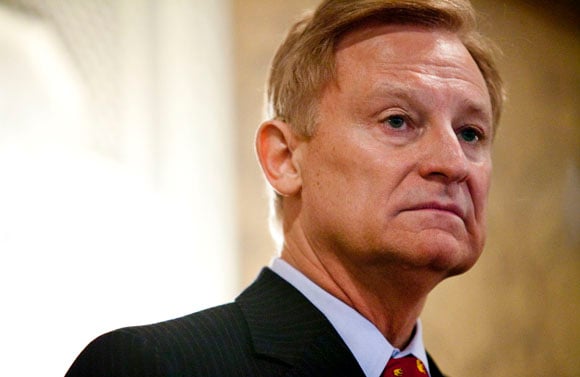
Last September, House Financial Services Committee Chairman
Spencer Bachus, R-Ala., released a so-called discussion draft of an SRO bill.
An SEC study in January 2011, mandated by the Dodd-Frank financial reform law, said that the agency lacked the resources adequately to examine advisers. Currently, the agency reviews about 9% annually of the approximately 11,800 advisers under its aegis.
The study recommended three ways to increase oversight: allow the SEC to charge user fees for exams, establish an SRO or allow Finra to extend its jurisdiction to advisers who are dually registered as brokers.
Each of the option requires congressional approval, which would be granted to the SRO approach, if Mr. Bachus' measure makes it through Congress. It has stirred up fierce lobbying.
Proponents, such as the
Financial Industry Regulatory Authority Inc., say that an SRO is needed to increase investor protection. Finra is seeking to become one of the adviser SROs.
Finra oversight is anathema to investment advisers, who say the broker SRO would be overbearing and unable to enforce the principles-based fiduciary duty standard to which advisers must adheres. Brokers operate a more permissive suitability standard.
Adviser advocates also have been promoting on Capitol Hill a Boston Consulting Group
study that says that an SRO would cost more than twice as much as adequate SEC funding. Finra has calls the analysis “flawed.”
A source at one industry organization, who insisted on anonymity, said that Mr. Bachus would introduce a formal bill this week, rather than a revised discussion draft, that focuses solely on retail investment advisers and could go straight to a full-committee vote in coming weeks.
At a hearing last fall, state regulators objected to the draft bill, saying that an SRO would usurp their adviser oversight authority. The formal bill would allow states to examine advisers once every four years, according to the lobbyist.
Even if a bill starts moving this week, its prospects for becoming a law by the end of the year are limited. Senate Banking Committee Chairman Tim Johnson, D-S.D., has expressed reservations about the SRO concept.
But if Mr. Bachus introduces a measure, it's almost certain to pass through his committee would have good odds for approval in the Republican-majority House.
“You have to take every step of the legislative process seriously,” said David Tittsworth, executive director of the Investment Adviser Association. “This is critically important legislation to all investment advisers. It would dramatically change the way investment advisers are inspected and regulated.”
The SRO legislation is likely to take years, according to Duane Thompson, senior policy analyst for Fi360.
A House vote this year could influence future action. If the bill is not signed into law by the end of the congressional session in December, it has to be reintroduced in the next Congress.
“Getting a bill out of one [chamber] and sent over to the other demonstrates the bill has legs so to speak,” Mr. Thompson said. “It demonstrates political support.”
Adding a twist to the political environment, the Securities Industry and Financial Market Association recently linked its support for universal fiduciary duty for investment advice to the establishment of an adviser SRO.
“For some time now, SIFMA has made clear that a uniform fiduciary standard of conduct should be uniformly supervised and enforce,” SIFMA spokeswoman Liz Pierce wrote in an email. “The SRO model currently used in the brokerage industry, where Finra visits firms on a regular exam cycle basis, provides greater supervision and stricter enforcement than the system currently used in the RIA space, where by the SEC's own statistics they visit RIA firms an average [of] only once every 11 years.”
The debate is likely to advance this year, perhaps starting this week, because Mr. Bachus will step down as House financial committee chairman in January due to GOP-caucus term limits. An adviser SRO could be one his last hurrahs.