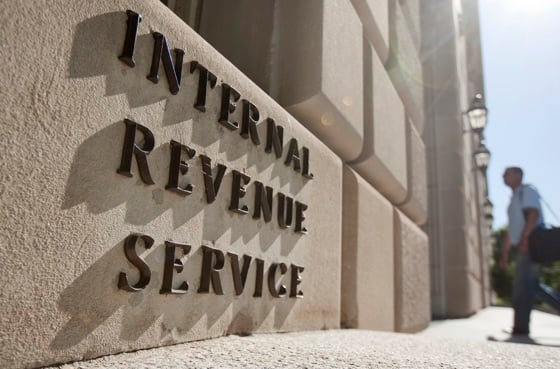
Spouses of accused tax cheats will get more time to file claims seeking to limit their liability under rules announced by the
Internal Revenue Service.
The agency said today it is eliminating a two-year limit that has drawn criticism from members of Congress and taxpayer advocates.
“It opens up relief for a whole universe of people who weren't eligible for relief in the past,” IRS Commissioner Douglas Shulman said in an interview. “We need to do the right thing with these taxpayers.”
The old rules, adopted in 2002, required such claims to be filed within two years after the first attempt to collect. The agency gets about 50,000 innocent-spouse requests a year, and about 2,000 of those are rejected automatically because of the two-year rule.
When spouses are accused of cheating on taxes, their partners who sign joint returns share the responsibility to pay taxes and penalties to the government. The innocent-spouse rules allow partners to apply to avoid their share of those liabilities. The agency considers the applicants' financial situation, possible domestic violence history and knowledge of their spouse's tax and financial matters.
Effective Immediately
The new rule, effective immediately, applies to certain cases pending before the IRS or in court. Some taxpayers who were denied past requests for relief solely because of the two- year limitation for filing claims will also be able to get the IRS to reconsider their cases.
Certain taxpayers, including some who have already divorced or separated, still face the two-year limit to apply, according to the IRS.
In practice, the two-year rule available for the broadest form of innocent spouse relief didn't work because the taxpayers often were unaware that the IRS had started the collection process, National Taxpayer Advocate Nina Olson said in a statement. The advocate is an ombudsman at the IRS to assist taxpayers.
“This is a welcome occasion where everyone has emerged a winner,” she said.
Members of Congress also have been urging the IRS to reconsider the two-year rule. In an April 18 letter to Shulman, Representatives Jim McDermott and Pete Stark, both senior members of the tax-writing House Ways and Means Committee, wrote that Congress specifically didn't include a statute of limitations in that portion of the tax code. Senators, including Finance Committee Chairman Max Baucus, a Montana Democrat, also called for the change.
‘Flexible and Compassionate'
Shulman had responded to the members' letter in April by saying he was seeking a review of the rules. He said in the interview today that upon examination, the rule was too restrictive and didn't fit the agency's goal of being “flexible and compassionate” with taxpayers in difficult situations.
Representative Michele Bachmann of Minnesota, a Republican presidential candidate and former IRS attorney, introduced a bill in April that would prevent the IRS from imposing a time limit.
McDermott, a Democrat from Washington state, said in a statement today that the change makes the IRS rules consistent with congressional intent.
“Today's decision is a victory for fairness and will provide innocent taxpayers with enough time to seek the relief that they deserve,” he said.
Regular Time Limits
The removal of the two-year rule means that the regular time limits for responding to collection actions will apply in the affected innocent spouse cases. That period can stretch back as far as 10 years, depending on the taxpayer's circumstances.
The U.S. agency has been defending the validity of the two- year rule in court. Shulman said the announcement doesn't change the agency's position about the validity of the regulation.
“It was well within our authority to have the two-year rule,” he said. “This is just something that we believe was the wrong policy call.”