
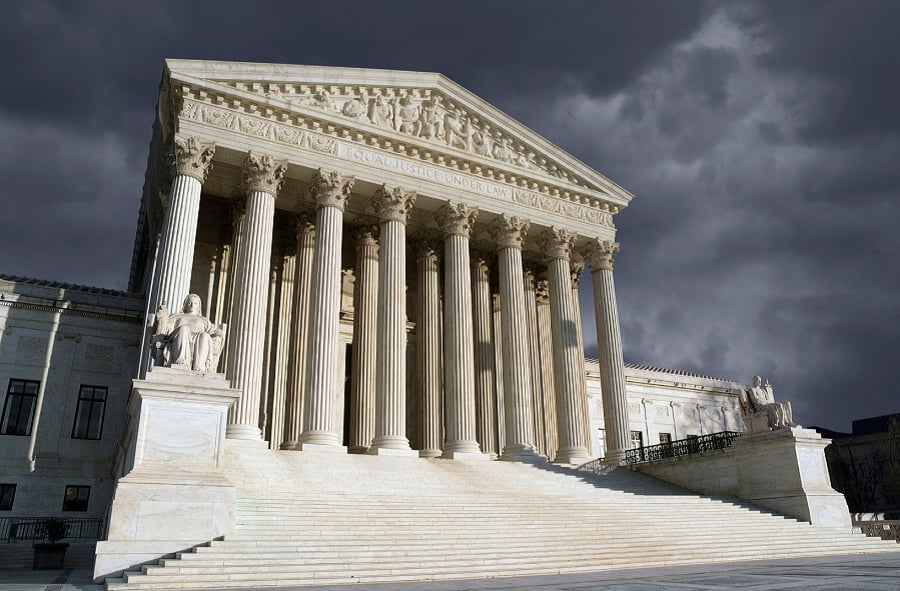
The Supreme Court sided with a Coinbase Global Inc. unit in a ruling that reinforces the ability of companies to channel customer and employee disputes into arbitration.
The justices, voting 5-4, ruled that lawsuits filed in federal court must be put on hold while a defendant presses an appeal that would send the case to arbitration.
Writing for the court, Justice Brett Kavanaugh said allowing district courts to move forward as the appeal is ongoing would reduce the benefits of arbitration.
“If the district court could move forward with pre-trial and trial proceedings while the appeal on arbitrability was ongoing, then many of the asserted benefits of arbitration (efficiency, less expense, less intrusive discovery, and the like) would be irretrievably lost,” Kavanaugh wrote.
Business groups rallied behind Coinbase in the case, saying that letting litigation go forward would impose unnecessary costs. Consumer advocates said judges should have the discretion to decide which claims should proceed during appeal, as courts do with other areas of the law.
Coinbase is battling claims by Abraham Bielski, who said the crypto company should compensate him for $31,000 he lost after he gave a scammer remote access to his account. In a second suit that was before the high court, Coinbase is accused of holding a $1.2 million Dogecoin sweepstakes without adequately disclosing that entrants didn’t have to buy or sell the cryptocurrency.
Over the past two decades, the Supreme Court has bolstered the power of companies to enforce arbitration clauses with consumers and employees. Those rulings have cited the 1925 Federal Arbitration Act, which says courts must enforce arbitration accords the same as any other contract. Arbitration can be less expensive and give defendants key procedural advantages.
Arbitration agreements are commonplace in the crypto industry, much as they are with other retail businesses that have large customer bases.
In a dissenting opinion, Justice Ketanji Brown Jackson said the majority opinion “comes out of nowhere.
“I see no basis here for wresting away the discretion traditionally entrusted to the judge closest to a case,” Jackson wrote.
Liberal Justices Sonia Sotomayor and Elena Kagan joined Jackson’s dissent, while Justice Clarence Thomas, a court conservative, joined in parts.
The case is Coinbase v. Bielski, 22-105.

Salespeople at the firm often went beyond the matching algorithm to recommend network advisors on its Zoe Wealth platform, according to the regulator.

The Protect College Sports Act would cap school payments and codify NIL rights, with implications for advisors guiding young athletes.

"I know the number that I want to be able to retire on, and now I just want out," says Wilmington Trust's Marguerite Weese, describing a common refrain among business-owner clients.

Bessemer and Brown Brothers Harriman veteran Robert Ludricks III and private markets specialist Olof Akesson join the ultra-high-net-worth push on the East Coast.

765 investors were promised 260% annual returns on truck leases
As AI makes financial information more accessible than ever, Lana Hock explains why human judgment, trust, and empathy remain the qualities clients value most in a financial advisor
Northern Trust’s Ken Lassner shows advisors how to convert volatility into after-tax portfolio gains

