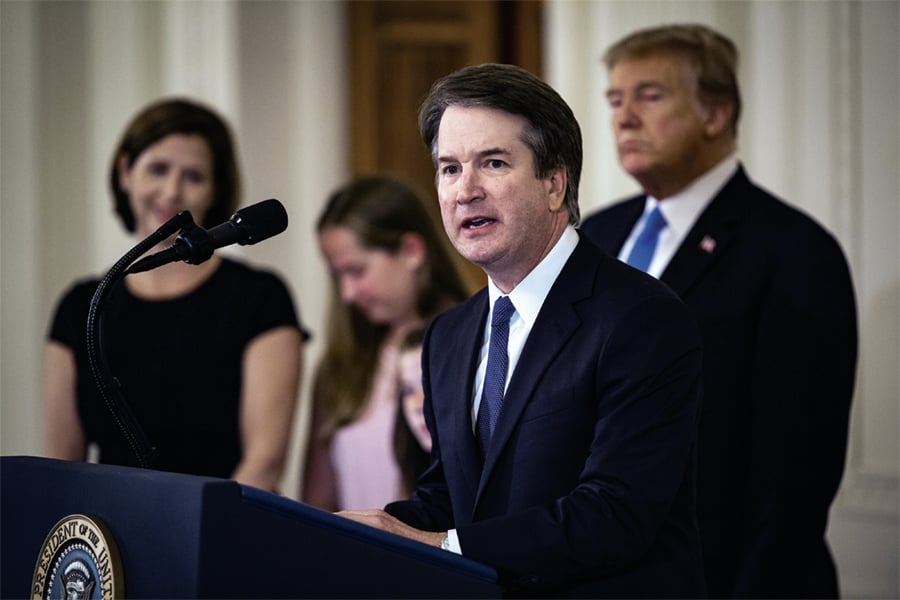
A federal judge nominated by President Donald J. Trump on Monday to fill a Supreme Court vacancy once cast a deciding vote in a case crucial to the evolution of investment advice standards.
Judge Brett M. Kavanaugh of the U.S. Circuit Court of Appeals for the D.C. Circuit voted in 2007 to vacate a Securities and Exchange Commission regulation that allowed brokers to charge asset-based fees in brokerage accounts without being subject to regulations governing investment advisers.
The
2-1 decision to strike down the so-called "Merrill Rule" (named after the wirehouse Merrill Lynch) meant brokers had to move assets into advisory accounts regulated by the Investment Advisers Act of 1940 if they wanted to charge fees rather than commissions, the revenue source for brokerage accounts.
The opinion in the case Financial Planning Association v. Securities and Exchange Commission was written by Judge Judith Rogers. A dissent was written by Judge Merrick Garland, who was later nominated for the Supreme Court by President Barack H. Obama. Senate Republicans did not allow a vote on Mr. Garland in 2016.
Mr. Kavanaugh's vote limited the SEC's latitude in providing exemptions for brokers under the 1940 law and is consistent with "strict construction" portrayals of his jurisprudence, said Duane Thompson, who managed the litigation for FPA at the time.
"He doesn't appear to have an expansive view of adapting existing market practices to a law passed decades ago by Congress," said Mr. Thompson, now president of Potomac Strategies, a policy consulting firm.
But Merril Hirsh, the lawyer who represented FPA, cautioned not to extrapolate too much about Mr. Kavanaugh's approach to regulatory independence based on the case — or the fact that the nominee is a Republican.
"It is not purely a political question," Mr. Hirsh said. "I wouldn't read from that that he would restrict particular agencies in other cases."
The decision saw someone seen as a liberal judge in Ms. Rogers and a conservative one in Mr. Kavanaugh vote to limit the SEC's authority, while Mr. Garland, a Democrat, voted to uphold it.
"It was a wild-card kind of case," Mr. Thompson said.
At the time, Mr. Kavanaugh was a junior member of the D.C. Circuit and maintained a fairly low-key demeanor during the oral argument.
"He asked questions and listened to the answers," Mr. Hirsh said. "I couldn't ask for anything more than that. I thought he made a reasonable decision based on the arguments."
Last year, Mr. Kavanaugh dissented in a case in which the D.C. Circuit set aside SEC sanctions against an investment adviser. But he did so because he would have gone further and also vacated the liability the SEC assessed on the adviser.