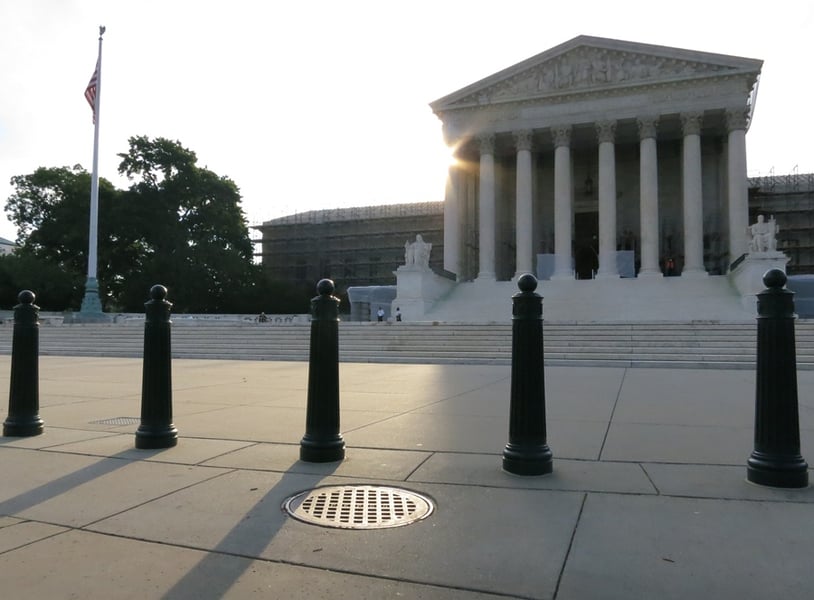
Supreme Court justices appeared ready to limit the Securities and Exchange Commission’s ability to recoup ill-gotten profits from wrongdoers, hearing arguments on a legal tool the commission has used to collect billions of dollars.
In an hour-long session Tuesday, the justices considered the SEC’s use of
“disgorgement” to collect money from someone the commission sues in federal court. Disgorgement is distinct from fines and other penalties the SEC seeks, in part because it’s geared toward reimbursing victims.
The justices didn’t appear willing to altogether eliminate disgorgement, which opponents say the SEC is using as an illegal punishment. The argument suggested the court instead might bar the commission from collecting more than the amount of profit a defendant gained through fraud. The justices also indicated they might require the agency to return more money to harmed investors.
Justice Sonia Sotomayor focused on the SEC’s practice of sending much of the money it collects to the treasury. “If the treasury is getting it, we don’t really know if it’s being used to help investors,” she said.
Without the disputed power, the SEC wouldn’t have been able to use federal courts to obtain about $1.5 billion in disgorgement orders last year, said Urska Velikonja, a professor at Georgetown University Law Center who tracks the agency’s enforcement data.
President Donald J. Trump’s administration and the SEC are defending the power, saying it comes from federal courts’ inherent authority and three statutes passed by Congress, including the 2002 Sarbanes-Oxley Act.
Protecting investors
The Sarbanes-Oxley law doesn’t explicitly mention disgorgement but says judges hearing SEC enforcement actions can award “any equitable relief” they deem appropriate to protect investors. Courts have traditionally viewed disgorgement as an “equitable” measure, which means judges make awards based on fairness rather than strict legal rules.
The justices are hearing
an appeal by Charles Liu and Xin Wang, a California couple fighting a $27 million disgorgement order. They were found to have defrauded people seeking to take advantage of a visa program for foreigners who make large U.S. investments. Mr. Liu and Ms. Wang were accused of falsely telling investors their money would be used for a cancer treatment center.
The couple’s attorneys say the order in their case went well beyond the $8 million the trial judge found they had gained from their scheme. They point to a 2017 Supreme Court decision that said disgorgement is covered by a five-year statute of limitations that applies to penalties.
But on Tuesday, Justice Ruth Bader Ginsburg questioned whether the 2017 decision dictated the outcome of the latest case. The ruling declined to say whether the SEC has the power to seek disgorgement in the first place.
“It was not saying that in every context it is a penalty,” Ms. Ginsburg said.
[More: SEC tallies more enforcement activity in 2019, increases penalties, money returned to investors]