
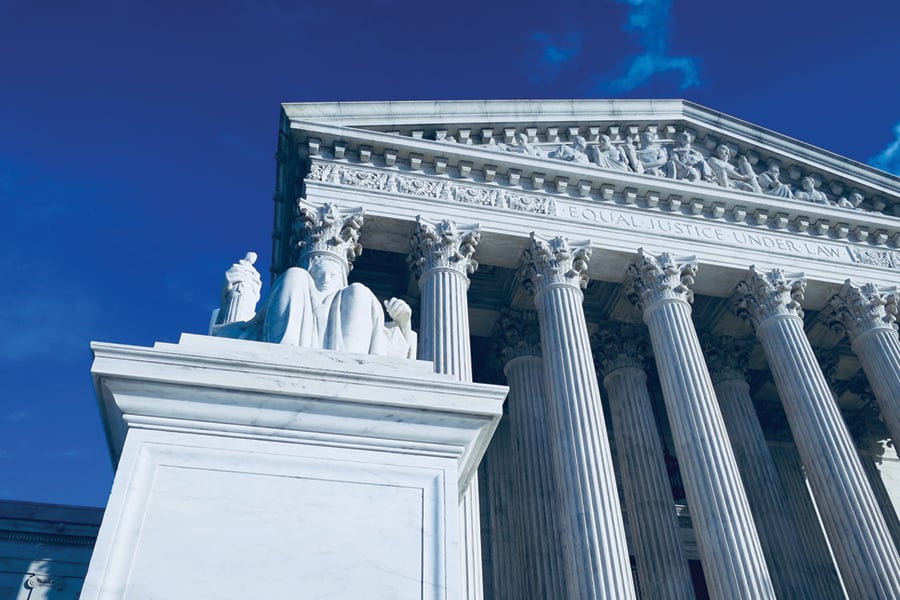
The Supreme Court declined to review a New York-led constitutional challenge to the $10,000 cap on state and local tax deductions imposed by Congress in the 2017 tax law.
The high court issued an order Monday denying the request from New York, New Jersey, Maryland and Connecticut to review a 2021 decision of the U.S. Court of Appeals for the Second Circuit in which the appeals court rejected several state legal arguments against the cap, including that it unconstitutionally coerces the states to abandon their preferred fiscal policies.
The cap generally blocks taxpayers who itemize federal deductions from deducting more than $10,000 per year for paid state and local taxes, including property taxes and either income or sales taxes.
The states argue the cap unconstitutionally interferes with their sovereign authority to levy and collect property and income taxes. The Second Circuit rejected their arguments, finding that neither Article I of the Constitution nor the 16th Amendment bars Congress from curtailing the SALT deduction, even if that means citizens in certain states will pay billions of dollars in additional federal taxes. Such injuries aren’t significant enough to be coercive under the Tenth Amendment, the appeals court ruled.
“It is obviously true that members of Congress were aware that the SALT deduction cap would adversely affect some States more than others,” the Second Circuit said. “But the SALT deduction cap is not unlike the countless federal laws whose benefits and burdens are unevenly distributed across the country and among the several States.”
Joe Bishop-Henchman, vice president of tax policy and litigation at the National Taxpayers Union Foundation, said the states’ petition was “meritless and probably was only filed so New York could pretend it was doing something.”
Nothing about a deduction for the 12% who still itemize is constitutionally mandated, he said. “While it is true that high taxes can harm competitiveness, New York should solve that problem in Albany not the federal courts.”
The Monday order leaves the cap in place. House Democratic Rep. Bill Pascrell of New Jersey said his state’s Democratic delegation “remains absolutely united to enacting SALT reform through the Congress this year.” He and other Democrats have vowed to oppose any White House proposals that don’t raise the $10,000 cap.
“Many critics of our push on SALT operate on incorrect assumptions,” Pascrell said in a statement. “One thing I continue to reiterate to my colleagues is that SALT is not just about providing tax relief to the middle class: it is about supporting our communities. New Jersey cities and towns directly rely on SALT to finance police, road-building, public transit. So a restored SALT cap helps provide the necessities our communities rely on every day and people need to understand that. No one is giving up here.”
Meanwhile, a $220 billion New York law enacted April 7 included an adjustment to state and local tax law affecting the cap. The move allows more state residents to get the full benefit of a state workaround to the cap that gave partnerships, LLCs and S corporations an avenue to ease the cap’s impact on individuals’ federal deductions for paid state and local taxes. More than 20 states have enacted such workarounds.
New York, New Jersey, and Connecticut have also sued challenging Treasury Department regulations blocking a form of state SALT cap workarounds, in a case pending at a New York federal court. The efforts involve tax credits offsetting a large portion of donations to state and local charitable funds. The rules blocked federal deductions for the donations.
The case is New York v. Yellen, U.S., No. 21-966, cert denied 4/18/22.

Daejon Love and Taylor Chan's $1.3 million romance fraud scheme exposes how AI search engines can be manipulated by fabricated online identities

“It was a third party scam,” said the attorney representing the claimants.

Meanwhile, &Partners draws another Commonwealth practice, and Wealthcare welcomes a $550 million planning practice in the Northeast.

Palo Alto AI platform recruits RIA and fintech leaders as industry data show AI adoption reshaping advisor staffing.

Meanwhile, Raymond James, Wedbush, and LPL recruited veteran advisors from across Texas, North Carolina, and California.
Northern Trust’s Ken Lassner shows advisors how to convert volatility into after-tax portfolio gains
Dan Biagini of American Equity says the steady decline of pensions, longer lifespans and a reset in interest rates are rewriting how advisors build retirement income

