When Republicans took over the House of Representatives in January 2011, they vowed a new era of open government. They said that every bill the chamber took up would be posted online 72-hours in advance of a vote.
As we reach the end of the fiscal-cliff hanger, it's becoming clear that the transparency promise is being violated, and both parties are adept at keeping the public in the dark about what's going on in the capital.
Later on Thursday, the House will vote on two bills. One is the
Permanent Tax Relief for Families and Small Businesses Act of 2012, or the so-called Plan B, that House Speaker John Boehner has offered that would extend the Bush administration tax cuts for households making less than $1 million annually. It also would increase the capital gains and
dividend rates to 20% for high earners and permanently extend the current estate tax rate of 35% with a $5 million individual exemption.
Details of the 14-page bill have only been available online for about 24 hours.
Late on Wednesday, Mr. Boehner added another 69-page bill to Thursday's voting calendar and posted it online, too. The second measure, the
Spending Reduction Act of 2012, would replace the defense portion of the mandatory $1.2 trillion in budget cuts over 10 years mandated by the debt-ceiling bill that was approved in 2011.
The bill would require cuts to a range of federal agencies and programs that add an additional $242-billion in reductions to what sequestration imposed, according to Mr. Boehner's office.
The second bill was hastily added when House Republicans balked at voting for a Plan B that only dealt with tax rates rather than debt reduction. As of early this afternoon, when I contacted the offices of a couple conservatives, their aides said they were still mulling the package and hadn't decided how to vote.
Who can blame them for needing more time? Even relatively simple bills can take a while to digest.
The whole exercise is likely to be for naught. Senate Democratic leaders announced earlier today that Plan B is not going to get a Senate vote, even if it makes it out of the House.
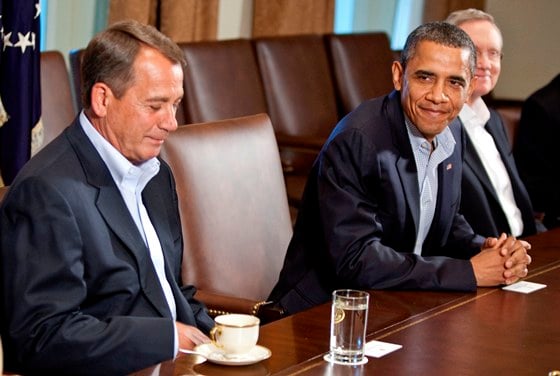
Mr. Boehner is pushing Plan B as a fallback position, if fiscal-cliff talks with President Barack Obama fail. The speaker and the president had been going back-and-forth with offers. The latest one from Mr. Obama involved raising taxes by about $1.2 trillion over 10 years and cutting spending by a similar amount. He is offering to increase the estate tax to 45% and the lower the individual exemption to $3.5 million.
Don't bother looking on the White House website for something on “paper” about the proposal. Inquiring minds will have to depend on leaks from administration aides that are then published in the media. At the other end of Pennsylvania Avenue, Capitol Hill Democrats have been reluctant to make explicit the budget cuts they can support.
Even Sen. Kent Conrad, D-N.D., chairman of the Senate Budget Committee, acknowledged he is in the dark about fiscal-cliff negotiations.
“I don't think we have sufficient information to know how big a deficit savings the [White House] package might provide,” Mr. Conrad said on Wednesday at the National Press Club in Washington. “I can't say firsthand this was the White House offer. I'm not in the room.”
Not many people can be in the room when the speaker and the president negotiate or when political deals are crafted on Capitol Hill. But it would be nice if lawmakers did a better job of illuminating where they want to take us and how considering that they're dealing with trillions of dollars of tax money.