
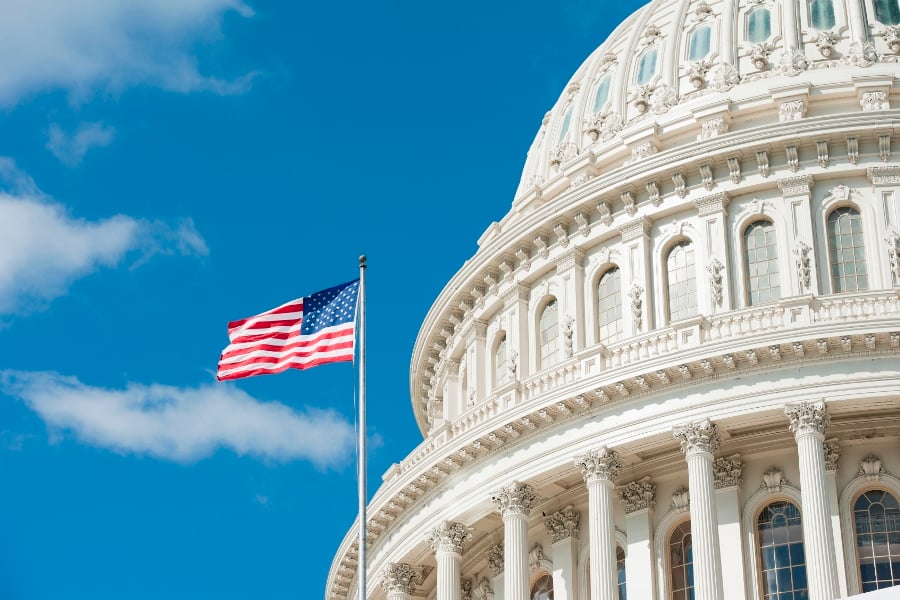
Donald Trump’s $3.3 trillion tax and spending cut bill passed the Senate Tuesday after a furious push by Republican leaders to persuade holdouts to back the legislation and hand the president a political win.
Senators voted 51-50 to pass the bill, with three Republicans — Susan Collins of Maine, Thom Tillis of North Carolina and Rand Paul of Kentucky, defying Trump to oppose the legislation. Vice President JD Vance cast the tie-breaking vote. The package, which now goes to the House, combines $4.5 trillion in tax cuts with $1.2 trillion in spending cuts.
“This was a team effort,” Senate Majority Leader John Thune told reporters immediately following the vote on Tuesday. “In the end, we got the job done.”
The Bloomberg Dollar Spot Index climbed to a session high after the bill passed the Senate. It was falling for six months through the end of June.
The package — informally known as the “One Big Beautiful Bill” — includes the entirety of the president’s legislative agenda in a single package. Trump personally lobbied lawmakers to quickly move the legislation through Congress.
“It’s a great bill. There is something for everyone,” Trump told reporters on Tuesday. “And I think it’s going to go very nicely in the House. Actually, I think it will be easier in the House than it was in the Senate.”
Republicans say passing the bill will help them maintain their congressional majorities in the midterms. But polling suggests the bill is not particularly popular. A recent Pew Research survey found that 49% of Americans oppose the bill, while 29% supported it. Some 21% weren’t sure what to think.
“This vote will haunt our Republican colleagues for years to come,” Senate Democratic leader Chuck Schumer said on Tuesday. “People will get sick and die, kids will go hungry and the debt will explode to levels that we have never seen.”
The House is expected to vote on the bill this week, but success is not guaranteed. Only a few Republicans can vote “no” in the House for the bill to pass in the face of united Democratic opposition.
Speaker Mike Johnson said the House “will work quickly” to pass the bill by July 4.
Conservatives there say they are still pushing for more spending cuts while moderates have expressed alarm at the Senate bill’s reductions to Medicaid and other social safety net programs.
Senator Lisa Murkowski, a GOP holdout who ultimately supported the bill, said she hopes the House makes changes to the bill that prompt further negotiations. The Alaska Republican, who was at the center of GOP leader’s push for votes, has raised concerns about Medicaid and clean energy cuts.
“More process is needed,” Murkowski said after the Senate vote.
It’s unclear whether the Senate bill can make it through the narrow Republican majority in the House, which passed its own version of Trump’s tax bill by a single vote.
The Senate bill would raise the state and local tax deduction from $10,000 to $40,000 for just five years, sparking opposition from one New York Republican who views it as inadequate. Meanwhile, cuts to hospital payments have moved others to declare their opposition.
Any changes in the House would force the Senate to take up the bill again, scuttling Trump’s plans to sign the bill by July 4.
Republicans have said the legislation will boost the economy, curb illegal immigration and start the process of cutting waste in Medicaid and other entitlement programs.
The tax cut bill would avoid a large tax increase for individuals at the start of next year when the 2017 Trump tax cuts expire and it would permanently extend some partly expired business tax breaks, which the president has said would contribute to economic growth.
Many economists, however, have warned that the bill provides little economic boost and exacerbates the country’s fiscal woes.
The “US fiscal path is not a sustainable one,” Federal Reserve Chair Jay Powell said Tuesday. “The level of the debt is sustainable but the path is not, and we need to address that sooner or later. Sooner is better than later.”
At Trump’s request, the bill adds new tax breaks for tips, car loans and overtime work and expands tax breaks for seniors and parents that he popularized on the campaign trail.
These new tax breaks are funded by deep cuts to the renewable energy sector, a move that will ultimately benefit the fossil fuel industry.
The popular electric vehicle tax credit would be axed, something that sparked outrage from Trump’s one-time staunch ally Elon Musk, whose Tesla Inc. would suffer.
The bill would send hundreds of billions in new funds to the military, solidifying Trump’s emphasis on hard power over foreign aid, which he has slashed. It also would boost funding for immigration enforcement.
These costly tax cuts and spending increases are partly paid for by spending cuts primarily targeted at Medicaid, food stamps and federal student loans.
Democrats say the cuts to anti-poverty programs combined with the tax cuts that disproportionately benefit the wealthy make the bill highly regressive. They also point out the $3.3 trillion increase in deficits over ten years despite GOP claims of fiscal responsibility.
Nearly $1 trillion would be cut from Medicaid by imposing a new work requirement for able-bodied adults without children, imposing co-pays and limiting federal reimbursements to states. Food stamp work requirements would expand and states with error-prone systems would be penalized.
The Congressional Budget Office estimates 11.8 million people could lose health coverage over the course of a decade as a result of the bill.
The legislation would avoid a US payment default as soon as August by raising the debt limit by $5 trillion. Trump and Republicans argued that using the partisan budget reconciliation process to raise the limit without Democrats allows the GOP to avoid making any concessions to the minority party, such as increased spending on domestic programs.
Senators during the final negotiations voted to kill a controversial effort to prevent US states from regulating artificial intelligence, marking a loss major technology companies including Microsoft Corp. and Meta Platforms Inc., as well as venture capital firms like Andreessen Horowitz, that pushed the measure to stave state-level rules.

LPL Financial and Raymond James also add independent advisors from Osaic and Edward Jones in Michigan and Arizona.

The SEC-registered RIA advises on more than $1 billion in client assets, with no advisory fee through 2027 and no human financial advisors.

95.8% of house trades were winners. For clients? The SEC says just 14.9%.

The complaint says Duolingo added friction on purpose, then lied about it.

The four wirehouse firms lost 1,449 experienced advisors and recruited 932 in the first six months of the year, according to Diamond Consultants.
Knighthead Life entered the market with a competitive MYGA. A strong launch earned advisor confidence and paved the way for FIAs.
As AI makes financial information more accessible than ever, Lana Hock explains why human judgment, trust, and empathy remain the qualities clients value most in a financial advisor

