
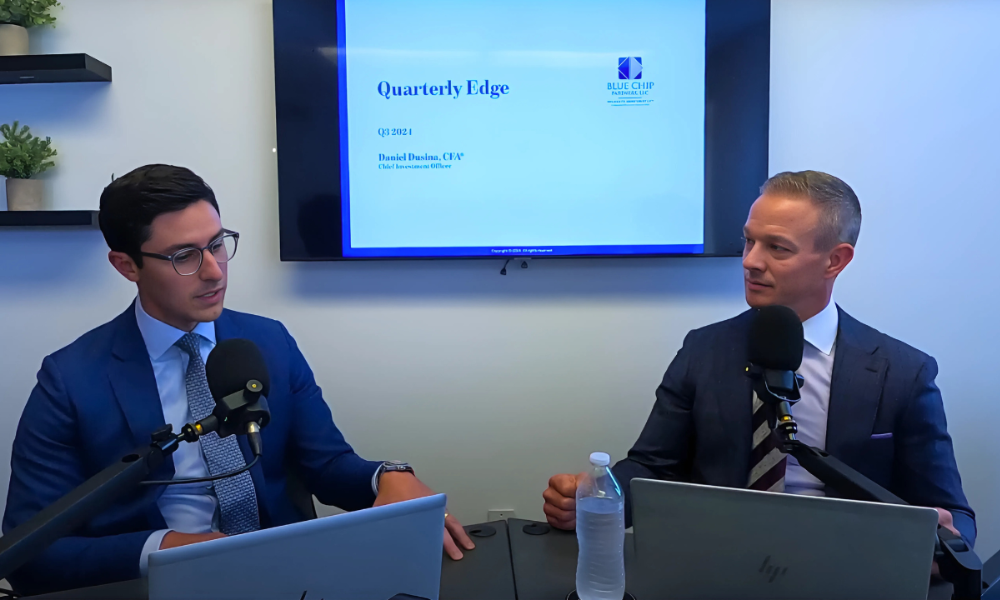
Executives navigating wealth management today face complex financial decisions, from managing concentrated stock positions to addressing behavioral biases and ensuring tax efficiency.
For Daniel Dusina and Daniel Seder of Blue Chip Partners, utilizing a deep-seated understanding of regulatory frameworks paired with an adoption of technology is crucial to successfully diversifying an executives’ portfolio while remaining in line with regulatory restrictions.
Amendments three years ago to the SEC’s 10b5-1 plans, which added disclosure requirements and enhanced investor protections against insider trading, have not significantly altered Blue Chip Partners’ approach to equity-based compensation. Seder emphasizes the importance of ensuring diversification in executives’ portfolios, which can often prove challenging.
“Our clients are … interested in de-risking a highly concentrated position. It's an enviable dilemma that they have, having a lot of money in one stock, but it's a huge risk to their portfolios,” said Seder, managing partner at Blue Chip. “They're interested in de-risking their portfolio, but also they want an affirmative defense against any type of insider trading.”
Because executives are often privy to material non-public information, they face stringent blackout periods that limit their trading windows. Seder says he takes full advantage of open windows to plan for the future.
“We use 10b5-1 plans to combat that. In an open window, they're eligible to identify price targets, identify share blocks that they want to liquidate, or certain types of grants that they want to exercise or execute upon, and then the plan will take care of itself,” adds Seder.
Executives often struggle with the psychological biases that come with significant wealth accumulation.
“As our wealth over the years has grown markedly due to market increases or the performance in the stock market, we're wealthier as a society,” Seder said. “When their company is doing well and they're becoming wealthier and wealthier, they often let that ride, and that conflicts with the concept of diversification and risk management.”
Additionally, the endowment effect—where individuals place a higher value on what they own—can cause executives to overestimate the worth of their company stock.
“That also is a very, very strong behavioral bias that would impact corporate executives, and one that we address, not only in our financial planning and modelling, but also in establishing 10b5-1 plans,” said Dusina, chief investment officer at Blue Chip.
The evolution of tax-efficient wealth management has been accelerated by technological advancements, providing firms with powerful tools for portfolio optimization.
“We are so spoiled today, just given the advancements of technology platforms, the availability of different types of products,” added Dusina. “It's unbelievable the tools and resources that we have at our disposal now.”
Source: Investopedia

Elsewhere, Wells Fargo Advisors adds a $400 million Morgan Stanley veteran in Naples as an ex-Cetera advisor goes independent with LPL

According to a federal charges Bradley Heppner, 60, received more than $150 million in payments through funneling money from GWG Holdings to a shell company.

A $1B fund allegedly skimmed 30% off the top, then swapped cash for locked-up stock.

Insiders allegedly rewrote projections three times in four days.

TCI Wealth Advisors also has also tapped JIFFYAI to unify onboarding and servicing, while TradePMR adds ICE market data to its Fusion advisor platform
Knighthead Life entered the market with a competitive MYGA. A strong launch earned advisor confidence and paved the way for FIAs.
As AI makes financial information more accessible than ever, Lana Hock explains why human judgment, trust, and empathy remain the qualities clients value most in a financial advisor

