
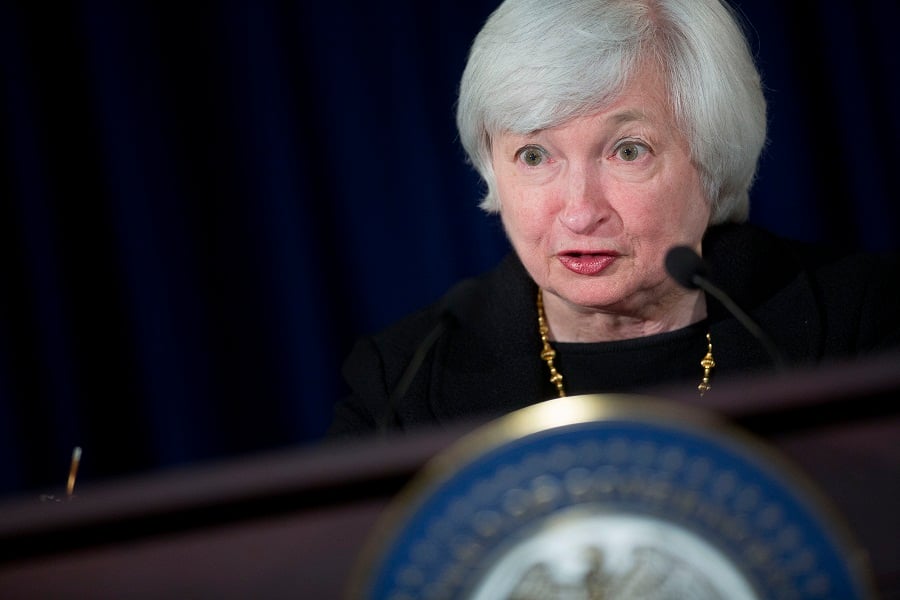
Treasury Secretary Janet Yellen said President Joe Biden should push forward with his $4 trillion spending plans even if they trigger inflation that persists into next year and higher interest rates.
“If we ended up with a slightly higher interest rate environment it would actually be a plus for society’s point of view and the Fed’s point of view,” Yellen said Sunday in an interview as she returned from the Group of Seven finance ministers’ meeting in London.
The debate around inflation has intensified in recent months, between those like Yellen who argue that current price increases are being driven by transitory anomalies created by the pandemic -- such as supply chain bottlenecks and a surge in spending as economies reopen -- and critics who say trillions in government aid could fuel a lasting spike in costs.
Biden’s packages would add up to roughly $400 billion in spending per year, Yellen said, contending that’s not enough to cause an inflation over-run. Any “spurt” in prices resulting from the rescue package will fade away next year, she said.
“We’ve been fighting inflation that’s too low and interest rates that are too low now for a decade,” the former Federal Reserve chair said, adding that “we want them to go back to” a normal interest-rate environment, “and if this helps a little bit to alleviate things, then that’s not a bad thing -- that’s a good thing.”
The headline measure of consumer prices rose 4.2% in the 12 months through April, and the numbers for May are due to be published on Thursday.
The Fed has committed to only begin scaling back the $120 billion monthly pace of its asset purchases after there’s “substantial further progress” on inflation and employment.
Chair Jerome Powell, who took the reins at the central bank from Yellen in 2018, has sought to convince investors that he’s not considering pulling back support for the economy any time soon. Powell and his colleagues have continued to project their key interest rate at near zero through 2023.
U.S. job growth picked up in May -- along with worker pay -- and the unemployment rate fell to 5.8%, according to a Labor Department report Friday.
“I will not give up on the next packages,” Yellen said. “They’re not meant as stimulus, they’re meant as investments to address long-standing needs of our economy.”
The G-7 finance ministers and central bankers held a phone call on May 28 in which the group pressed Yellen on her views on inflation, according to a Treasury official. The group ultimately agreed with her assessment that price spikes through the year are likely to be transitory, said the official, who briefed reporters on condition of anonymity.
Yellen said that monetary policy makers can handle any potential rise in inflation if it sticks.
“I know that world -- they’re very good,” Yellen said in the interview. “I don’t believe they’re going to screw it up.”

Meanwhile, DPL Financial Partners adds two annuity executives and Prime Capital Financial hires a Mid-Atlantic retirement plan consultant

Andrew Komarow pleaded guilty Thursday in federal court in Hartford to defrauding three financial services companies of close to $3.3 million.

Elsewhere, Cetera picks up a $210 million Connecticut team from MML, while Wells Fargo FiNet adds a San Diego family practice from LPL

Celebrity endorsements, $500M in claimed assets, and a state regulator stepping in.

“We needed to become a more agile and efficient organization,” said American Express CEO Stephen Squeri.
Knighthead Life entered the market with a competitive MYGA. A strong launch earned advisor confidence and paved the way for FIAs.
As AI makes financial information more accessible than ever, Lana Hock explains why human judgment, trust, and empathy remain the qualities clients value most in a financial advisor

