

The notion that socially responsible investing is beating the overall stock market this year is starting to come under fire from academics and market observers, who say it may be better to stick with more traditional metrics.
U.S. equities with higher scores on environmental, social and governance metrics didn’t actually sustain smaller losses during the pandemic-triggered sell-off in the first quarter of 2020, according to research by the University of Waterloo, Tilburg University and New York University’s Stern School of Business. The study found that ESG scores were negatively associated with returns during the market’s recovery in the second quarter, and that factors including leverage, liquidity and intangible assets had bigger roles to play in returns.
“Contrary to widespread claims, ESG is not an important determinant of crisis period returns,” the researchers led by Elizabeth Demers of the University of Waterloo wrote in the paper dated Aug. 27. ESG scores don’t offer any “meaningful” predictive power to help discriminate between a crisis period’s winners and losers, they added.
The global push into ESG investing has gathered pace this year as governments channel virus-related recovery funds into health and environmental projects. Equity and bond funds with ESG mandates attracted at least $100 billion in the year through Aug. 6, according to EPFR data. The S&P 500 ESG Index is up 12% this year, beating the benchmark S&P 500 by about three percentage points.
Asset managers including BlackRock Inc. and Allianz Global Investors have touted the performance of their ESG investments as a shield against volatility and price declines. Morningstar Inc. went as far as to call sustainability an “equity vaccine,” not only helping funds weather the hit from the coronavirus but also charting a course for future market success.
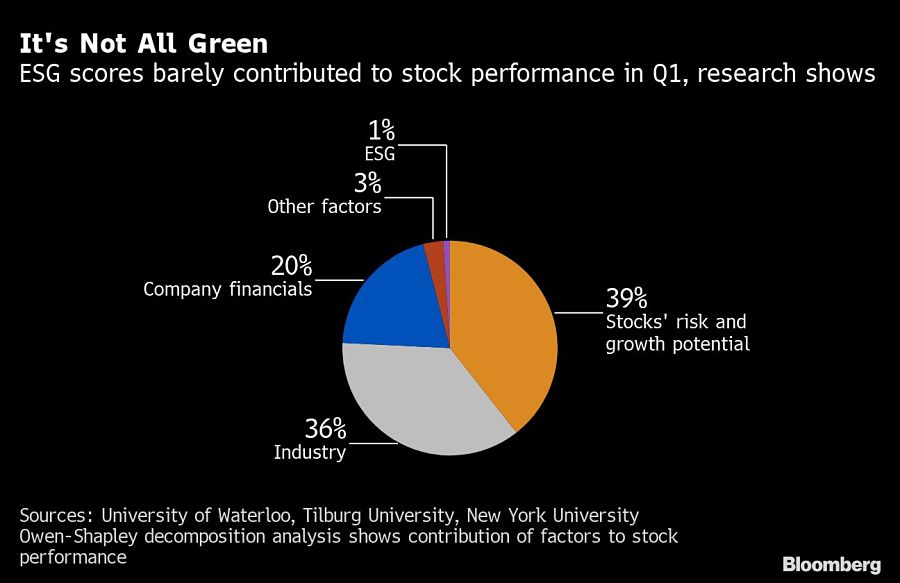
The academics’ study contradicts such claims. Using statistical analysis of ESG scores and the performance of more than 1,600 U.S. stocks, the researchers found that ESG was responsible for only 1% of the total explained variation in the period from January to March, and up to 3% from April through June.
Cash levels, another theme that has been a favorite of investors this year, are actually a better guide to a company’s prospects, along with “innovation-related assets” such as a company’s own internal research and development, according to Demers and her colleagues.
In a separate recent report, Jefferies Financial Group Inc. found that while applying an ESG filter after stocks were selected added an average of 2.5% to annual returns on Asian equities over the past five years, integrating ESG criteria into share selection from the beginning had only a limited impact. While it’s true that investors often make ESG investments for reasons other than bottom-line concerns, evidence that they may not be outperforming could impact future investment decisions.

Daejon Love and Taylor Chan's $1.3 million romance fraud scheme exposes how AI search engines can be manipulated by fabricated online identities

“It was a third party scam,” said the attorney representing the claimants.

Meanwhile, &Partners draws another Commonwealth practice, and Wealthcare welcomes a $550 million planning practice in the Northeast.

Palo Alto AI platform recruits RIA and fintech leaders as industry data show AI adoption reshaping advisor staffing.

Meanwhile, Raymond James, Wedbush, and LPL recruited veteran advisors from across Texas, North Carolina, and California.
Northern Trust’s Ken Lassner shows advisors how to convert volatility into after-tax portfolio gains
Dan Biagini of American Equity says the steady decline of pensions, longer lifespans and a reset in interest rates are rewriting how advisors build retirement income

