

Financial advisors and their clients are largely on the same page about what keeps them up at night – and it's not a lack of market optimism, according to a new survey from InspereX.
The Spring 2026 InspereX Pulse Survey, which polled 783 financial advisors between March 27 and April 7, found that both groups ranked geopolitics, market volatility and inflation as their top three concerns heading into the back half of the year – in that order.
The survey was conducted by Red Zone Marketing on behalf of InspereX and drew responses from advisors at independent broker-dealers, RIAs, banks and regional firms.
With no prospects of a resolution to the conflict in the Middle East as of now, geopolitics were top of mind for both advisors (43%) and clients (45%), followed by market volatility (cited by 17% of advisors and 35% of clients) and inflation (16% of advisors, 9% of clients).
Notably, inflation has displaced recession as a top-three concern for advisors since InspereX's fall 2025 Pulse Survey.
The alignment extends to where advisors and clients see opportunity. Geopolitical tensions and global security topped the list of investment themes advisors expect to drive the greatest opportunities through year-end, cited by 31%, followed by artificial intelligence and tech innovation (28%) and increased market volatility and risk management (18%).
In spite of the shared anxiety, advisors remained broadly bullish. Seventy percent forecast the S&P 500 will finish 2026 up at least 5% from its survey-period range. Of those, 31% projected a gain between 5% and 10%, 30% anticipated a rise of 10% or more, and 8% forecast an increase of 15% or more. Just over one-fifth of advisors polled expected a decline of at least 5%.
"Despite challenging market conditions in the first quarter, the majority of advisors see the potential for meaningful upside in the remainder of the year," said Chris Mee, managing director at InspereX.
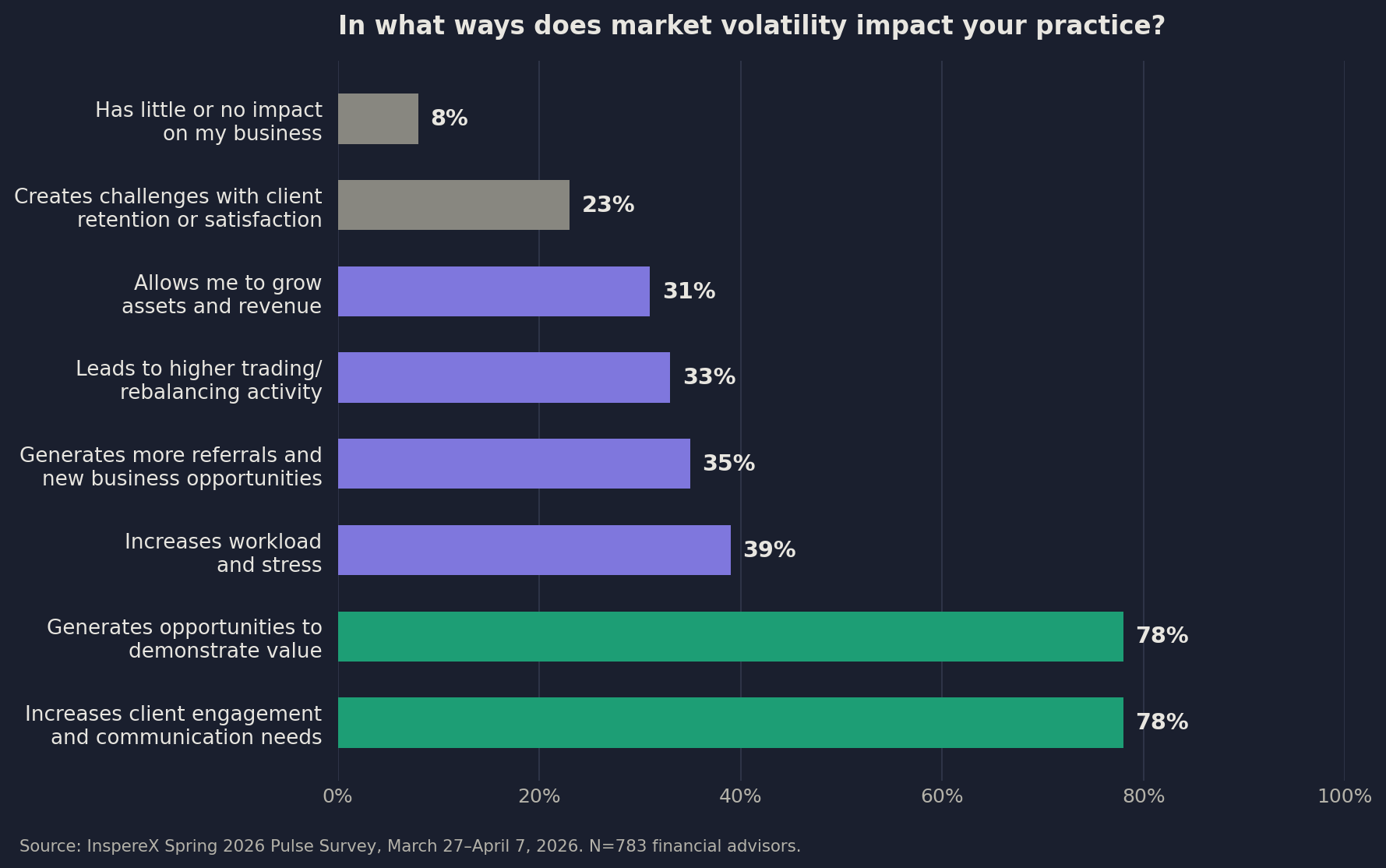
While volatility registered as a top concern, a majority of advisors described it as a net positive for their practices.
Seventy-eight percent said market swings increase client engagement and communication, and an equal share said they generate opportunities to demonstrate value. Another 35% said volatility opens doors to referrals and new business.
Half of respondents said their practice is operating more on offense than defense during volatile periods, a tendency more pronounced among higher-AUM advisors. The most common approaches were reassuring clients about their long-term strategy (32%), increasing proactive outreach (31%), and adding or expanding protection strategies (18%).
Fifty-four percent of advisors said they expect to moderately or significantly increase their use of protection-oriented strategies for the remainder of the year. The leading reasons included providing peace of mind (71%), reducing or eliminating client risk exposure (67%), and delivering growth alongside protection (64%).
When advisors introduce downside protection or defined-outcome products during volatile markets, 39% said the most common result is that assets that would otherwise have gone to cash remain invested, while 37% said the primary outcome is improved client confidence with limited asset movement.
Structured products are now used by 88% of survey respondents. Among those advisors, 59% said they help differentiate their practice, half said they strengthen client relationships, and 49% said they improve the overall client experience.
The survey also found more than three-quarters of advisors plan to maintain (46%) or increase (33%) their use of indexed annuities in 2026. Just over 70% of advisors planned to keep up or ramp up on fixed annuities (52% maintain, 21% increase) and around two-thirds had similar plans for variable annuities (52% maintaining VA use, 16% increasing VA use).
"Market volatility once fueled anxiety between advisors and their clients," Mee said. "Today's expanded toolkit that includes downside protection strategies helps advisors position portfolios to better endure uncertainty – keeping clients more confident and calmer."

Retiring RIA seller David Laidlaw alleges the Carnegie valued his stake on $11.7 million EBITA while pitching potential buyers on $21.3 million.

New tool gives RIAs and family offices AI help vetting private market deals, with some users reportedly halving review time.

Investors got projected returns dressed up as real ones, SEC says

Parents must still act to get the $1,000 federal seed and employer contributions, giving financial advisors a role in the rollout.

FINRA booted Rudy Anguiano from the industry for “conversion - the intentional and unauthorized taking of another person’s property.”
As AI makes financial information more accessible than ever, Lana Hock explains why human judgment, trust, and empathy remain the qualities clients value most in a financial advisor
Northern Trust’s Ken Lassner shows advisors how to convert volatility into after-tax portfolio gains

