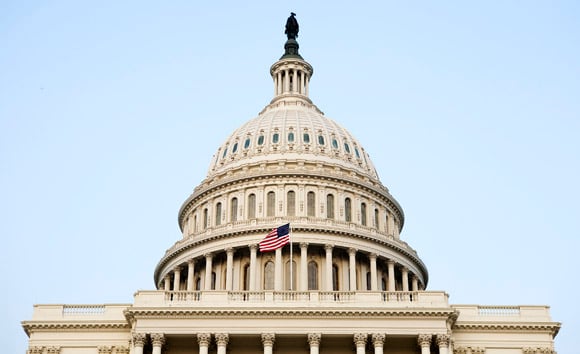
Even with Congress out of town last week — or, more precisely, because the lawmakers were gone — Washington blew up over the appointment of Richard Cordray as director of the Consumer Financial Protection Bureau.
President Barack Obama installed the former Ohio attorney general as head of the agency created by the Dodd-Frank financial reform law to regulate consumer lending and financial products, such as credit cards, student loans and mortgages.
Senate Republicans filibustered Mr. Cordray's nomination in December, asserting that the CFPB could run amok with regulatory powers that they say cannot be curtailed by Congress.
The Senate and House GOP have called for structural reforms to the agency before they will support a new director. The want to turn the CFPB into another Securities and Exchange Commission — an agency that is governed by a bipartisan five-member commission rather than a director, and one that must come to Congress to get its annual appropriation rather than being funded by the Federal Reserve.
Congressional Democrats support the recess appointment of Mr. Cordray, saying that the Senate GOP was abusing the filibuster in order to achieve an outcome — dismantling the CFPB — that it couldn't obtain through the regular legislative process. Mr. Cordray can serve until the end of 2013 without being confirmed by the Senate.
Even though this dust-up occurred one day after the Iowa Caucuses and less than one week before today's New Hampshire primary, Mr. Cordray's appointment has not become an issue in the Republican presidential race.
Don't expect the controversy to suddenly propel a debate about Dodd-Frank to the forefront of the GOP contest.
“I just don't think Dodd-Frank is an issue that resonates on Main Street,” said Andrew Friedman, principal at The Washington Update.
Mr. Friedman sees the struggle over the Cordray appointment not as a Dodd-Frank matter but “more of a power struggle issue” between Congress and the Obama administration.
The Republican GOP candidates generally have steered clear of their congressional colleagues, who have achieved a rock-bottom approval rating. In addition, this is not an ideal time for Republican front-runner Mitt Romney to bash Dodd-Frank.
The former Massachusetts governor does call for the repeal of Dodd-Frank in his comprehensive manifesto, “Believe in America” (mittromney.com/jobs).
But just as New Hampshire voters were about to go to the polls, his GOP rivals began an attack on his tenure as chief executive of
Bain Capital LLC (baincapital.com), the private-equity firm that Mr. Romney helped found and then ran for 15 years.
Former House Speaker Newt Gingrich criticized
Bain Capital for squeezing profits out of companies that it acquired and shut down — sometimes at the cost of hundreds of jobs each time. A so-called super political-action committee backing Mr. Gingrich plans to launch ads focused on Mr. Romney's Bain years prior to the Jan. 21 South Carolina primary.
Mr. Romney contends that during his tenure at Bain, the company helped turn around dozens of companies, played a role in establishing enterprises such as Staples Inc. and created 100,000 jobs.
Everyone was anticipating an attack on Mr. Romney's private-equity past from President Barack Obama's campaign during the general election if Mr. Romney captured the Republican nomination. It is surprising to see other Republicans launching the barrage.
While this debate is raging, don't expect Mr. Romney to go after the CFPB — even though Mr. Cordray's recess appointment probably leaves a bad taste in his mouth.
Now is not the time for someone as closely tied to Wall Street as Mr. Romney to hammer away at an agency that is being portrayed by Mr. Obama as protecting middle-class consumers against “irresponsible debt collectors and payday lenders, and independent mortgage servicers and loan providers.”
“We can make sure that folks don't lose their homes or their life savings just because somebody saw them as an easy target,” Mr. Obama said in a Jan. 6 speech to CFPB employees. “Let's do everything we can to make sure that middle-class families can regain some of the security that they've lost over the last decade.”
The CFPB is not an easy target for Mr. Romney at the moment.