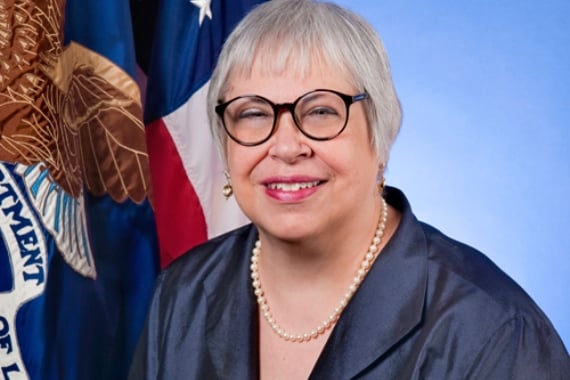
The assistant labor secretary recounts her serendipitous career and what motivates her to help women facing financial crises in retirement.
I regularly talk to university students about my career path. The title of my speech is always the same: Life is not a straight line.
I grew up in a close-knit Italian family in New York with my parents as my most important role models. My dad was a high-school dropout who enlisted in the Army to serve in World War II. After the war, he rose through the ranks to manage a large and important department in his company despite his lack of formal education. My mom worked in aircraft manufacturing during the war, but she saw her No. 1 job as making sure that my siblings and I were well taken care of and understood the unconditional love and support we had from our parents. The Golden Rule as they taught it was simple: “If you work hard, and play by the rules, even when others don't, you will be successful.”
I took these lessons with me as I immersed myself in my studies in college, graduate school and then at Catholic University Law School. It was there I began my employee benefits career. I answered an ad on the school bulletin board for a part-time researcher/writer to help clients of a small consulting firm understand the new pension law and the compliance guidance that was being issued.
It was 1975 and ERISA had just been passed.
I passed the bar and worked briefly at a large D.C. law firm, but quickly concluded that world was not for me. Just as my stumbling across the world of ERISA was serendipitous, so too was being hired as a Congressional staffer for the U.S. House of Representatives. I had no political connections, but I was in the right place at the right time and, most importantly, willing to work cheap. Sixteen years later I had risen through the ranks of the staff to become employee benefits counsel to a subcommittee of the House Education and Labor, and a key point person for the committee on pension and health issues, with a bit of work on employment discrimination based on age and disability on the side.
PASSING COBRA
My early experiences were shaped by the constituent services work that the members of Congress brought to me. I had women regularly coming through my door telling me how federal health care benefits laws were working against them and their families. It was these very people who took a stand against insurance companies in the 1980s and 1990s and convinced Congress to pass incremental legislation, like the health insurance continuation provisions, commonly called COBRA.
I repeatedly saw women in dire circumstances as they entered retirement. Many, after lives spent working at home, were counting on survivor's benefits from their husband's pensions. These would often be denied as a result of plan rules that these women never knew about or didn't understand. And as workers, their lower wages, shorter tenures, part-time and intermittent work histories often resulted in small or no pension benefits at retirement.
Over and over these experiences reinforced my long-time but not unique observation that “the fastest ticket to poverty for a woman is divorce or the death of a spouse.” One of the keys to fixing this, and my true passion, is financial literacy. Particularly among women and people of color, there should be a focus on what it really means to save for a 30- or 40-year retirement.
Thankfully, I have never had to tackle these issues alone. Many of the young women I have mentored and worked with over the years are now leaders in the employee benefits and investment arena. Although it is often our differences that garner headlines, there are so many occasions where groups of advocates, plan sponsors, service providers, lawmakers and federal agencies have come together to develop regulatory approaches, tweak the law and make operational changes to improve the fairness and effectiveness of the retirement system. Time and again, women have played a powerful role in speaking up and forcing positive changes in employee benefits law. I saw it when I started down this path, and I am living it today.
CHOOSING YOUR HILLS
There is always too much to do and too little time when you are passionate about many things, as I am. I rely on another piece of wisdom from my father in setting priorities. His commanding officer used to tell the troops that in war, you have to fight on every hill, but in life, you should “pick the hill you choose to die on,” rather than try to fight every battle. I focus on causes where my dedication and stubbornness can make a difference in the lives of ordinary people. Those are the hills I choose.
Phyllis C. Borzi is assistant secretary of labor of the Employee Benefits Security Administration at the U.S. Department of Labor.