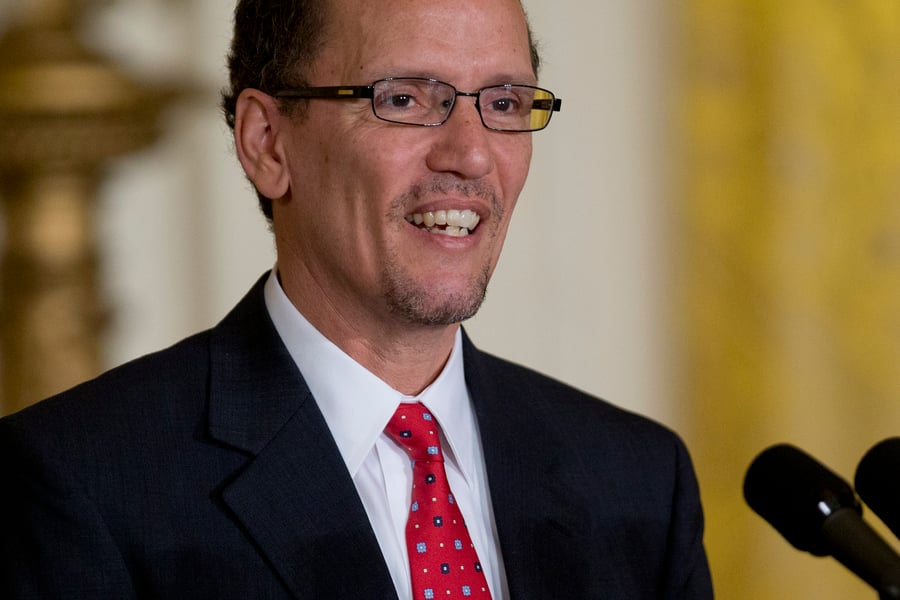
Department of Labor Secretary Thomas Perez expressed confidence Friday that his agency will be able to complete work on a rule to strengthen investment-advice standards for retirement accounts before the end of the Obama administration.
“This is one of the most remarkably important things we can undertake in the remaining 650 days,” Mr. Perez said in Washington at a Consumer Federation of America conference. “I know we can get this done. We will thread this needle.”
Last month, President Barack Obama
directed the DOL to move ahead with the rule, which has languished since the first proposal was withdrawn in 2011 amid fierce industry protest. The new proposal was sent to the Office of Management and Budget for review on Feb. 25.
After the OMB signs off, which could take 90 days, the DOL will release the rule for public comment, another months-long undertaking. At each step of the way, there's a possibility the
rulemaking could bog down.
The White House backing has greatly improved the rule's chances, even though the clock is ticking.
“Our aim is to make sure that we have a final rule in place in this administration that will be effective,” Mr. Perez told reporters after his speech at the conference.
The rule would extend the definition of “fiduciary” to more financial advisers of 401(k) and individual retirement accounts, requiring them to act in the best interests of their clients. Investment advisers already meet this standard.
Brokers currently adhere to a “suitability” rule under which they can sell high-priced investment products as long as they meet a client's objectives and risk tolerance.
The DOL has been pushing for the rule as a way to protect workers and retirees from conflicted advice as they build their retirement nest eggs. The financial industry has warned that the rule would significantly increase brokers' regulatory and liability costs, driving them out of the advice market for investors with modest assets.
The agency is taking that skepticism into account, Mr. Perez said.
“We deliberately slowed this process down because we knew how important it was, we knew the value of listening and we knew we had to engage a broad array of stakeholders,” he said.
Mr. Perez tried to flip the industry's assertion about small investors to the administration's advantage.
“The small investors are the people who are in the greatest need for getting advice that's in their best interest because they don't have a margin for error,” he said. “At the heart, this rule is about middle-class economics. Retirement security is a pillar of middle-class economics.”
He argued that small investors are being hurt by high fees associated with complex investment products that don't fit their retirement portfolio.
“The vast majority of them need an
index fund or something really simple,” Mr. Perez said. “That's why business models have already emerged that can help them.”
He took on other industry criticisms that the rule would prohibit commissions and curtail investor education.
“We will not be banning commissions in the proposed rule,” Mr. Perez said. “We're going to clarify the line between education and advice.”
He also pushed back on the industry claim that DOL is not coordinating with the Securities and Exchange Commission, as the SEC
considers a fiduciary-duty rule for retail investment advice. He said the DOL and SEC have talked “with great regularity.”
One of the groups that has talked with DOL is the Financial Services Institute, which represents independent broker-dealers and financial advisers. Its executive vice president and general counsel, David Bellaire, has qualms about what he sees as the administration’s emphasis on advisers ripping off clients. Instead, advisers should be lifted up for helping investors avoid major mistakes, such as failing to plan for retirement and cashing out their nest eggs.
“All we can do to evaluate what is coming is to look at what they proposed [previously] and what they have been saying over the last few weeks about the upcoming proposal — and we’re discouraged by both,” he said. “It’s the overall tone of their message about the value of financial advisers and advice.”
In his remarks, Mr. Perez gave a nod to “scores” of advisers “who do fantastic work” and already act in their clients' best interests. He said his family uses a certified financial planner.
“He looks out for us,” Mr. Perez said.