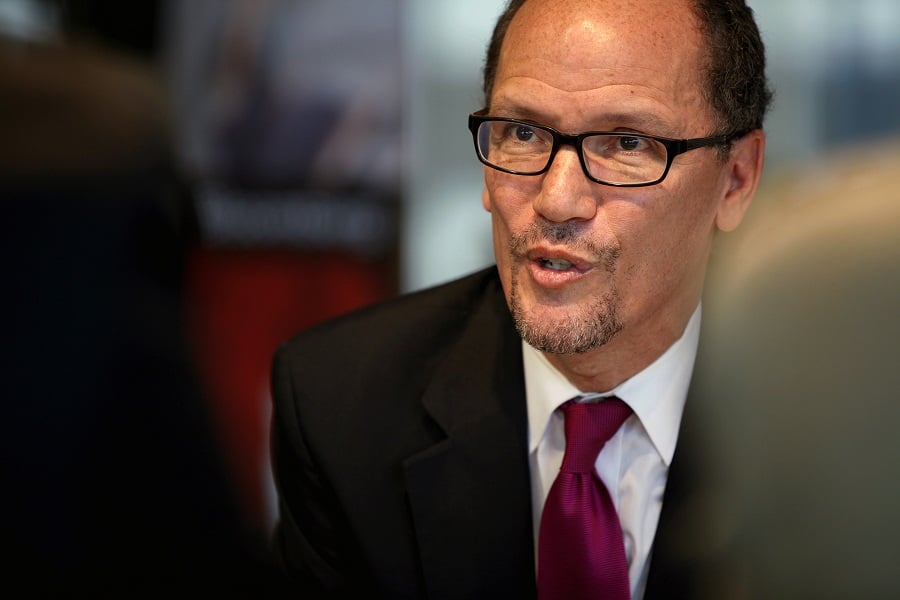
Labor Secretary Thomas Perez defended a proposal to raise investment advice standards for retirement accounts by asserting that studies showing the need for such a rule are more reliable than industry-funded analyses that question it.
In a speech Friday at The Brookings Institution in Washington, Mr. Perez cited the “conservative estimates” of a White House Council of Economic Advisers study that showed retirement savers lose $17 billion annually due to brokers selling them high-fee products, an action the rule is designed to curb.
“When you look at all of the peer-reviewed empirical academic studies that have been published in this area, they overwhelmingly support our fundamental position that
conflicts of interest are harming American savers to the tune of billions of dollars,” Mr. Perez said.
He was participating in an event sponsored by the think tank, which recently cut ties to one of its scholars, Robert Litan, after supporters of the DOL rule criticized a study he wrote that found the measure would harm low- and middle-income savers. The DOL rule supporters charged Mr. Litan was biased because the study was funded by the
Capital Group, a mutual fund manager.
Mr. Perez hit industry studies head on.
“Most of the industry-commissioned research reaching the opposite conclusion does not meet equally rigorous analytical standards,” Mr. Perez said.
The Securities Industry and Financial Markets Association
conducted its own review of the White House study and found it lacking. The review said the White House report used “flawed figures” and underestimated the benefits that investors receive from working with a broker.
The DOL's
economic-impact analysis of the rule states that it would give IRA investors gains of between $40 billion and $44 billion over 10 years, while costing the industry between $2.4 billion and $5.7 billion.
But the Investment Company Institute, which represents the mutual fund industry, disputes the DOL's findings.
The DOL analysis was flawed because it relied on academic studies that did not take into account market performance data, according to Sean Collins, ICI senior director of industry and financial analysis. Broker-sold funds have delivered returns higher than their Morningstar Inc. averages.
In a presentation at the Brookings event, Mr. Collins said the DOL rule would cost investors $109 billion over 10 years.
“The [DOL] proposal, if adopted as structured, would be very costly for retirement savers of modest means,” Mr. Collins said.
But Jane Dokko, a fellow in economic studies at Brookings, criticized the ICI study for not establishing the extent to which broker incentives to put clients in high-fee products reduced returns.
“Those conflicts matter for savers,” said Ms. Dokko, who worked on the White House study when she was in the Obama administration.
Brookings scholars who participated in the event were careful to announce their conflicts of interest, such as industry funding for their programs. But they did not comment on Mr. Litan.
“I'm going to rule that out of order,” said Martin Neil Bailey, Brookings economic policy chairman, when a question about Mr. Litan was posed by an audience member. “This is not a situation where we want to have a discussion of Robert Litan.”
The
second comment period on the proposal concluded last month. A final rule is anticipated early next year so that it can be implemented before the Obama administration leaves office.