
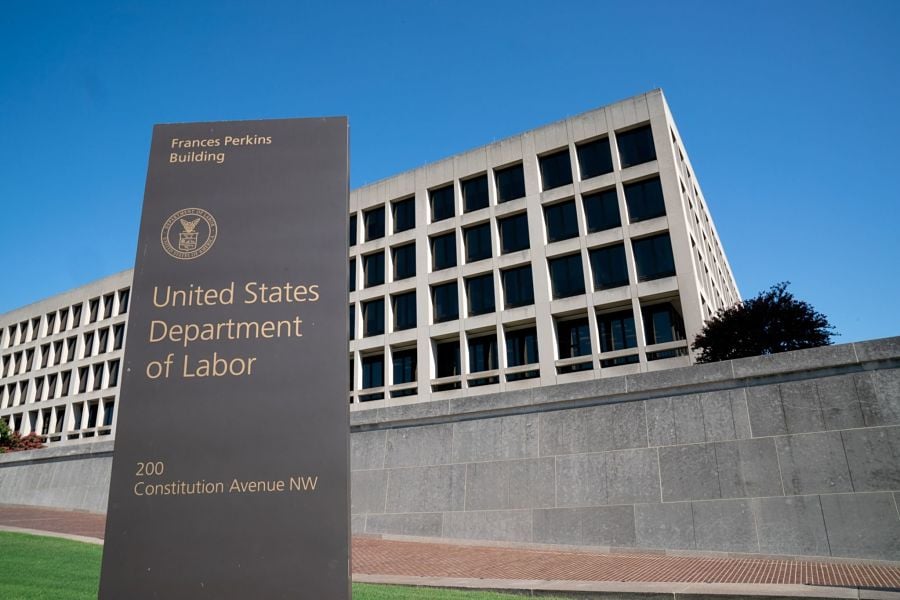
The Department of Labor released guidance on Tuesday that reinforces that a regulation governing investment advice in retirement accounts will strengthen oversight of rollover recommendations and require investment advisers to mitigate conflicts of interest.
The guidance relates to a Trump administration fiduciary rule that the Biden DOL allowed to become effective in mid-February. The regulation provides exemptions under federal retirement law — the Employee Retirement Income Security Act — that allows fiduciaries to receive compensation for advice that would otherwise be prohibited, such as third-party payments, as long as they act in a retirement savers’ best interests.
In a set of frequently asked questions, the DOL said that a recommendation to rollover retirement funds from a company plan to an individual retirement account can be part of an ongoing client-adviser relationship and trigger a fiduciary standard of care.
“Rollover recommendations are a primary concern of the department because of their extraordinary importance to retirement investors,” the guidance states.
The rule leaves in a place a five-part test that allows wiggle room for financial advisers to get around a fiduciary obligation. But the guidance indicates the DOL will be monitoring rollovers for potential investor harm.
“It goes as far as it can to make clear that some rollover recommendations are fiduciary advice,” said Barbara Roper, director of investor protection at the Consumer Federation of America.
The guidance tells the financial industry that “a new paradigm” is in place for conversations between advisers and clients about rollovers, said George Michael Gerstein, counsel at Stradley Ronon Stevens & Young. “In many cases, it appears these rollover communications would be investment advice,” Gerstein said.
Taking advantage of the five-part test to avoid fiduciary status has become more difficult.
“You have to be really careful about walking the fine line between rollover communications and whether you intend for them to be investment advice or not,” Gerstein said.
The DOL FAQs also go into some depth on how retirement-plan advisers must handle potential conflicts of interest that would put the advisers’ interests ahead of those of the client. For instance, it instructs firms not to use quotas, bonuses, prizes or performance standards as incentives and tells them to avoid compensation practices that encourage conflicts.
“The financial institution should aim to eliminate such conflicts to the extent possible, not create them,” the guidance states.
The DOL fiduciary rule is meant to align with the Securities and Exchange Commission’s Regulation Best Interest, the broker advice standard.
SEC Acting Chair Allison Herren Lee praised the DOL guidance.
“The DOL is taking important and thoughtful steps to protect investors’ best interests and ensure that fiduciaries meaningfully address conflicts of interest that can undermine the advice investors receive,” Lee wrote in a Tweet.
Lee’s Democratic colleague on the commission, Caroline Crenshaw, said: “The DOL has provided valuable guidance designed to ensure fiduciaries’ incentives are aligned with investors’. This information is key for both investors and financial firms.”
The SEC will have a 3-2 Democratic majority when the Senate confirms the Biden administration’s nominee for SEC chair, Gary Gensler. Experts are anticipating that that agency will revisit Reg BI, which went into force during the Trump administration, to better define “best interest” and provide more detail on mitigating conflicts.
The DOL guidance could provide a roadmap. Roper said it puts obstacles in the way of advisers who want to roll their clients from an inexpensive company retirement plan to a more expensive IRA.
“They’re going to have to look at the long-term impact of any cost increase,” Roper said. “A lot of investment professionals won’t clear that hurdle.”
The fact that the Biden DOL is keeping the Trump fiduciary rule in place took many by surprise. The Trump regulation replaced an Obama administration investment-advice rule that was struck down by a federal appeals court in 2018 in a lawsuit brought by the financial industry.
The DOL said it “anticipates taking further regulatory and sub-regulatory actions, as appropriate, including amending the investment advice fiduciary regulation,” among other steps.

The financial advice industry has been facing inquiries into its cash sweep programs for years now.

Investor money allegedly went to strip clubs, exotic cars, and landscaping

Procyon adds $415 million in assets under management in New Jersey while Savant picks up a $213 million Southern California planning firm

With a growing number of real estate-rich Baby Boomers aging into retirement, some advisors may be failing to consider all the options available for those clients' assets.

Cornerstone Advisors study reveals compliance bottlenecks stall campaigns weeks after customer opportunities close.
As AI makes financial information more accessible than ever, Lana Hock explains why human judgment, trust, and empathy remain the qualities clients value most in a financial advisor
Northern Trust’s Ken Lassner shows advisors how to convert volatility into after-tax portfolio gains

