
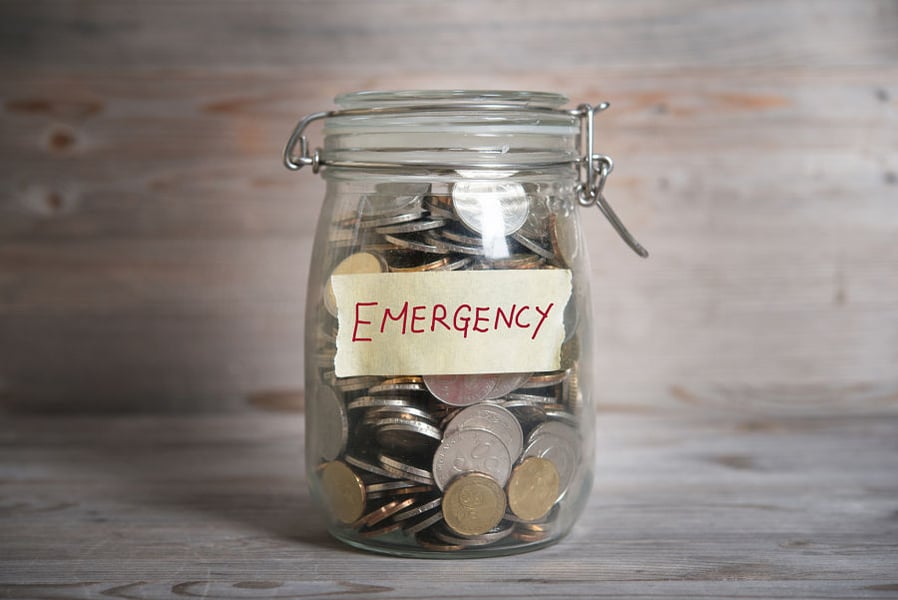
New research from BlackRock shows that workers without short-term savings buffers are undermining their own long-term retirement security – and employers are increasingly positioned to close that gap.
Nearly 40% of U.S. adults remain unable to cover a $400 unexpected expense without borrowing or selling assets, according to a new BlackRock Emergency Savings Initiative (ESI) Impact Report released Tuesday.
Drawing from seven years of employer pilots, behavioral research, and cross-sector collaboration involving more than 60 projects, BlackRock's report published Tuesday confirmed that not having financial buffers isn't just a personal hardship, but a structural threat to retirement readiness.
Unsurprisingly, the ESI data showed that workers who don't have adequate emergency funds are much more likely to take hardship withdrawals from their 401(k)s, taking away from both the principal and the compounding growth that underpins long-term wealth building.
"Too many Americans are forced to choose between managing an unexpected expense today and saving for their future tomorrow," Claire Chamberlain, president of The BlackRock Foundation, said in a statement accompanying the report.
In its most recent How America Saves report, Vanguard found hardship withdrawal activity ticked up in 2025, with 6% of participants dipping into their retirement plans last year compared to 5% in 2024.
While macroeconomic pressures like inflation and interest rates may be playing a role, Vanguard said changes in plan design, administrative options, and regulation have also fostered higher withdrawal rates. Nearly half of workers taking hardship withdrawals in its plans took multiple distributions, Vanguard added.
BlackRock's report found that more than 28% of workers who opened an emergency savings account made a withdrawal from those accounts during financial shocks – helping preserve an estimated $38 million in retirement assets by reducing early retirement withdrawals across the pilot group.
Among participants who were not yet contributing to a retirement plan, one in five began doing so for the first time after opening an emergency savings account, with just over half of those new savers starting contributions within four months.
The behavior didn't appear to be linked to account balances, which the report's authors suggested means the simple act of building a rainy-day fund was enough to kickstart a retirement savings habit. Based on its data, BlackRock estimated that emergency savings drove an additional $3.5 million in new retirement contributions.
Among participants who were not yet contributing to a retirement plan, one in five began doing so for the first time after opening an emergency savings account, with more than half of those new savers starting contributions within four months.
The benefit also extends to education savings, the report found, as families with a dedicated emergency savings account were more likely to consider 529 plans. While households may hesitate to lock away funds in 529 plans because of taxes and penalties on withdrawals for non-educational expenses, that hesitation declines when they have access to a dedicated emergency savings account.
"Emergency savings are a critical form of household economic 'infrastructure,' acting as a financial 'shock absorber' that provides stability, reduces the need for high-cost debt, and prevents financial disruptions from cascading into greater crises," said Timothy Flacke, CEO of Commonwealth, the nonprofit that partnered with BlackRock on the initiative.
Employer appetite for emergency savings solutions is also accelerating, according to BlackRock. Based on its forthcoming annual Read on Retirement report, 79% of retirement plan participants said they would be interested in contributing to an emergency savings program if their employer offered one. Among employers who currently don't offer emergency savings options, it said the share of those actively considering it have more than doubled in the past year, from 8% to 17%.
The ESI research also pointed to two key SECURE 2.0 provisions: the Pension-Linked Emergency Savings Account (PLESA), which allows workers to save up to $2,500 in an emergency account attached to their retirement plan; and the $1,000 emergency expense withdrawal provision, which permits penalty-free withdrawals for qualifying emergencies.
People don't seem to be taking the emergency withdrawal provision as a license to draw down their savings, according to BlackRock. Among those who took advantage of it, the report said 90% kept contributing to their retirement plan afterward, and 66% of those who dipped into their retirement savings during the first three quarters of 2024 went on to fully repay the amount.
"Without an accessible savings cushion, workers living on [low and moderate incomes] pause retirement contributions, sell investments at the wrong moment, or turn to high cost debt – eroding the compounding that drives long-term wealth," the report said.

The products in question were a mix of sophisticated, complex and potentially volatile offerings.

Winstone Wealth Partners joins Concurrent from Raymond James, pushing the RIA platform's assets past $23 billion this year.

Senior Democrats including Senator Bernie Sanders urge a DOJ and FBI investigation into thousands of allegedly fake comments backing DOL's private-assets 401(k) rule.

Total US retirement holdings jumped 7.9% in the second quarter, with 401(k) balances and IRA contributions both climbing despite lingering economic unease

Megadeals are surging in 2026, but small and mid-market transaction volume remains well below historical norms.
As AI makes financial information more accessible than ever, Lana Hock explains why human judgment, trust, and empathy remain the qualities clients value most in a financial advisor
Northern Trust’s Ken Lassner shows advisors how to convert volatility into after-tax portfolio gains

