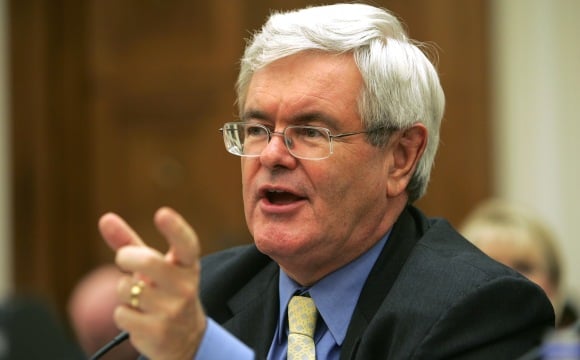
Republican presidential candidate Newt Gingrich and his wife reported giving 2.6 percent of their $3.1 million adjusted gross income to charity in 2010, below the average donation level of taxpayers at their income level, according to
Internal Revenue Service data.
The Gingriches reported $81,133 in charitable donations, according to tax documents they released Jan. 19. The sole named benefactor, the Basilica of the National Shrine in Washington, received $9,540, and it paid wife Callista Gingrich $5,918. She is a member of the choir. Another $68,493 in charitable deductions were listed as gifts from Gingrich's companies to unidentified charities. The rest, $3,100, was labeled miscellaneous donations.
Gingrich, a former U.S. House speaker who in recent years has worked as a health care and housing industry consultant, is the first of the four remaining 2012 Republican presidential contenders to release tax returns. Gingrich provided his 2010 forms. He hasn't said whether he'll release those from other years.
Previous presidential candidates -- including Democrats Barack Obama and Al Gore -- have faced criticism that they didn't contribute enough to charity.
Russell James, director of a graduate program in charitable
financial planning at Texas Tech University in Lubbock, Texas, said while Gingrich's level of giving “isn't shockingly low,” research shows older, conservative Americans typically are among the most generous with donations. Gingrich, 68, has described himself as the true conservative in the Republican primary field.
Tax Benefits
“Someone with his political philosophy, you would expect to be on the very high end of giving,” James said. Conservatives “tend to be more churchgoing and believe that others outside of the government should take care of people.”
Charitable giving doesn't just warm the heart, it provides a tax break.
U.S. taxpayers with income of between $2 million and $5 million a year on average donated 3.5 percent of their adjusted gross income, according to 2009 IRS data, the most recent figures available. The average for all taxpayers is 3 percent, the data show.
“The obvious advantage to charity is it's deductible,” Roberton Williams, a senior fellow at the Tax Policy Center in Washington, said in an interview yesterday. “It reduces your taxable income, meaning the cost of giving away a dollar is substantially less than a dollar.” R.C. Hammond, Gingrich's spokesman, didn't return a phone call or e-mail yesterday.
‘Values'
Gingrich said at the CNN debate on Jan. 19 that he released his 2010 tax forms “so that people can see what we do and how we did it and what our values are.”
His joint filing with Callista Gingrich gives no indication which charities other than the National Shrine benefited from donations.
A separate tax document released Jan. 19 for The Gingrich Foundation provides a list of donation recipients.
The foundation, based in Washington, received $152,609 in contributions in 2010 -- it doesn't list donors -- and provided $120,000 to 14 organizations. Luther College in Iowa, Callista Gingrich's alma mater, received the most, $30,000. The National Shrine received $20,000. Smaller amounts went to the Mount Vernon Association, the Washington National Opera and the Atlanta Ballet, according to the tax returns.
Most presidential candidates since the 1970s have released tax returns, and some have been criticized for below-average giving.
RELATED ITEM Richest president candidates ever? Here's the top 10 »
In 1997, then-Vice President Al Gore, a Democrat who ran for president in 2000, donated $353 of his $197,729 earnings. He bumped up his giving to $15,197 the next year.
The Obamas donated less than 1 percent of their income from 2000 through 2004 and 5 percent of the money they made in 2005 and 2006, according to the tax returns they released. Vice President Joe Biden and his wife reported in 2008 giving an average of $369 to charity each year for a decade -- less than 1 percent of their income.
Republican Richard Nixon, well-known for penny-pinching, reported donating $295 in 1972 while he was president, according to presidential tax returns archived on the Tax Analysts' Tax History Project website.
While Gingrich's giving might be on the low side, James said, fellow presidential contender Mitt Romney's donations to the Mormon Church may dominate the charity storyline of this year's presidential election. Romney, the former Massachusetts governor who has made millions of dollars as a co-founder of Boston private-equity firm
Bain Capital LLC, reported in a financial disclosure form filed in August with the Federal Election Commission that his assets are worth as much as $250 million. The Mormon Church asks its members to donate at least 10 percent of their income.
Romney said Jan. 19 that he will release his most recent tax returns in April. Fellow Republicans including New Jersey Governor Chris Christie have asked him to do so sooner.
--Bloomberg News--