
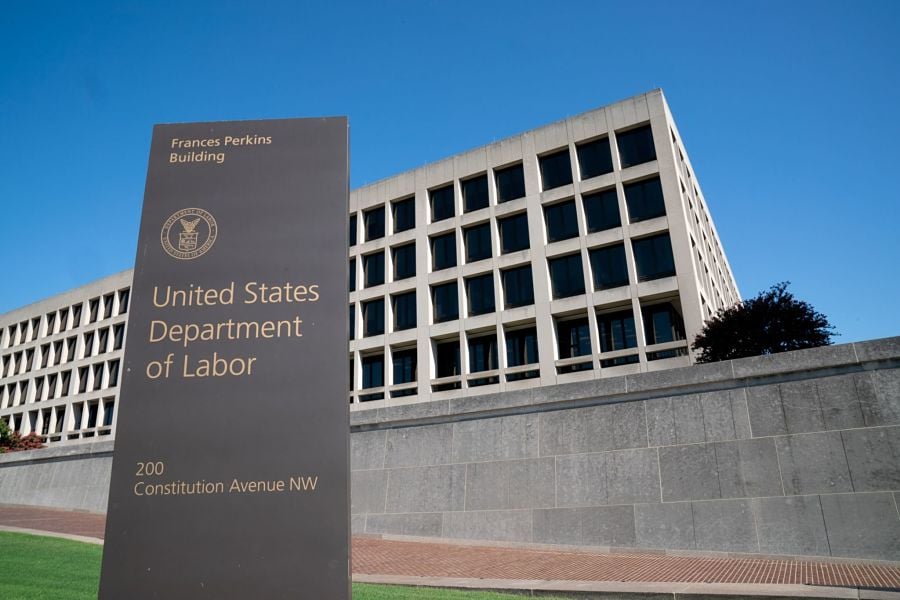
Financial industry trade associations are calling on the Department of Labor to withdraw recent guidance warning retirement plans to be cautious about adding cryptocurrency products to their investment menus.
Last month, the agency’s Employee Benefits Security Administration issued a compliance assistance release that said plan fiduciaries should “exercise extreme care” when considering cryptocurrency investments.
“The plan fiduciaries responsible for overseeing such investment options or allowing such investments through brokerage windows should expect to be questioned about how they can square their actions with their duties of prudence and loyalty in light of the risks described above,” the release states.
Earlier this week, 11 financial industry interest groups wrote to the DOL asking that the agency withdraw the compliance release because it was issued outside of normal rulemaking. The organizations are concerned that the DOL was establishing policy while sidestepping the notice and comment process to obtain public input.
The interest groups stressed that they weren't expressing an opinion on whether it’s appropriate to use cryptocurrency in retirement accounts. Their problem is with the way the DOL is addressing the issue, they said.
“[W]e are troubled by what we perceive to be a trend at EBSA away from rulemaking based on a robust notice and comment process, including review by the Office of Information and Regulatory Affairs (OIRA),” the groups wrote in an April 12 letter to DOL acting assistant secretary Ali Khawar. “The Department’s new cryptocurrency position is inconsistent with current law, and adopted retroactively without notice and comment or OIRA review.”
A DOL spokesperson said the agency did not introduce new policy in the crypto guidance but rather emphasized requirements that exist under federal retirement law, known as the Employee Retirement Income Security Act.
“While we are still reviewing the letter, we want to emphasize that the duties of prudence and loyalty discussed in the guidance have applied to plan fiduciaries since ERISA’s inception, and [a 2012 DOL bulletin] specifically noted the application of these same preexisting duties with respect to the nature and quality of services provided in connection with brokerage windows,” DOL spokesperson Grant Vaught wrote in an email. “As the compliance assistance release states, these duties should lead 401(k) plan fiduciaries to exercise extreme care before including options to invest in cryptocurrencies at this early stage of their development.”
The groups signing the letter include the American Council of Life Insurers, the Insured Retirement Institute, the Investment Company Institute, the Securities Industry and Financial Markets Association and the U.S. Chamber of Commerce.
The American Retirement Association did not sign the letter, but it ran a story about it on Friday in an edition of the electronic newsletter of the National Association of Plan Advisors, one of its affiliates.
“The American Retirement Association (ARA) is directly engaged in a conversation with DOL on how to practically deal with their guidance particularly as to the implications with respect to self-directed brokerage accounts,” the ARA said in a statement at the bottom of the article.
But Michael Canning, principal and founder at the LXR Group, questioned the concerns that the financial industry groups raised about the crypto compliance release.
“I think that it’s a little ironic that many of these industries have been clamoring for more clarity and transparency about how regulators view cryptocurrency — and when they get it, because they don’t like some of the things they’re hearing, they’re objecting to it on process grounds,” he wrote in an email. "I don’t think guidance and other ‘sub regulatory’ actions and notice-and-comment rulemaking are mutually exclusive; very often, the former presages the latter.”
The compliance release is a good interim step before promulgating a regulation, Canning said.
“As the associations are well aware, notice-and-comment rulemaking takes time — easily a year or two — and as the letter itself notes, investment products tied to crypto are proliferating rapidly,” he said. “The idea that we should defer any measure of clarity for another couple of years doesn’t seem like a very good one, for investors or anyone else.”
The letter from the trade groups said that EBSA’s cryptocurrency compliance release imposes new obligations for retirement plan fiduciaries.
“[P]lan sponsors have not been charged previously with fiduciary responsibility for investments made through brokerage windows,” the letter states. “The Department’s guidance now puts plan sponsors in the untenable position of having to choose between extending their fiduciary responsibility to such investments, contrary to longstanding guidance, or accepting the likelihood of a plan investigative audit, along with the very real expenditures, both in time and money, associated with such audits.”
The interest groups argued that the use of the term “extreme care” in the compliance release creates confusion about fiduciaries’ legal standard. They also asserted that DOL should not weigh in on which investments are appropriate.
“We are not aware of any legal basis on which the Department can proceed down this path, and this would set a concerning precedent for future announcements by any Administration about what investments are permissible,” the letter states.

Deal creates a $20B-plus custody platform for private market investing in IRAs, months after Schwab closed its Forge Global purchase

Cullen marks the fourth firm the New York-based RIA aggregator has bought in 2026 as deal volume heads for a record year.

The quality of AI ROI measurement depends on pre-deployment decisions around business outcomes, leadership alignment, and establishing trusted information, among other factors.

A state-by-state analysis of retail investor behavior reveals AI-powered research tools are reshaping how clients approach investment decisions.

LPL picks up $1.1B from Wells Fargo's independent channel as the wirehouse gains a $410M family team from UBS.
Knighthead Life entered the market with a competitive MYGA. A strong launch earned advisor confidence and paved the way for FIAs.
As AI makes financial information more accessible than ever, Lana Hock explains why human judgment, trust, and empathy remain the qualities clients value most in a financial advisor

