

Black American workers have become more confident in their household financial situations over the past two years, according to new research findings revealed by Limra.
Drawn from its 2024 Financial Wellness Index study, Limra's findings suggest a growing sense of financial security among Black American emplopyees and an increased recognition of the role professional financial advice can play in long-term stability.
Limra’s research found that Black Americans were more likely in 2024 than in 2022 to agree that financial knowledge, professional guidance, and employer-provided benefits contribute to their overall financial wellness.
Citing a separate consumer sentiment study conducted in January, Limra said Black Americans are also more likely than the general population to believe their personal financial situation will improve in 2025 (61 percent vs. 51 percent).
Highlighting the role of workplace benefits in financial confidence, 77 percent of Black American workers said their employers should offer services to help reduce financial stress, up from 69 percent in 2022. Meanwhile, 74 percent viewed their workplace benefits as a critical part of their financial wellness strategy.
Limra’s findings align with previous research showing elevated concerns among Black Americans on a range of personal finance areas including saving for retirement, covering expenses if they can no longer work, or building emergency savings.
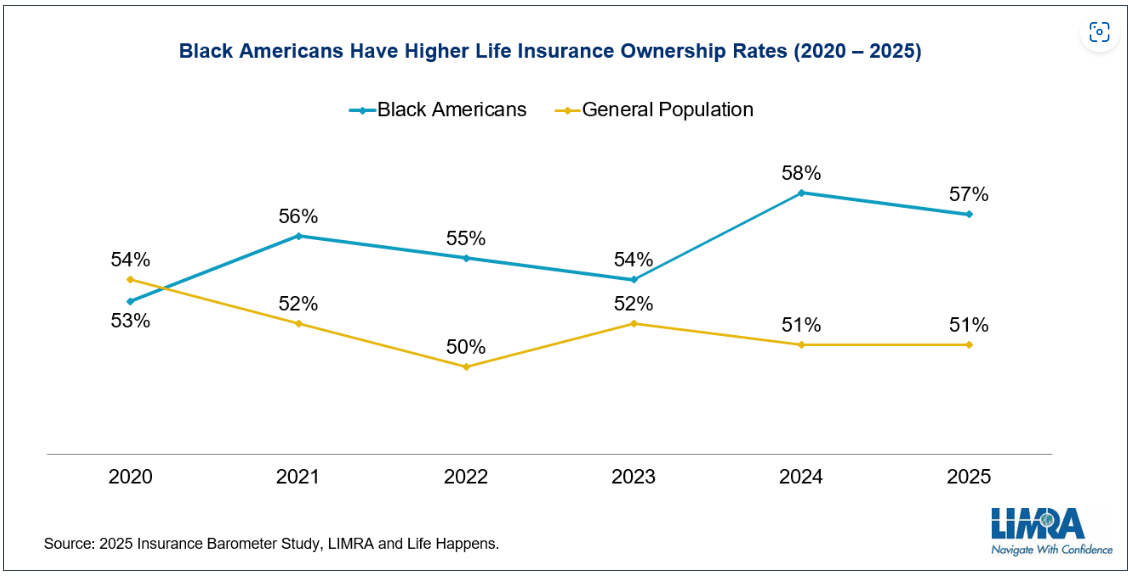
One bright spot amidst the findings, Limra said, is the consistently higher reported rates of life insurance ownership among the Black community than the general population. At last count, it found 57 percent of Black Americans owned life insurance, compared to 51 percent for the American population as a whole.
The 2024 Insurance Barometer Study by Life Happens and Limra found roughly half of US adults currently own life insurance policies, while a record 42 percent admitted their need for additional life insurance.
Limra's latest research showed that Black Americans were slightly less likely than the general population to cite expense or other financial priorities as barriers to owning life insurance, suggesting a distinct perspective on how life insurance fits into their broader financial planning.

What will financial advice look like 20 years from now? Evan Vladem explores how AI may transform wealth management while reinforcing the enduring value of human guidance, trust, and empathy.

The Boston deal is set to push the PE-backed consolidator past $187 billion amid a broad RIA M&A slowdown and a potential shift in its ownership.

Advisors with clients who own second homes in New York City face fresh uncertainty as the city seeks a stay and plans an appeal.

Meanwhile, a deal in the Midwest gives NorthRock Partners a new office in Wisconsin, while two teams join OnePoint BFG in Georgia and Atlanta.

These challenges are “changing the economics we see retirement savers face,” said Christopher Ceder of Goldman Sachs Asset Management
As AI makes financial information more accessible than ever, Lana Hock explains why human judgment, trust, and empathy remain the qualities clients value most in a financial advisor
Northern Trust’s Ken Lassner shows advisors how to convert volatility into after-tax portfolio gains

