

Long-term services and supports (LTSS), which represents one of the biggest threats to retirement security, would likely be improved through the Well-Being Insurance for Seniors to be at Home (WISH) Act, according to a new report from Morningstar. In the report, released today, Morningstar applied its Model of U.S. Retirement Outcomes to simulate retirement adequacy for Gen Z, millennials, and Gen X households under current law and under the WISH Act. LTSS represents major retirement risk, with the present value of LTSS costs for baby boomers' projected costs exceeding $130,000 per household, and the mean for those with a simulated LTSS need exceeded $242,000.
The WISH Act, a bipartisan proposal in Congress, is designed to create a federal catastrophic insurance program for LTSS. The proposal contains language to mitigate LTSS risk by providing benefits after a one- to five-year waiting period, depending on income history, with lower-income people qualifying sooner. Benefits would be administered by the Social Security Administration, with payments estimated at about $4,000 per month in today’s dollars.
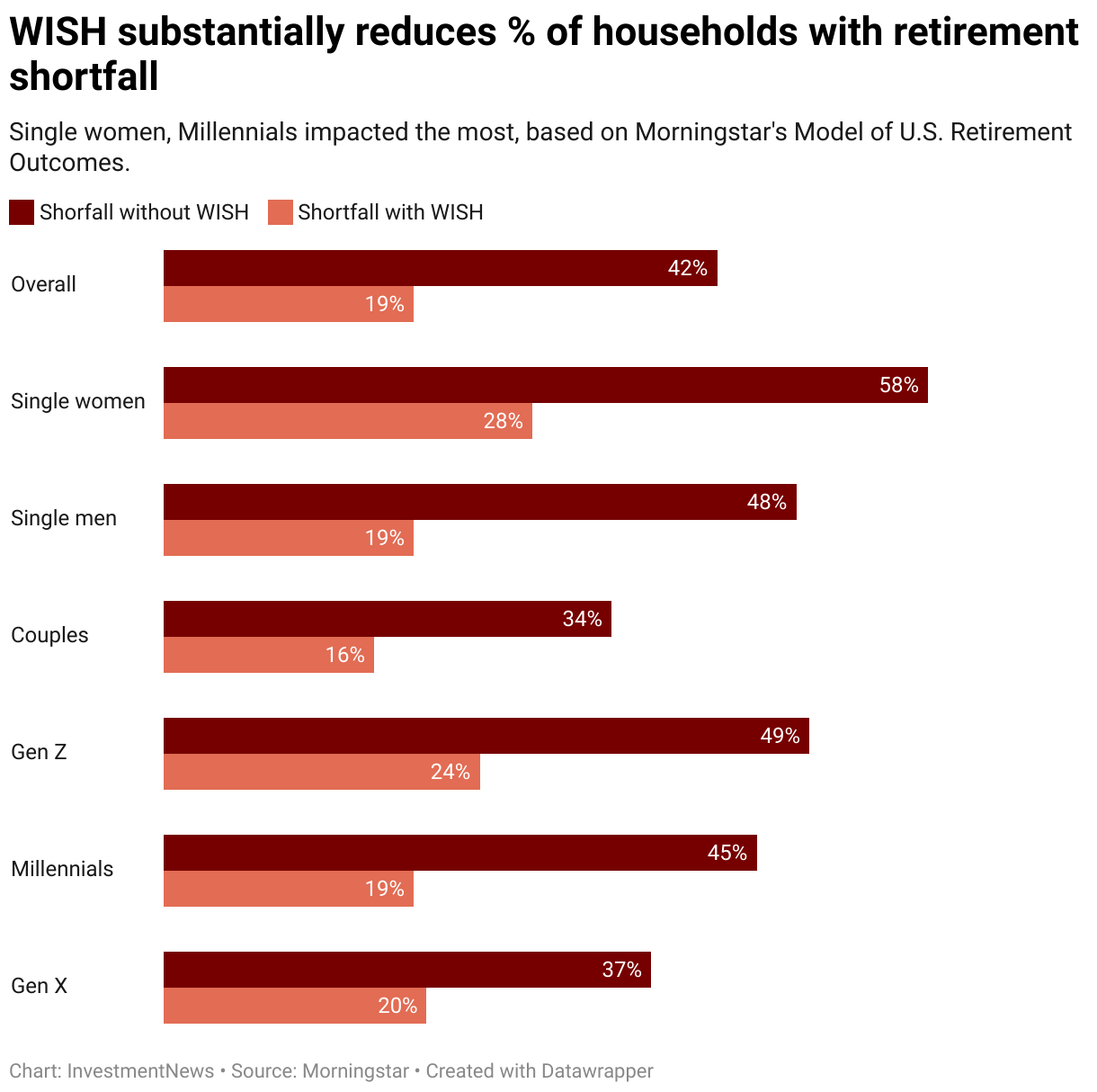
The Morningstar analysis finds the WISH Act dramatically improves retirement adequacy for households who qualify for benefits. Overall, the share of such households running short of money in retirement would fall from 42% to 19%. Single women’s shortfall rates would decline from 58% to 28%, single men’s from 48% to 19%, and couples’ from 34% to 16%. Generationally, Gen Z and millennials see the biggest reductions due to the compounding impact of LTSS inflation, with shortfalls halved. Gen X households also benefit, though to a slightly lesser degree. Middle-income households are most exposed to LTSS risk, as they have too much wealth to qualify quickly for Medicaid but not enough to absorb catastrophic costs.
Even when expanding the analysis to all households with paid LTSS needs, including those whose care needs fall short of the WISH Act’s waiting period, the program still meaningfully reduces retirement insecurity. Middle-income households gain the most from the WISH Act, as they face the greatest exposure to LTSS costs. Households with higher LTSS costs benefit significantly, while hispanic and black households see particularly large gains, helping narrow racial wealth gaps.
Morningstar notes the importance of indexing WISH benefits to LTSS costs. If benefits only grow at the rate of general inflation, the improvements shrink significantly — especially for younger households who are more exposed to long-term cost growth. It would reduce Medicaid reliance, strengthen retirement security across demographics, and potentially encourage private long-term care insurance markets.

LPL Financial and Raymond James also add independent advisors from Osaic and Edward Jones in Michigan and Arizona.

The SEC-registered RIA advises on more than $1 billion in client assets, with no advisory fee through 2027 and no human financial advisors.

The four wirehouse firms lost 1,449 experienced advisors and recruited 932 in the first six months of the year, according to Diamond Consultants.

Merit's 10th Commonwealth addition deepens its Western New York reach, while another Hightower partner joins its Signature Wealth platform in Michigan.

Report on Climate Action 100+ signals risk for passive managers' 13G status heading into the 2027 proxy season.
Knighthead Life entered the market with a competitive MYGA. A strong launch earned advisor confidence and paved the way for FIAs.
As AI makes financial information more accessible than ever, Lana Hock explains why human judgment, trust, and empathy remain the qualities clients value most in a financial advisor

