

Many investors who are within 20 years of retirement have reacted to the current market conditions by selling target-date fund assets.
In March, about $9.4 billion flowed out of target-date funds in vintages 2035 and lower, with the biggest outflows coming from funds dated 2020, according to a paper published Thursday by Morningstar Inc.
Meanwhile, net inflows to 2040 target-date funds were slightly positive, and new sales into longer-dated funds were larger, according to the report.
“It’s another sign of how scared people got in March,” said the report’s author, Jason Kephart, a senior manager and research analyst for Morningstar. “It was the fastest 20% [stock market] decline ever, and you had so much uncertainty."
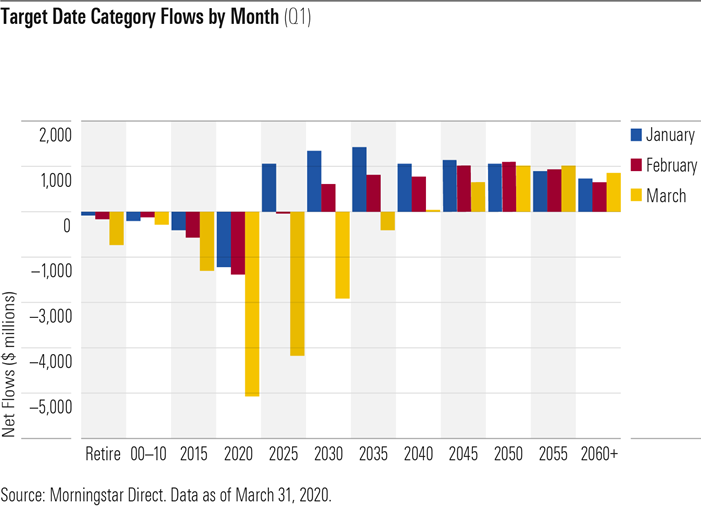
In 2020 funds, investors pulled more than $5 billion in March. Morningstar compared that with the outflows from 2015 funds during the first quarter of 2015. In the first quarter of 2015, investors withdrew about 1% of total assets from that vintage, compared with 4% in the first quarter of 2020 from 2020-dated funds, the paper shows.
Outflows from target-date funds that have reached their target dates are expected, but not at that rate, Kephart noted.
“It definitely seems like people are pulling [money] out faster,” he said.
The effect of the market drop and COVID-19 was seen even in 2025, 2030 and 2035 vintages, with investors pulling money from all three. That is significant because target-date funds are intended to be long-term investments, and investors typically do not withdraw assets so far from the products’ maturity.
The sell-offs could mean that investors locked-in losses, instead of giving their assets time to recover.
“Time is your friend in a situation like this,” Kephart said. “No one can call the bottom. No one will know when it’s really safe to get back in. The further you are from retirement, the better off you are just staying in.”
The recent findings contrast somewhat with information from retirement-plan record keepers, some of which have reported that their participants have remained calm amid the volatility.
About three-quarters of investors recently surveyed by Empower Retirement said they have no plans to sell their investments or cash out of plans, the company wrote in a March 31 report.
A separate analysis of the company’s 9.4 million participants over 30 days showed that 99.3% did not make any changes to their retirement investments, according to Empower.
The recent target-date sell-off could have implications for product design, which generally considers longevity, Kephart noted.
“A lot of target-date fund glide paths are based on this assumption that investors in target-date funds are more likely to stay the course,” he said. “I wonder if this will change anything about where the equity allocation should be at the target date.”

The financial advice industry has been facing inquiries into its cash sweep programs for years now.

Investor money allegedly went to strip clubs, exotic cars, and landscaping

Procyon adds $415 million in assets under management in New Jersey while Savant picks up a $213 million Southern California planning firm

With a growing number of real estate-rich Baby Boomers aging into retirement, some advisors may be failing to consider all the options available for those clients' assets.

Cornerstone Advisors study reveals compliance bottlenecks stall campaigns weeks after customer opportunities close.
As AI makes financial information more accessible than ever, Lana Hock explains why human judgment, trust, and empathy remain the qualities clients value most in a financial advisor
Northern Trust’s Ken Lassner shows advisors how to convert volatility into after-tax portfolio gains

