
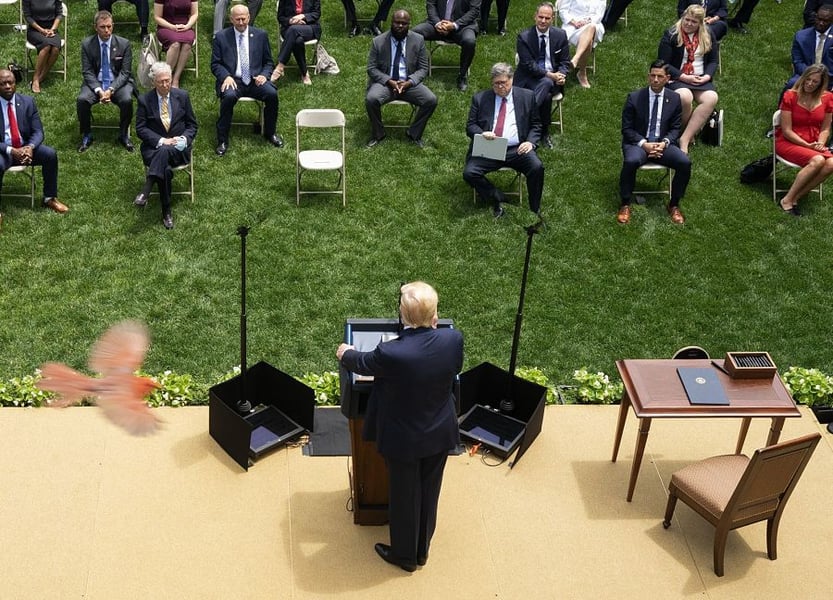
White House officials said the administration has no plans to do away with the payroll tax even though President Donald Trump said he would seek a permanent repeal if he wins another term.
Even if Trump were to follow through, the idea of doing away with the tax is unlikely to get much support in Congress because it could drive up the deficit by trillions of dollars to plug a funding gap, or spell the end of some Social Security payments for millions of Americans.
“The idea is drastic and crazy,” said Brian Riedl, a senior fellow at the conservative Manhattan Institute. “It is complete fantasyland.”
Alan Viard, resident scholar at the conservative American Enterprise Institute and a former Treasury official in the George W. Bush administration called it “absolutely insane” and an “unfathomable” proposal.
“The only silver lining here is that there is zero chance of this being adopted,” Viard said.
Trump has suggested a radical revamp to the taxes, which fund Social Security and Medicare, several times over the past week, saying he’ll make a move in that direction if he wins reelection.
“On the assumption I win, we are going to be terminating the payroll tax after the beginning of the new year,” Trump said Wednesday.
White House press secretary Kayleigh McEnany and a second official, who spoke on condition of anonymity, said Trump is only talking about forgiving the worker payroll taxes he deferred last week with an executive action set to be in place from Sept. 1 to the end of the year.
“What he was meaning yesterday is he wants permanent forgiveness of the deferral,” McEnany said at a press briefing Thursday.
But Trump has said more than once he wants to end the payroll tax. “If I win, I may extend and terminate. In other words, I’ll extend it beyond the end of the year and terminate the tax,” he said of the payroll tax last Saturday.
Congress would need to act to terminate the 6.2% payroll tax that funds Social Security or the 1.45% levy that funds Medicare. Democrats are universally opposed to any cuts in the payroll taxes that would harm these benefits.
While Republicans are more open to policies that would reduce the program’s costs over time, Congressional leaders have been wary of even a short-term reduction in payroll taxes because programs are already in danger of becoming insolvent.
If Congress terminated those levies at the end of this year, the trust funds would have enough money to pay retirement benefits for two and a half years, disability benefits for eight months, and Medicare payments for six months, according to Riedl’s estimates.
Congress would likely then step in to fund those programs with general revenues, which would amount to adding $16 trillion to the deficit over a decade, rather than let those benefits expire, he said.
Even Trump’s short-term plan has deficit implications. On Tuesday, White House economic adviser Larry Kudlow said the administration would “bond out” -- that is, borrow money -- to cover any Social Security or Medicare shortfalls that may arise.
Asked on Wednesday about how he intended to pay for Social Security from the general fund, Trump said, “We’re going to have tremendous growth,” suggesting other tax revenues would rise.
“His pledge to replace lost revenue with growth is a classic Trump con,” Sen. Ron Wyden, the top Democrat on the Senate Finance Committee, said in a statement. “Republican tax cuts have never delivered promised growth.”
Changes to Social Security, a program with widespread support that’s been around since 1935, were once called the “third rail” of American politics -- an allusion to the danger of electrocution.
The program created during the Great Depression is the largest single source of income for older Americans, providing the majority of income for half of retirees, and at least 90% of income for 18% of retirees, according to the Center on Budget and Policy Priorities, a progressive think tank.
The outlook for Social Security and Medicare is already dire, with retirement funds projected to run out by 2035, according to the Social Security Administration. Though payroll taxes ostensibly go to “trust funds” that build up assets from which the benefits are paid, the demographic challenge posed by the large, rapidly retiring baby-boomer generation means there’s not enough money for the government’s obligations.
Last Saturday, Trump announced an executive action to defer the levies on workers from September through the end of the year. Democrats and Republicans criticized the move because those tax payments will still come due, creating an administrative nightmare for workers and employers. The directive came after Trump had asked Congress to do a payroll tax holiday, which lawmakers rebuffed.

CFP, CFA and CPA holders could gain accredited investor status as regulators weigh wider private market access for advisory clients

DeepVest, Vanilla and Libretto roll out tools to help financial advisors launch firms, close estate plans and sharpen planning skills

“People aren't effectively using their wealth in retirement,” said David Blanchett of Prudential.

Second-generation NFL ref Shawn Hochuli co-founded IWM Partners in Irvine, California, a wealth management practice with more than $500M in client assets

U.S. seniors lose $28.3 billion annually as a result of financial exploitation, according to a 2023 AARP study.
As AI makes financial information more accessible than ever, Lana Hock explains why human judgment, trust, and empathy remain the qualities clients value most in a financial advisor
Northern Trust’s Ken Lassner shows advisors how to convert volatility into after-tax portfolio gains

