
Checking your 401(k) account balance is a little less painful these days.
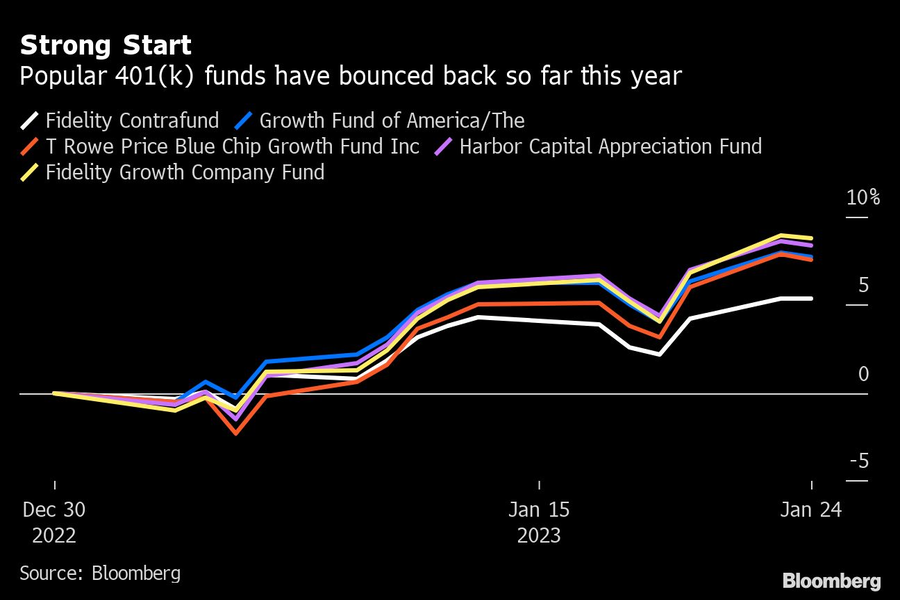
Popular active equity funds in 401(k)s tanked last year because of their heavy focus on the big technology companies that got battered by surging inflation and steep interest rate hikes. Those same stocks have given them a boost so far in 2023.
Fidelity Contrafund (FCNTX), Growth Fund of America (AGTHX), T. Rowe Price Blue Chip Growth (TRBCX), Harbor Capital Appreciation (HNACX) and Fidelity Growth Company (FDGRX) are up anywhere from 5.4% to 8.8% through Tuesday’s close. By comparison, the S&P 500 is up 4.6%.
Of course, that strong start doesn’t come close to making investors whole. Those five funds were all down at least 33% in 2022, and overcoming that loss would take stupendous results. Someone with $1,000 in a fund that lost 30% would need a gain of about 43% on the remaining money to get back to that initial $1,000.
A look at what’s fueling the gains is reminiscent of bubblier times. At Fidelity Contrafund, three of its top 10 holdings as of Dec. 31 are tech companies that are up double-digits this year, with Meta Platforms Inc. (5.5% of assets) gaining 19%, Amazon.com Inc. (5% of assets) up 15% and Alphabet Inc. (about 4.2% of assets) up about 11%.
Investor hopes that declining inflation will cause the Federal Reserve to pause or even reverse rate hikes are helping boost the same growth stocks that led last year’s decline. The rally wavered on Wednesday after Microsoft Corp. (MSFT) warned of a slowdown in sales, but the Nasdaq managed to erase most of the day’s losses by 2:30 p.m.
At T. Rowe Price Blue Chip Growth Fund, concentrated positions in some big tech stocks are juicing returns, with Amazon and Alphabet at 6.8% of assets each as of Dec. 31. Nvidia Corp., the fund’s eighth-largest holding at 2.8% of assets, is up 32%. Rounding out the fund’s top 10 is software company ServiceNow Inc., with a gain of 14% for the year.

Goldman Sachs retirement survey finds 83% want guaranteed income, while the annuities providing that income increasingly hold private credit.

The AI meeting assistant's Advisor Intelligence plugin turns client conversation data into annual reviews, tax scans and attrition alerts.

Chuck Roberts and Stifel have been facing scrutiny due to sales of structured products and structured notes.

Among other updates, the proposals would let advisors to regulated funds earn performance fees and allow interval funds to offer monthly repurchases.

What will financial advice look like 20 years from now? Evan Vladem explores how AI may transform wealth management while reinforcing the enduring value of human guidance, trust, and empathy.
As AI makes financial information more accessible than ever, Lana Hock explains why human judgment, trust, and empathy remain the qualities clients value most in a financial advisor
Northern Trust’s Ken Lassner shows advisors how to convert volatility into after-tax portfolio gains

