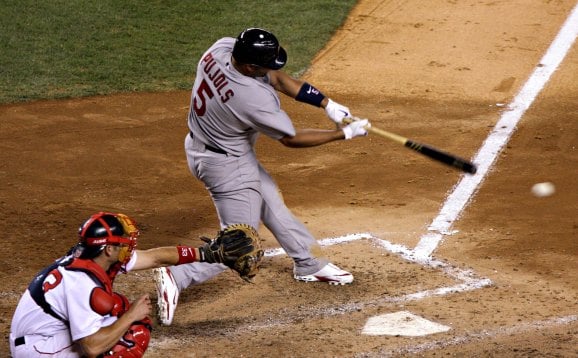
Securing a no-trade clause in his contract gives Major League Baseball all-star Albert Pujols more job security and cachet as a Los Angeles Angel than he would have had as a Miami Marlin.
But in signing a $254 million, 10-year deal with the Angels, Mr. Pujols may not have made the best decision for managing his considerable wealth.
The Angels gave him more money than the $210 million that the Marlins were said to have offered and the $220 million his previous team, the World Series Champion St. Louis Cardinals, put on the table.
But playing in California will subject the slugger to a state income tax of 10.3%. Missouri places a 6% levy on incomes. Florida does not have a state income tax.
That puts his pre-Federal income tax pay at just under $22.8 million per year in Anaheim, Calif., about $20.7 million per year in St. Louis and $21 million per year in income-tax-fee Florida.
“A Marlins deal would have saved him significantly on taxes, assuming he would have become a Florida resident,” said Tim Steffen, director of
financial planning at Robert W.
Baird & Co. Inc.
A former National Football League player who is now a lawyer working with professional athletes made the same calculation.
“Strictly speaking, financially, he should have signed with the Marlins if that was the most important criteria for him,” said William Conaty, an attorney with Montgomery McCracken Walker & Rhoads LLP and a former offensive lineman for the Buffalo Bills, Dallas Cowboys and other teams.
RELATED ITEM States with the highest tax rates »
Mr. Pujols may be able to save some on taxes if he decides not to live in the Orange County, Calif., area that is home to the Angels and ranks above average in cost of living. About 60% of the Angels' games will be played in California, when you include road contests against San Diego, the Los Angels Dodgers and the Oakland A's, according to Mr. Steffen.
St. Louis can claim the lowest average property price at about $192,306, according to Coldwell Banker Real Estate LLC. Miami comes in at $265,895 and Anaheim is tops at $381,213.
What Mr. Pujols can try to do is convince California that he lives in another state. That could shelter his off-field revenue from the Left Coast's high tax rate.
“The playing income would be sourced to California, but the other income — perhaps he has endorsements or restaurants — could be sourced to another state,” Mr. Steffen said.
Taxes may be on the verge of rising in California just as Mr. Pujols dons his new Angels jersey, though.
New, higher rate?
A referendum on the ballot in next year's election would create three new tax brackets. Residents making more than $1 million annually would have to pay an 11.3% rate. If approved, the law would be retroactive for 2012. That would drop Mr. Pujols' take-home pay to $22.53 million a year.
“It's bad enough as it is,” Mr. Steffen said. “He might be walking into something even worse.”
Mr. Pujols, however, is likely putting a higher priority on factors such as his new team's chances of getting to the World Series than on the amount of taxes he will be paying.
Most athletes have their minds on the field or court where they excel rather than the geography of their residence.
“You're in this almost fantasy world, where taxes don't matter,” Mr. Conaty said. “You're worried about hitting home runs or hitting .350.”
That's why an athlete's entourage — which could include an agent, lawyer and financial adviser for a star such as Mr. Pujols — is critical.
“It's incumbent on agents and lawyers to educate athletes on what it's going to be like when they're done, and they don't make $10 million a year but they live a $10 million-a-year lifestyle,” Mr. Conaty said.
Even Mr. Pujols one day will be sitting in the stands watching baseball games rather than on the field starring in them.
“He's not going to have another job where he's making $25 million a year,” Mr. Conaty said.
“Well, he might,” Mr. Conaty added, considering that Mr. Pujols is likely to end up in the baseball hall of fame and have other big-payday opportunities after his career ends.