

Most wealthy clients assume Medicaid will never touch their finances. Many are right. That changes when a parent needs round-the-clock care and the family learns how the program works in that parent's state.
A 50-state Medicaid report card measures how much those state programs differ. It comes from the Heartland Institute, a free-market think tank in Schaumburg, Ill. Kansas scored highest with 74 out of 100. California scored lowest with 22. The average was 45.5.
The grades reflect Heartland's view of what Medicaid should be. The heaviest single metric, worth 12 points, goes to states that rejected the Affordable Care Act's expansion. The 10 states that did so averaged 57.7 points, compared with 42.4 for everyone else.
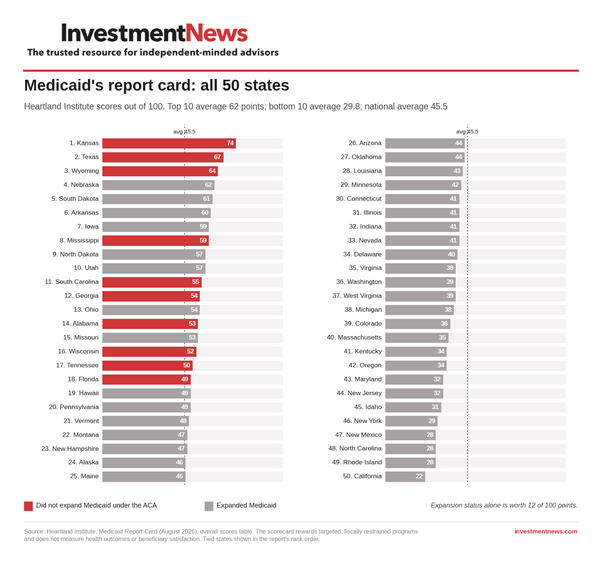
The report says it does not measure health outcomes. Other research finds those outcomes differ as well. According to the Commonwealth Fund, Kentucky expanded early, and the uninsured rate among its low-income residents fell from 38% to 12% between 2013 and 2023. Neighboring Tennessee did not expand, and its rate fell only from 37% to 24%.
Advisors can use the data without taking sides in that argument. Medicaid is the country's largest payer for long-term care. KFF has reported that it covered more than half of the roughly $415 billion spent on long-term services and supports in 2022. Much of the program's rulebook is written state by state.
The report's fiscal section is the most useful part for planners. The 10 top-ranked states averaged 18 of 26 fiscal points, and the bottom 10 averaged 7. Wyoming, Mississippi and Hawaii earned all 26 points. New York earned none.
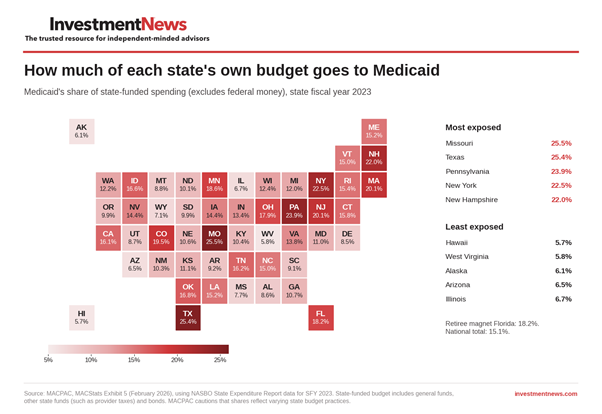
The share of each state's own budget that goes to Medicaid varies by a factor of four. MACPAC's latest figures show Medicaid took 25.5% of Missouri's state-funded spending in fiscal 2023 and 25.4% of Texas's. In Hawaii the figure was 5.7%, and in West Virginia 5.8%. Florida, home to many retired clients, came in at 18.2%.
State budgets were under strain before the new federal rules took effect. A KFF survey of Medicaid directors found that state Medicaid spending rose 12.2% in fiscal 2025. Nearly two-thirds of directors said the chance of a shortfall in fiscal 2026 was at least 50-50. Rising long-term care demand was among the cost drivers they cited.
The 2025 reconciliation law, known as the One Big Beautiful Bill Act, reduces federal Medicaid spending by an estimated $911 billion through 2034. The pain will not match Heartland's rankings.
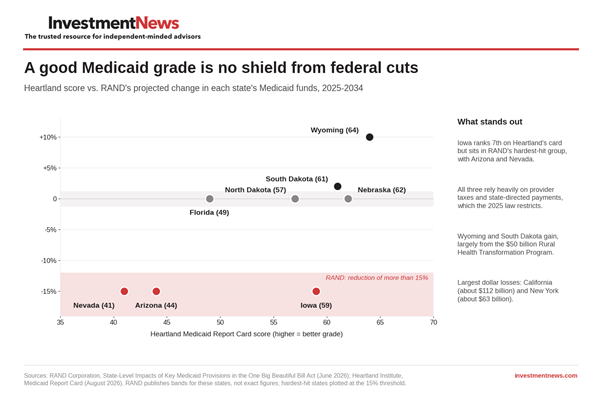
A RAND Corporation analysis projects that states will lose more than $660 billion in combined Medicaid funds over the decade. Arizona, Iowa and Nevada are expected to lose more than 15% each, because all three lean heavily on provider taxes and state-directed payments that the law restricts. Iowa ranks seventh on Heartland's card.
Florida, North Dakota and Nebraska come out roughly even. Wyoming and South Dakota actually gain, largely because of a new $50 billion rural health fund. Declining expansion did not protect everyone, though. RAND expects Tennessee, Mississippi and South Carolina to take the biggest hits from the payment limits relative to the size of their programs.
Long-term care is usually where states look for savings when budgets tighten. KFF found that during the last major federal pullback, every state reduced home care spending. Forty served fewer people, and 47 cut benefits or payment rates.
Firms are adjusting. Some now help Gen X clients plan for aging parents as part of regular reviews.
The provision most likely to affect affluent families takes effect on Jan. 1, 2028. From then on, Medicaid won't cover long-term care for anyone with more than $1 million in home equity. The cap will not rise with inflation.
In 2025, states chose between limits of $730,000 and $1,097,000. The new ceiling therefore cuts the limit in higher-limit states, and it will affect more families each year that home prices climb. The cap does not apply if a spouse or a qualifying child still lives in the home.
Consider a widowed mother in suburban Boston or coastal California who owns her house outright. She could exceed the cap with few other assets. Justice in Aging, an advocacy group, warns that some seniors will face a choice between selling the home and going without care.
The law also shortens the window in which Medicaid will pay bills that predate an application. That makes timing more important when a health crisis hits. Medicaid also looks back five years at asset transfers, so options such as trusts, gifts or a reverse mortgage need to be discussed with an elder law attorney well before they are needed.
The same stress reaches fixed income. Hospitals are the second-largest sector in the Bloomberg Municipal Bond Index by par value, with 358 issuers and more than $163 billion outstanding. Medicaid covered 19% of hospital spending in 2023, according to an InvestmentNews analysis of not-for-profit hospital credit.
Work requirements for many expansion enrollees begin in January 2027, and uncompensated care is expected to rise afterward. Clients who hold single-state muni funds or hospital revenue bonds may want their state's Medicaid exposure added to the credit review.
Heartland says it will update the scorecard in future editions. Advisors don't need to wait for it. They can look up the state where a client's parents live, see how much of its budget Medicaid already consumes and how hard the federal changes hit it, and start the long-term care conversation before the state legislature starts its own.

Goldman's president and COO is expected to replace David Solomon as CEO as soon as 2027, ending a near-decade at the firm's helm.

New model blends public and private markets as demand for alternatives among wealthy clients accelerates.

Salespeople at the firm often went beyond the matching algorithm to recommend network advisors on its Zoe Wealth platform, according to the regulator.

The Protect College Sports Act would cap school payments and codify NIL rights, with implications for advisors guiding young athletes.

"I know the number that I want to be able to retire on, and now I just want out," says Wilmington Trust's Marguerite Weese, describing a common refrain among business-owner clients.
As AI makes financial information more accessible than ever, Lana Hock explains why human judgment, trust, and empathy remain the qualities clients value most in a financial advisor
Northern Trust’s Ken Lassner shows advisors how to convert volatility into after-tax portfolio gains

