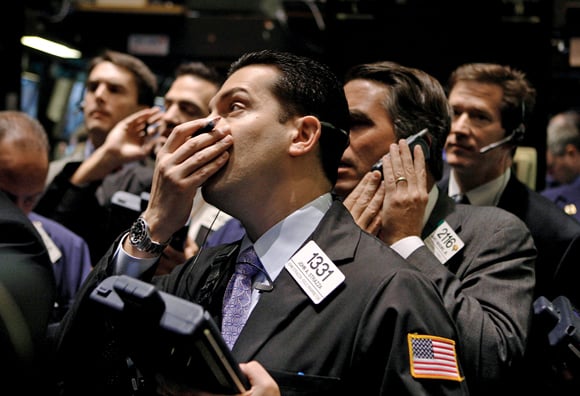
This was the kind of day that turns into a nightmare for financial advisers.
The Dow Jones Industrial Average posted its biggest intraday loss since the market crash of 1987, the euro slid to a 14-month low and yields on Greek, Spanish and Italian bonds surged on concern European leaders aren't doing enough to stem the region's debt crisis.
“It's panic selling,” said Burt White, chief investment officer at
LPL Financial in Boston, which oversees $379 billion. “There's concern that the European situation might cool down global growth and freeze the credit markets.”
(There's an alternate explanation now for the sell-off and CNBC reports that a typo may have been the source for the market madness.)
For investors, however fear ruled the day. “The massive jump in the fear gauge points to the all-out panic investors are feeling right now while watching equities across the board in free-fall,” said Caitlin Duffy, an equity options analyst at Greenwich, Connecticut-based Interactive Brokers Group Inc., commenting on the 60% spike in the The VIX, as the Chicago Board Options Exchange Volatility Index is known. (To read
”The fear index freaks,” click here.)
The Dow lost as much as 998.5 points, or 9.2%, before paring its loss to 434 points at 2:56 p.m. in New York. The Standard & Poor's 500 Index fell as much as 8.6 percent, its biggest plunge since December 2008, before trimming its decline to 4.1 percent.
Leo Marzen, who oversees $850 million as principal at Bridgewater Advisors Inc. in New York, was slightly ahead of other sellers today. This morning, he reduced his clients' exposure to European equities by about 60%, he said. The firm has almost no exposure to European debt, he added.
“Given the market reaction with these huge swings, we're confident that making some preemptive moves was appropriate. Even if the markets rally tomorrow, it's indicative of huge unrest globally, about what's happening in Greece. There just continues to be growing unresolve. We recognize that even if there's some resolution, there are other countries, such as Spain and Portugal, that aren't far behind. There's no easy fix here.”
European Central Bank President Jean-Claude Trichet held interest rates steady at a record low of 1 percent today and said the bank didn't discuss whether to purchase government bonds to stem the region's debt crisis, defying market speculation that he would take such measures. The euro maintained losses even as Greece's parliament approved austerity measures demanded by the European Union and International Monetary Fund as a condition of its 110 billion ($140 billion) bailout.
“The ECB can fix this instantly by doing what the Fed has done -- instantly providing liquidity by buying bad fixed-income instruments and paying cash in U.S. dollars,” said David Kovacs, head of quantitative strategies at Turner Investment Partners in Berwyn, Pennsylvania, which manages $18 billion. “The reason the market is horrified now is Trichet said it's not even being discussed. Smart investors are basically selling risk assets.”
Back in the U.S, a number of financial services and bank stocks -- recently the darling of scores of analysts and money managers -- took a beating.
Bank of America was one of the day's big losers, shedding 6.62% of its share price as of 3:45 EST.
In the advisory and custody space, TD Ameritrade Holding Corp had a tough day, dropping 3.88% by late afternoon.
Raymond James Financial was down close to 4%.
On the mutual fund front,
T. Rowe Price Group saw its stock price drop around 5%. To see how the entire advisory and brokerage industries held up today,
click here.
[
Bloomberg contributed to this story]