

Reports of the demise of excess U.S. household savings were greatly exaggerated. Revised government data indicate that Americans have hundreds of billions of dollars more in extra cash stashed away than previously believed.
“It definitely raises the prospects of a soft landing pretty significantly,” Citigroup Inc. senior global economist Robert Sockin said. He puts the odds of a soft landing at around 50-50, after previously viewing a recession as more likely than not.
Sockin reckons that households have about $1 trillion in excess savings remaining — a tally in line with a growing number of estimates. That still-large stockpile, some 3½ years after the first fiscal rescue package, may offer a cushion for the economy in the face of headwinds including a surge in bond yields that’s raising borrowing costs for households and companies.
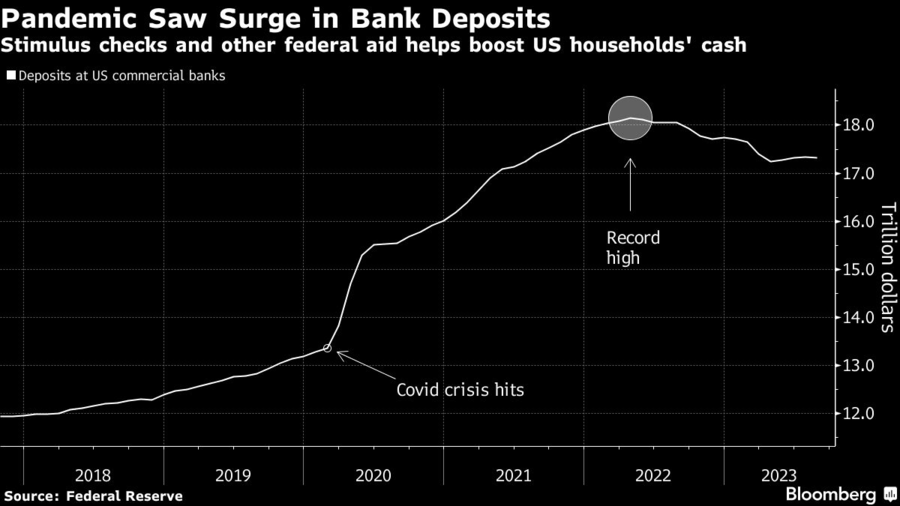
Americans were able to build up a savings cushion during the pandemic, in part as a result of large government support, but have since seen that eroded by elevated inflation and a return to more normal spending patterns as fears of Covid faded.
Economists’ estimates of excess savings hinge on their assessment of the underlying trend in the savings rate. The lower the perceived trend prior to the pandemic, the bigger the bundle of extra savings built up during the virus crisis.
In its comprehensive update of national economic data at the end of last month, the Bureau of Economic Analysis revised down calculations for household savings to reflect a change in how it accounts for income from mutual funds and real estate investment trusts. The bulk of those revisions occurred prior to the pandemic.
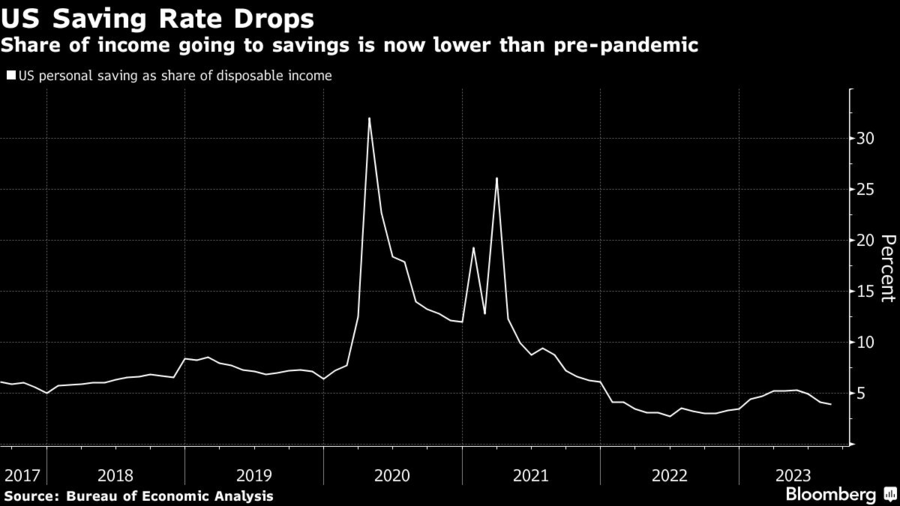
As a result, the household savings rate was lowered to an annual average of 6.5% from 2017 through 2019, from 7.9% previously, tilting economists’ estimates of the trend downward.
Savings then surged to 15.4% of disposable income in 2020 and 11.4% in 2021 after the onset of the pandemic. It slumped to an average of 3.3% last year and stood at 3.9% in August.
The BEA’s revisions prompted JPMorgan Chase & Co. economists Michael Hanson and Murat Tasci to ramp up their estimate of the savings buffer to $1.2 trillion, from $400 billion. “Excess saving may not be exhausted until sometime next year,” they wrote in an Oct. 6 report.
“Households are in a lot better financial shape than we thought,” said Jonathan Pingle, chief U.S. economist for UBS Group, who increased his estimate of excess savings by $600 billion to more than $1 trillion after the recent data revisions.
He still sees the U.S. falling into a recession, though it comes later and is milder than he previously expected: It begins in the second quarter of next year, rather than this year, with the economy contracting by a half percent peak to trough compared to closer to 1%.
In a widely noted paper released on Aug. 16, Federal Reserve Bank of San Francisco researchers Hamza Abdelrahman and Luiz Oliveira argued that excess savings was all but exhausted.
While they haven’t updated their numbers, other economists such as Sockin have replicated their methodology using the new government data. Those calculations indicate that households still have more than $500 billion in extra cash squirreled away.
Much of the excess cash is held by upper-income households. Moody’s Analytics chief economist Mark Zandi reckons that more than half of the $1.8 trillion in excess savings he calculates remains is held by households in the top 10% of the income bracket.
Americans have also benefited from increased household wealth, courtesy of higher property and equity prices since the pandemic.
“They can sustainably save less of their paychecks and spend more of their income because they have more wealth,” Sockin said.

LPL Financial and Raymond James also add independent advisors from Osaic and Edward Jones in Michigan and Arizona.

The SEC-registered RIA advises on more than $1 billion in client assets, with no advisory fee through 2027 and no human financial advisors.

The four wirehouse firms lost 1,449 experienced advisors and recruited 932 in the first six months of the year, according to Diamond Consultants.

Merit's 10th Commonwealth addition deepens its Western New York reach, while another Hightower partner joins its Signature Wealth platform in Michigan.

Report on Climate Action 100+ signals risk for passive managers' 13G status heading into the 2027 proxy season.
Knighthead Life entered the market with a competitive MYGA. A strong launch earned advisor confidence and paved the way for FIAs.
As AI makes financial information more accessible than ever, Lana Hock explains why human judgment, trust, and empathy remain the qualities clients value most in a financial advisor

