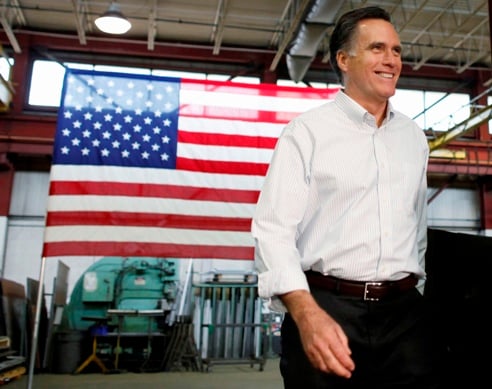
Despite withering criticism from Democrats, it appears Mitt Romney's tax math does indeed add up. At least, that's the verdict from the non-partisan Tax Foundation.
Republican presidential nominee Mitt Romney's latest income tax cut proposal would be able to pay for itself by placing a cap on individual deductions, according to the Tax Foundation.
“When you add the new deduction cap, we find that the plan actually does come in on balance,” Scott Hodge, president of the Washington-based group that favors a simpler tax code, said today at a Bloomberg Government breakfast.
Tax cuts proposed by Romney would create a $5 trillion hole in the U.S. budget, which the former Massachusetts governor says would be filled by limiting tax breaks and by assuming the cuts will spur economic growth. President Barack Obama says that assumption would result in a bigger budget deficit.
Overhauling the corporate tax code by lowering rates wouldn't hurt federal revenue, Hodge said. With the top rate now at 35 percent, Romney wants to cut it to 25 percent. Obama wants to reduce it to 28 percent, with a 25 percent rate for manufacturers.
“When it comes to business taxation, the United States has a Neiman Marcus tax system in a world of Wal-Mart tax systems,” Hodge said. “We have every-day high prices every day and we offer a few white sales to get people in the door. But everyone else is competing on low tax rates.”
Individual Taxes
The latest component of Romney's plan for individual income taxes would create a ceiling on deductions as part of a three- part set of limits on tax breaks, according to a campaign aide who spoke on condition of anonymity on Oct. 3 to provide details on the options. The aide said there would be a $17,000 cap on deductions and credits, while Romney suggested a ceiling of $25,000 during the Oct. 16 debate.
A second ceiling would apply to personal exemptions and a third cap would apply to the tax break for employer-provided health insurance.
One undecided issue is how to handle the fact that a $1,000 credit, which is a subtraction from a person's tax payment, is different from a $1,000 deduction, which is a subtraction from income.
The amount and details of the limits could be changed to meet Romney's targets for revenue and distribution of the tax burden. The aide said the three-cap idea is only one option being considered.
20 Percent
Romney's plan would cut individual income tax rates by 20 percent, eliminate the estate tax and alternative minimum tax and reduce the corporate tax rate to 25 percent from 35 percent. The combination of those policies would reduce federal revenue by $5 trillion over the next decade, an amount Romney has pledged to make up.
Obama has said he wants to raise taxes for top earners and multinational corporations. He has said Romney's insistence on rate cuts would mean a bigger deficit or higher taxes for the middle class.
Increased taxes for middle-class Americans may be inevitable, according to Gary Hufbauer, a senior fellow at the Peterson Institute for International Economics in Washington, who also spoke at today's Bloomberg Government breakfast.
Unless spending on entitlement programs such as Medicare is significantly reduced, Hufbauer said, “you can't close the budget deficit without raising taxes in one shape or another on the middle class. It's as simple as that, and the arithmetic is extremely powerful.”
Hufbauer said taxes most likely would be raised by limiting deductions.
International Taxation
Hodge and Hufbauer also said the U.S. needs to overhaul international taxation of domestic companies, something proposed by Romney. Under current law, companies owe U.S. taxes on profits they earn around the world. They receive tax credits for payments to foreign governments and don't pay the U.S. until they bring the money home.
Romney wants to adopt a so-called territorial tax system, under which companies would owe little or no taxes on their overseas income. Obama has said lower taxes on foreign income earned by U.S.-based companies would encourage them to send more jobs and investment overseas.
“We are beginning to see companies move abroad” to take advantage of lower tax rates in other countries, Hodge said. “The handwriting is on the wall: We have to move to a territorial system or we will further erode our global competitiveness.”
Adding Up
Romney says his tax plan adds up, assuming that some revenue to pay for the proposed tax cuts comes from growth. Obama, in contending the plan doesn't add up, cites math used by Congress, which doesn't allow higher growth to cover the cost of tax cuts.
The nonpartisan Tax Policy Center said that, even with growth effects, Romney's plan would be $33 billion short of paying for itself in 2015. Romney allies objected and said other changes, such as ending the tax break for municipal bond interest, would fill the gap.
Under the Tax Policy Center's standard, erasing that gap would require Romney to support proposals he hasn't offered or has suggested he wouldn't accept, such as eliminating the charitable deduction once a household's annual income reaches $200,000.
Another variable in any tax overhaul is how to classify carried interest, or the share of profits that private-equity managers receive.
Carried interest is now taxed as capital gains -- at 15 percent -- rather than at higher rates for ordinary income. Obama wants to tax it as ordinary income, while the Romney campaign hasn't said whether he wants to keep the preferential tax treatment.
“It's income, without a doubt,” Hufbauer said. Hodge said that while it “is probably income, if you eliminated it, people would find other ways to accomplish the same thing.”
--Bloomberg News--