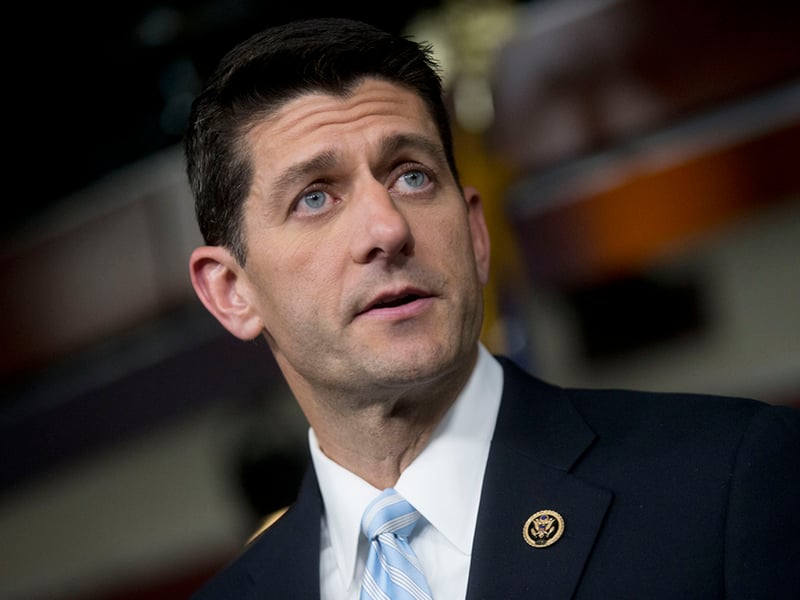
The decision by Rep. Paul Ryan, R-Wisc., to run for speaker of the House has investment advisers hoping that he will help ease partisan tensions in Washington and emphasize deficit cutting.
The decision by Rep. Paul Ryan, R-Wisc., to run for speaker of the House of Representatives has investment advisers hoping that he will help ease partisan tensions in Washington and bring an emphasis on deficit cutting to the powerful position.
“If we're ever going to get out of gridlock, he could be the person to reach across the aisle,” said John Gugle, principal at Alpha Financial Advisors. “That's a good sign that the political ice may be thawing in Washington.”
Advisers also welcomed Mr. Ryan's ascension to the speakership because it would give him a bigger platform to pursue his signature issues: cutting the federal deficit, reforming entitlements and overhauling the tax code. Mr. Ryan is currently chairman of the House Ways and Means Committee and is former chairman of the House Budget Committee.
“He understands a lot of issues the [investment advice] industry would like to see action on, including tax and entitlement reform,” said Greg Valliere, chief global strategist at Horizon Investments. “He is a policy wonk and he understands these issues better than any other member of Congress.”
BUDGET HAWK
Mr. Ryan's reputation as a budget hawk appeals to many advisers.
“He brings a thoughtful voice on the national deficit in that leadership position, which I think is a positive,” said Steve Wykoff, senior financial planner at Mersereau, Lazenby & Rockas.
If Mr. Ryan is successful in getting Republicans on the same page, that will be good for reducing the federal deficit, added William Jerome, president of Capital Financial Services.
“Getting the budget under control and promoting growth in the economy are the most important issues, from where I'm sitting,” he said. “We need to spend less money in this country, and it's obvious the Democrats are not going to do that.”
Should he be elected to the top position in the House — the GOP caucus will vote on its nominee for speaker next Wednesday and the entire House is scheduled to vote Thursday — Mr. Ryan would be in charge of an unruly Republican caucus that has come under the influence of strict conservatives in the Freedom Caucus. That group not only helped force out current Speaker John Boehner, R-Ohio, but also dissuaded House Majority Leader Kevin McCarthy, R-Calif., from running.
In a letter to his Republican colleagues Thursday, Mr. Ryan called for his party to come together and concentrate on legislating rather than fighting.
WASHINGTON 'FALLING SHORT'
“Instead of rising to the occasion, Washington is falling short — including the House of Representatives,” Mr. Ryan wrote. “We are not solving the country's problems; we are only adding to them. I've spoken with many of you over the past few days, and I can sense the hunger in our conference to get to work. I know many of you want to show the country how to fix our tax code, how to rebuild our military, how to strengthen the safety net and how to lift people out of poverty.”
Mr. Ryan's determination to make the House productive is a positive change of pace, according to Geoffrey Brown, NAPFA chief executive.
“The demands that potential Speaker Ryan has put out there among his group is something that will put us in the right direction to allow them to actually legislate and to potentially do some of the across-the-aisle type of work that has happened in the past,” he said. “It would be a big departure from the last 10 years” of gridlock.
Mr. Ryan has a reputation for collaborating with Democrats. For instance, as chairman of the House Budget Committee, he reached an agreement in 2013 with then-chairwoman of the Senate Budget Committee, Patty Murray, D-Wash., to keep the government running after it had shut down due to budget squabbles.
“It would be great if there were someone [as House speaker] who the other side can say from day one, 'I can work with him,'” said Skip Schweiss, managing director of adviser advocacy and industry affairs at TD Ameritrade Institutional. “It's about putting someone in that spot who can work with the other side on the debt ceiling, the budget, immigration and other issues.”
And the debt ceiling will certainly be one of the first things Congress battles over as a new speaker comes on the scene.