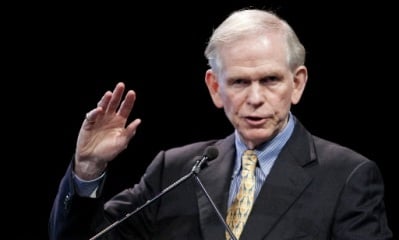
Legendary stock-picker Jeremy Grantham didn't get famous for being wrong very often. So when he says two unrelated events could break the commodities market 'en masse,' it's worth taking note.
Jeremy Grantham said there is a 25 percent chance that China, the world's second-largest economy, will “stumble” by next year over imbalances such as too much capital spending, an overheating real estate market or accelerating inflation.
“You could have a financial stumble, a housing stumble, a stumble from rebalancing of capital spending, or any combination thereof,” Grantham, chief investment officer of Grantham Mayo Van Otterloo & Co., said in an April 26 interview in Boston.
China's economic growth may “slow to considerably less” than the 9.7 percent pace reported for the first quarter, Grantham said. Inflation accelerated to 5.4 percent in March, the fastest pace since July 2008, adding more pressure on officials to tighten monetary policy.
Grantham, 72, is best known for his bearish outlook and for spotting asset bubbles early. He correctly forecast in 2000 that U.S. stocks would decline in the coming decade, and as early as July 2007 predicted that a large global bank would go bust amid credit market declines. He recommended buying U.S. stocks for a five-month period starting in early 2009 in what he called “my very short life as a bull.”
“I find it intellectually convincing,” Grantham said, referring to the idea that China's economy will slow. Still, “they have the ability to get everybody to change the game on a dime.”
‘Incredibly Suspicious'
China is seeking to slow the growth of credit after a $2.7 trillion, two-year lending boom. China's regulators on April 20 ordered lenders to strengthen credit controls for local- government financing vehicles, including halting loans or demanding early repayment in the most serious cases. The cost of insuring Chinese bank bonds against default rose more than that for lenders in Russia and India this month.
“If the housing market takes a break, you have a lot of banking losses,” Grantham said in the interview. “They've made a lot of loans that look incredibly suspicious.”
Grantham says his views on China's economy are less grim than those of his colleague Edward Chancellor, who since last year has said that the nation has displayed symptoms of a “great speculative mania.” Hedge-fund manager Jim Chanos, who was among the first investors to predict Enron Corp.'s collapse, said last month that the property bubble in China is “as big or bigger than what we saw in the West” when compared with the size of the economy.
‘Break the Markets'
In an April 25 letter to investors, Grantham said that a decline in China's economy would hurt the commodity markets. If a Chinese decline were accompanied by better-than-expected weather globally, then “it will very probably break the commodity markets en masse,” he wrote in the letter.
“If the weather and China syndromes strike together, it will surely produce the second ‘once in a lifetime' event in three years,” Grantham wrote.
Despite some short-term shocks, global demand for energy, metals and crops is outpacing supply, Grantham said, creating “brilliant long-term prospects” for commodities.
Grantham said in January that the U.S. stock market rally is living on “borrowed time,” driven by low interest rates and the Federal Reserve's unprecedented stimulus. The Standard & Poor's 500 is worth about 920, Grantham said in the interview, about 32 percent below where it is now. When the Fed eventually “runs out of money,” the U.S. stock market will fall, Grantham said.
“I'm not good at timing,” he said. “Sooner or later, it will happen,” he said.
Boston-based Grantham Mayo managed more than $107 billion as of Dec. 31, according to its web site.