
Millionaires could see much bigger tax bills if Democrat Joe Biden is elected president in November, but levies on most households below the top income brackets would stay about the same as under President Donald Trump, an outside analysis shows.
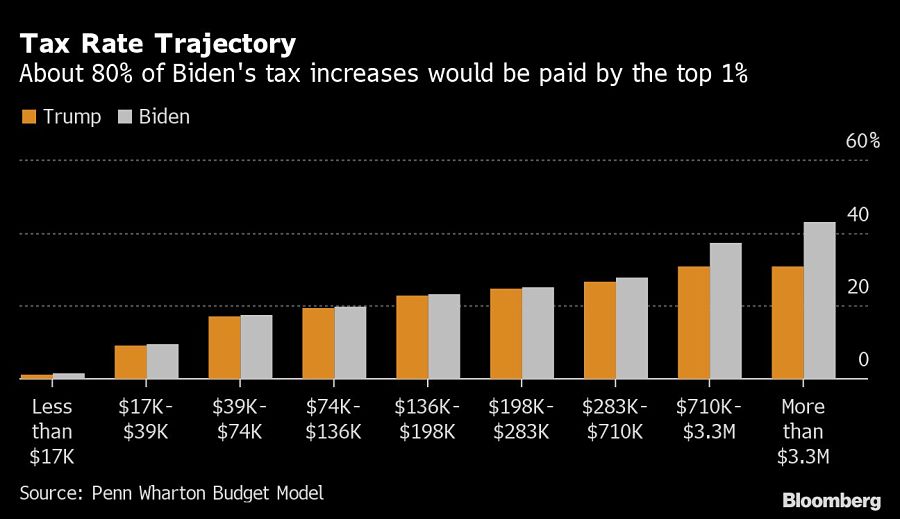
Biden’s tax proposals would have the top 0.1% of earners -- those currently making about $3.3 million or more annually -- paying a 43% rate on their income, according to the Penn Wharton Budget Model. That top group pays a rate of about 30.6% under Trump’s 2017 tax law, according to the report, which accounts for income, payroll and corporate duties.
The figures highlight the key dividing line between the two candidates when it comes to taxes. The Trump campaign has run ads saying Biden’s increases would crush middle-class families, but the data show there would be little effect for most who earn less than $400,000. Trump has said he wants to cut taxes again, but hasn’t released a plan on how he would do that.
Biden’s platform would increase the top rate to 39.6%, where it was before Trump’s overhaul pared it to 37%. The Democrat would also tax capital gains earnings the same as regular income for top earners, and impose an additional payroll levy on incomes above $400,000. Payroll taxes are currently only paid on the first $137,700 of income. About 80% of Biden’s increases would fall on the top 1% of earners, or those earning at least $710,000, according to the report.
The biggest tax increases in the Biden plan are the corporate tax at $1.4 trillion over the 10-year budget window, followed by the payroll tax at $992.8 billion and the individual income tax at $944 billion, according to the study.
Biden would do little to tinker with the tax obligations of those earning less than $400,000 a year. Middle-income households would see slightly higher rates due to indirect effects of higher corporate taxes. For example, the middle 20% of earners, who now pay an effective tax rate of 16.9%, would owe 17.3% under Biden.
“There is a tax increase on the lower earners, but it’s small and it’s through those indirect tax effects,” said Richard Prisinzano, director of policy analysis at the Penn Wharton Budget Model.
Proposed tax rates under Biden’s plans are far lower than some touted by more progressive Democrats. Sen. Bernie Sanders, who battled Biden for the party’s nomination before endorsing him, proposed rates as high as 97.5% on some of the richest Americans. Rep. Alexandria Ocasio-Cortez of New York has called for taxing income above $10 million at 70%.
Biden’s plans would raise $3.4 trillion over the next decade, or some $2 trillion dollars short of covering the $5.4 trillion price tag for his spending programs, the analysis showed. But after accounting for the macroeconomic effects of his immigration, infrastructure, health and other proposals, federal debt would decrease by 6.1% and gross domestic product would rise by 0.8% by 2050 relative to current law, according to the report.
The Penn Wharton Budget Model is a nonpartisan, research-based initiative that provides economic analysis of the fiscal impact of public policy, according to its website. The group describes its goal as “providing rigorous analysis without policy advocacy.”

The financial advice industry has been facing inquiries into its cash sweep programs for years now.

Investor money allegedly went to strip clubs, exotic cars, and landscaping

Procyon adds $415 million in assets under management in New Jersey while Savant picks up a $213 million Southern California planning firm

With a growing number of real estate-rich Baby Boomers aging into retirement, some advisors may be failing to consider all the options available for those clients' assets.

Cornerstone Advisors study reveals compliance bottlenecks stall campaigns weeks after customer opportunities close.
As AI makes financial information more accessible than ever, Lana Hock explains why human judgment, trust, and empathy remain the qualities clients value most in a financial advisor
Northern Trust’s Ken Lassner shows advisors how to convert volatility into after-tax portfolio gains

