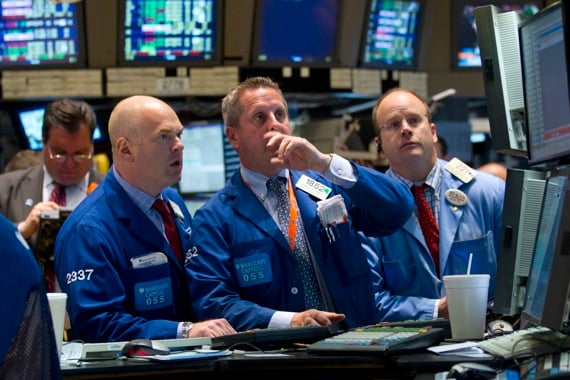
Birinyi Associates Inc.'s Jeffrey Yale Rubin said his firm is bullish on equities this year, leading managers expressing optimism that six straight weeks of declines in the stock market and weak economic data will be reversed in the second half.
Rubin said at the Bloomberg Money Managers conference in Boston yesterday that his firm's long-term target for the Standard & Poor's 500 Index is 2,100. Bond managers Eric Stein at Eaton Vance Corp. and Ken Taubes of Pioneer Investment Management Inc. said the recent slowdown in the economy was temporary and they weren't worried that U.S. lawmakers would block raising the debt limit.
BlackRock Inc.'s Dan Rice said oil prices, which hurt consumers this year, will come down.
“For the remainder of the year, we're positive,” said Rubin, director of research at Westport, Connecticut-based Birinyi Associates, which analyzes historical charts and patterns to make forecasts.
The S&P 500 and Dow Jones Industrial Average have fallen for six weeks, the longest streaks since 2008 and 2002, respectively, as reports on jobs and manufacturing spurred concern that the economy is slowing. Higher oil prices following unrest in the Middle East and disruptions from the earthquake earlier this year in Japan contributed to global market declines. Concerns that lawmakers won't agree on raising the $14.3 trillion U.S. debt limit before Aug. 2 have also weighed on stocks.
The S&P 500 is still up 90 percent from its low in March 2009, the month the U.S.
Federal Reserve announced large-scale asset spurchases to buoy the economy. The S&P 500 rose 1.3 percent to 1,287.87 yesterday.
‘Phase Two'
“We have a target of 2,100 but that's not this year, that's not next year,” said Rubin. “When we look at stock markets that go on for a long period of time, that start off quickly -- 1974, 1982, 2009 -- those markets are not ones that end quickly. If you also look at those markets during this period, phase two of the market, it runs into difficulty.”
The forecast represents a 63 percent gain from the S&P 500's close yesterday, and a 34 percent advance from the gauge's record high of 1,565.15 reached in October 2007.
In January, Laszlo Birinyi, one of the first money managers to advise buying U.S. stocks before they bottomed in March 2009, said the S&P 500 will rally to 2,854 by 2013.
Peter Andersen, chief investment officer at Boston-based Congress Asset Management Co., said he is “excited about individual opportunities” in the stock market.
Avoiding QE3
“I'm hopeful we won't need a QE3,” Andersen said at yesterday's conference, referring to the Federal Reserve's program of buying assets in a process called quantitative easing, the second phase of which ends this month.
Some managers on the panel were less optimistic that markets would rally after the Fed stops buying. Dean Curnutt, founder and chief executive officer of Macro Risk Advisors in New York, said the performance of stocks depends on the actions by the Fed. The S&P 500 could rise to 2,100 if the Fed decided it wanted it to, he said at the conference.
“One of the problems we're having is asset prices are necessarily imposed with a tremendous amount of artificiality from the Fed, from the fiscal response,” Curnutt said. Tighter fiscal and monetary policy “could be bad news for equities,” he said.
The S&P 500 has risen 23 percent since Fed Chairman Ben S. Bernanke signaled in August the central bank would pursue a second phase of stimulus measures to boost the economy.
Temporary Slowdown
Stocks and the economy may get a boost as oil prices start to retreat from highs reached in April, the managers said. Rice, who manages the BlackRock Energy and Resources Portfolio, said oil prices tend to be “self-regulating” and will come down over the long term. People substituting natural gas for oil may also bring down the price of the latter, he said.
“Any time it gets above $90 a barrel, the growth rate comes down, and prices come down back to $90,” Rice said. “I think you will find out a year from now, it would have been a temporary spike.”
Bond managers including Loomis Sayles & Co.'s Dan Fuss and Pioneer's Taubes said that in addition to oil, the earthquake and ensuing tsunami in Japan in March led to a temporary slowdown in the U.S. economy.
Fuss, manager of the top-ranked $20.6 billion Loomis Sayles Bond Fund, said the U.S. saw a correction in inventories after the earthquake in Japan, and that has come to an end.
‘Who's Going to Buy?'
“I guess that the soft inventory correction in the industrial sector is over,” Fuss said. “Unless something else happens, that's going to start to reshape, with a lag, the economic numbers.”
Thomas Higgins, global macro strategist at Standish Mellon Asset Management, said he expects 3 percent growth in the U.S. economy in the second half of 2011.
The main concern, the asset managers said, is what happens to Treasuries once the economy stabilizes and the Fed stops buying the securities.
“When the Fed pulls back, who is going to buy notes and bonds?” Fuss said. “I don't see anyone.”
--Bloomberg News