
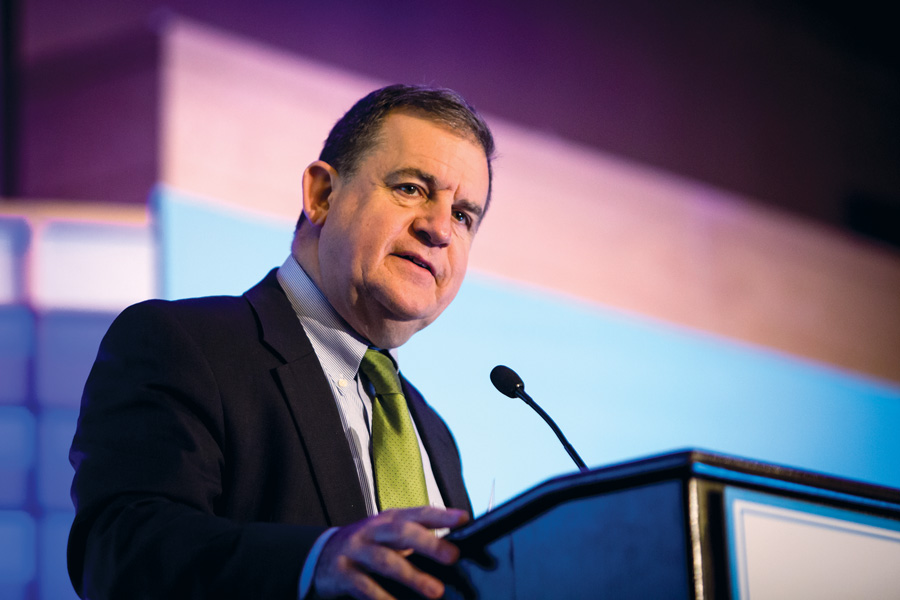
Despite the daily cacophony, fundamentals indicate that the U.S. economy will settle down by the end of the year, with inflation subsiding to a still-too-high 4% and sustained low unemployment buoying households, Bob Doll, chief investment officer at Crossmark Global Investments, said Monday morning.
Doll opened the InvestmentNews Retirement Income Summit with an overview heavy on historical perspective and a prediction of moderate growth for 2022, though that prediction reflected a different set of factors than seemed likely in January. After all, in January the Federal Reserve predicted a mix of 4% GDP growth and 2.6% inflation, but it's now flipped that to project 2.8% GDP growth and 4.3% inflation.
“For 40 years, we’ve seen interest rates declining,” Doll told the group convened in Chicago for the two-day event. “It’s been easy. Buy both stocks and bonds, and if you got the earnings wrong, valuations would bail you out. But now you can’t depend on the P/E. You have to get the earnings right.”
American households are in better shape than one might think, given the travails of sudden, sharp inflation and churn in the job market. At the moment, households are collectively sitting on upwards of $3 trillion in savings, thanks to pandemic-constricted spending combined with pandemic-prompted supplemental income provided by government programs. That cushion gives consumers some breathing room even as they gasp at high gas prices, grocery bills and other daily evidence of inflation, Doll said.
Inflation will likely edge down to about 4% this year as supply chain kinks straighten out, even as continued demand for labor sustains consumer confidence. Though a few historic signals are blinking green for a recession, such as the briefly inverted yield curve, the overriding trend is the deep and ongoing strength of the labor market, which arms households with both optimism and the wherewithal to rise above inflation, he said.
“We’ve never had a recession in this country start with such a strong labor market,” Doll said. As of April 15, when the Bureau of Labor Statistics released the most recent data, the nonfarm unemployment rate was 3.6%, down 0.2 percentage points from the prior month.
Meanwhile, corporate earnings are holding up, which bodes well for a stabilizing economy in the coming months.
“One of the pleasant surprises is how well corporate America is doing,” Doll said. “They’ve passed on price increases to consumers and that’s key for stocks to remain vigorous.” Overall, stocks are likely to perform in a “sideways pattern” for the balance of this year, he said, which translates to “more modest returns” over the next three to five years, especially compared to 2021.
As individual investors rebalance their portfolios, they are likely to fine-tune their approach to values-based investing to better balance equities they want to avoid with those they want to actively pursue and support, Doll added.
“We are finding more organizations and individuals lining up their portfolios with their values,” he said. “It’s not just what they’re against, but what they’re for, and how they express that within their portfolios.”

A Nationwide survey finds 47% of GLP-1 users have never discussed the drugs’ financial impact with an advisor, even as many dip into savings.

The hundreds of millions of dollars from a sale of Inspired Healthcare properties does not mean an immediate windfall for investors.

Its SEC filings said one thing - a congressional probe said another.

Sham agreements allegedly padded revenue by 345%.

"Most pre-retirees are uncomfortable making key retirement income decisions without an advisor's help," said Chris Bailey of Cerulli.
Knighthead Life entered the market with a competitive MYGA. A strong launch earned advisor confidence and paved the way for FIAs.
As AI makes financial information more accessible than ever, Lana Hock explains why human judgment, trust, and empathy remain the qualities clients value most in a financial advisor

