
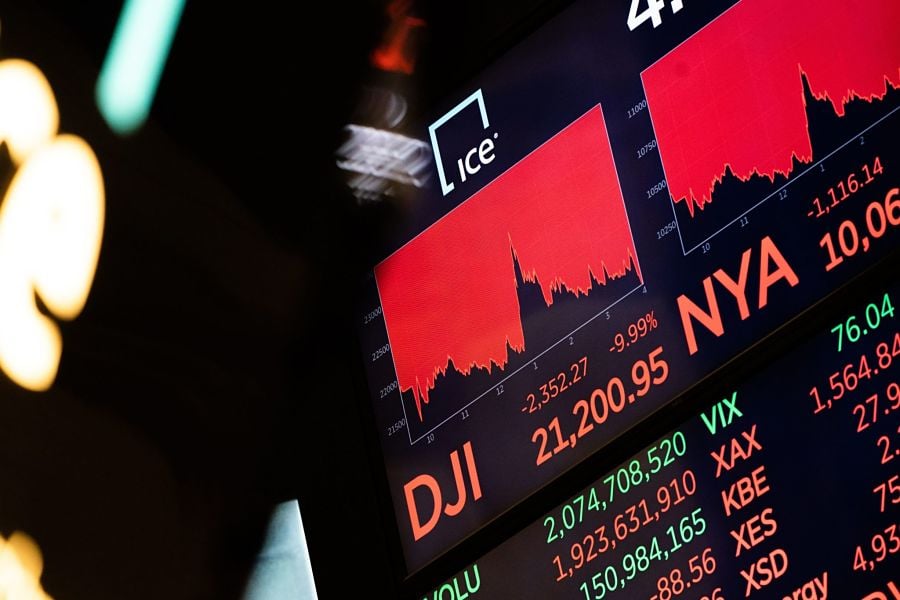
Deeper stock pullbacks and more modest returns lay ahead in 2022 after a year of abnormally smooth sailing.
That’s the word from Truist Advisory Services, which says the market is set up for a return to the occasional gut-wrenching dives that characterize the later years of bull markets. Instead of the mild pullbacks of 5% or less that prevailed in 2021, history shows the potential for bigger retreats that sometimes ranged into double digits, according to Keith Lerner, Truist’s co-chief investment officer.
“The infrequent and shallow pullbacks seen over the past year should be viewed as the exception rather than the norm,” Lerner said in a note to clients. “The first phase of a new bull market tends to see the strongest returns. In the current phase, we expect positive but moderating returns, sustained by solid fundamentals and earnings.”
Lerner points to prior years with shallow pullbacks such as 1993, 1995 and 2017; each saw deeper declines the next year of 9%, 8% and 20%, respectively.
This doesn’t mean the bull is dead. Selloffs can happen even in healthy financial markets when corporate earnings and the U.S. economy are growing. Corrections in the S&P 500 — defined as a drop of at least 10% from a recent peak — have occurred about every two years since 1950, according to Ally Invest.
In fact, Truist expects the S&P 500 will build on this year’s 27% advance. The gains, however, are likely to be smaller as the Federal Reserve winds down its pandemic-era monetary support to tame inflation. In turn, this will weigh on corporate earnings growth, and eventually on stock prices, Lerner said.
Given the market’s already sizable rally and declining policy accommodation, there’s “less room for valuation expansion and upside earnings surprises,” Lerner said.

Retail banks and private wealth firms scored 40 in Fitch's AI stress test, signaling possible one-notch downgrade risk under an adverse scenario.

Elsewhere, Wells Fargo Advisors adds a $400 million Morgan Stanley veteran in Naples as an ex-Cetera advisor goes independent with LPL

According to a federal charges Bradley Heppner, 60, received more than $150 million in payments through funneling money from GWG Holdings to a shell company.

A $1B fund allegedly skimmed 30% off the top, then swapped cash for locked-up stock.

Insiders allegedly rewrote projections three times in four days.
Knighthead Life entered the market with a competitive MYGA. A strong launch earned advisor confidence and paved the way for FIAs.
As AI makes financial information more accessible than ever, Lana Hock explains why human judgment, trust, and empathy remain the qualities clients value most in a financial advisor

