

A top-performing emerging market bond fund is avoiding investments in Russia, China and Saudi Arabia because the three countries score too low in its ratings for environmental, social and governance risks.
The $1.5 billion Candriam SRI Bond Emerging Markets Fund, which has outperformed almost 90% of its peers in the past three years, screens for ESG factors. The bottom 25% of countries in the fund’s ranking get blacklisted, no matter how big a role they play in the bond world.
This approach could be a harbinger of the challenges facing developing nation governments that rely on foreign capital. At the moment sovereign borrowing costs don’t typically take into account factors such as a commitment to cutting carbon emissions or reducing corruption, but they might in the future.
“ESG investing is gaining pace in the emerging market debt space,” Magda Branet, deputy head of emerging market debt at Candriam, said in an emailed response to questions. “Clearly investors will increasingly look to be compensated for ESG-related risks. They will demand higher risk premia from countries that score poorly in their criteria, or avoid some issuers altogether.”
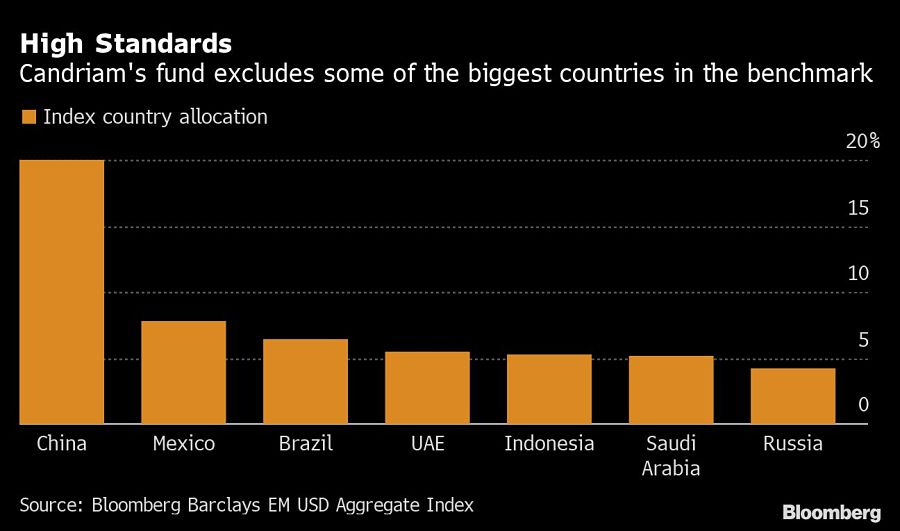
Candriam’s model evaluates how countries access and deploy natural, human, social and economic capital. Regimes deemed to be non-democratic or repressive are stripped out, along with those with a credit rating lower than B-, or six levels below investment grade. The fund’s biggest country holdings are Mexico, Indonesia and Chile.
Currently the model excludes 33 emerging markets, or about 40% of the JPMorgan EMBI Global Diversified Index, considered the benchmark for most emerging-market sovereign bond funds, Branet said during a webinar earlier this month. The model is reviewed regularly, allowing poorly-rated countries the chance to move onto the investment list if they improve.
“Good practices and policies, especially on the environment, can help a country make it onto the investment list,” Branet said by email.
There’s currently no industry-wide standard for applying ESG to sovereign debt, leaving most fund managers that want to incorporate it reliant on internal analysis. Very few funds exclude major emerging markets due to low scores.
“Greenwashing” practices such as misusing ESG ratings are making it difficult for regulators to protect investors, though policy makers are starting to work together to address this, according to Christine Kung, head of sustainable finance at Hong Kong’s Securities and Futures Commission.
Bram Bos, a lead portfolio manager at NN Investment Partners, says investor demands are changing and it’s possible that ESG will begin to have an impact on borrowing costs. Governments and companies selling green and social bonds -- where issuance has hit record highs this year -- are already starting to see that pay off.
“In the past there was a roadshow when a government issued a bond, and it was all about macroeconomic fundamentals,” said Bos, whose firm manages 287 billion euros ($336 billion). “Nowadays, with green and social bonds, other topics are also being discussed and that gives investors another tool to press governments.”

Is your 401(k) working as hard as the rest of your portfolio?

A former executive called it "kind of a dumping ground"

A $200M guidance cut and two stock drops tell the story

Carmel-based Elements Group joins the employee advisor channel as Raymond James extends its run of wirehouse and bank recruits

Former Hightower CEO Bob Oros takes a seat at the board of Praxis Solutions as Nuveen taps a private credit distribution lead and FinServ Foundation adds advisory board members
A continuity plan is one of the most important risk tools an advisor has, and the right successor is easier to find among peers

