
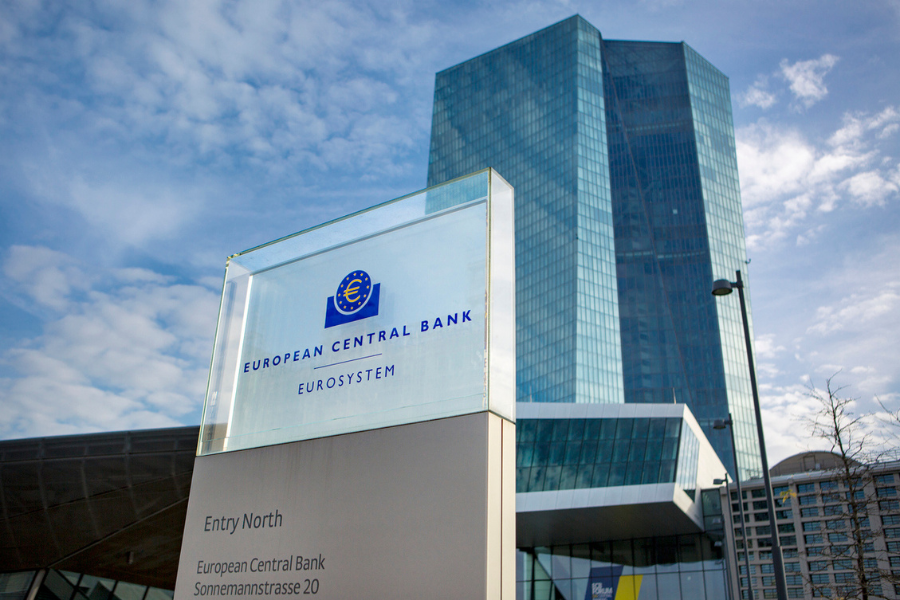
A key gauge of euro-zone wages eased — reinforcing the case for the European Central Bank to continue lowering interest rates next month.
Second-quarter negotiated pay rose 3.6% from a year ago, the ECB said Thursday. That’s down from 4.7% in the previous three months and broadly in line with estimates from Bloomberg Economics, as well as analysts at Morgan Stanley and Citi.
German bonds pared their decline to leave the 10-year yield three basis points higher at 2.22%. The euro slipped versus the dollar, dropping 0.1% to $1.1139 after earlier rising to $1.1164.
The data begin a three-week countdown to the ECB’s September meeting, where officials are expected to lower the deposit rate for a second time, following June’s initial move. In the meantime, officials will receive further details on workers’ pay, as well as this month’s inflation reading and economic projections through 2025.
While policymakers led by President Christine Lagarde left little doubt before their summer break that borrowing costs would fall further this year, lingering uncertainty has meant they haven’t committed to when and by how much.
The growth outlook for the euro area’s 20-nation economy has since soured, with confidence slumping. Germany, the bloc’s largest member, saw output unexpectedly contract in the second quarter.
Such risks strengthen arguments to cut rates next month, according to Finland’s Olli Rehn, one of the first officials to speak following the ECB’s customary August hiatus. He reiterated that inflation’s path back to the 2% target by end-2025 will be bumpy, though stressed that there’s been considerable progress since a peak of 10.6% in 2022.
Aside from a slowdown in wage gains, the ECB’s inflation outlook needs corporate profit margins to absorb some of the rise in labor costs and productivity to improve. That last element has disappointed lately — fueling concern that the ECB may be too optimistic.
Even on wages, there have been some warning signs.
German salary growth isn’t abating quickly enough for the Bundesbank, which has warned that inflation may remain elevated for some time. Elsewhere, a tally by Citi’s Giada Giani showed that increases in negotiated pay eased in France, the Netherlands and Austria, but accelerated in Belgium, Italy and Spain.
ECB officials won’t have to wait long to analyze a broader gauge of workers’ pay — compensation per employee. Those data are due on Sept. 6 — less than a week before the rate decision.

LPL Financial and Raymond James also add independent advisors from Osaic and Edward Jones in Michigan and Arizona.

The SEC-registered RIA advises on more than $1 billion in client assets, with no advisory fee through 2027 and no human financial advisors.

95.8% of house trades were winners. For clients? The SEC says just 14.9%.

The complaint says Duolingo added friction on purpose, then lied about it.

The four wirehouse firms lost 1,449 experienced advisors and recruited 932 in the first six months of the year, according to Diamond Consultants.
Knighthead Life entered the market with a competitive MYGA. A strong launch earned advisor confidence and paved the way for FIAs.
As AI makes financial information more accessible than ever, Lana Hock explains why human judgment, trust, and empathy remain the qualities clients value most in a financial advisor

