
Investing in technology is now a family – office - affair.
“Because it's long-term money, we have to look at the long-term prospects for some of these very exciting public companies,” said Carol Pepper, CEO of Pepper International, a family office and consulting firm overseeing more than $5B in assets. “And the clear winners for over the last ten years have been tech stocks.”
Pepper says she advises clients to simply own market leaders such as AI chipmaker Nvidia (Ticker: NVDA) or ETFs such as the Invesco QQQ Trust (Ticker: QQQ), which is heavily overweight mega-cap technology stocks including Microsoft, Apple, Amazon.com and Meta. In her view, “bigger is better” when it comes to tech investing, and growth trumps value, especially in an elevated inflation environment.
“It’s not that you shouldn't have a balanced portfolio,” said Pepper. “But I say overweight tech and growth relative to your value in your public securities. And the size of those allocations depends on the purpose of that portfolio.”
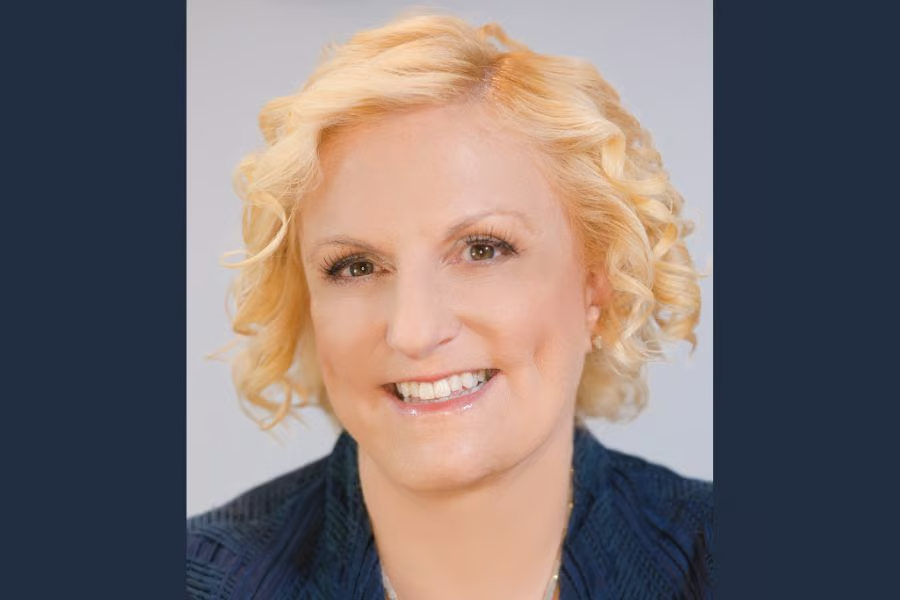
Carol Pepper was shortlisted by Private Asset Management for 2020 Best Family Office Consulting Firm. In 2009, Barron’s named Pepper International as one of the top family offices in the United States. Prior to forming Pepper International in 2001, Pepper served as a private banker at JP Morgan Private Bank, Citibank Private Bank and Credit Suisse Private Bank.
PRIVATE DEALS
Of course, one need not be a member of an ultra-high-net-worth family to invest in a publicly traded “Magnificent 7” technology stock. Anybody with a brokerage account and the cash can do it.
Family office advisors often do have the ability to see private deals that most retail investors do not, however. And non-public investments, or alternatives, often make up a substantial chunk of a family office portfolio. According to the 2024 J.P. Morgan Private Bank Global Family Office Report, for instance, the average family office allocates 46 percent of its assets into alternative investments, including private equity, real estate, venture capital, hedge funds, and private credit, compared with 26 percent into publicly traded stocks.
Pepper says the larger private deal funds sponsored by large Wall Street players have not performed as well as expected. As a result, she says family offices are increasingly co-investing directly into deals, where one of the families has a significant market share.
“You take a private company in Mexico for example that's a huge exporter of steel,” said Pepper. “And a family from let's say, Sweden or wherever might prefer to invest directly in their operations rather than investing through BlackRock or Blackstone. They get access directly to the CEOs of these companies, and they do private deals without the heavy private banking fees or the fund fees. And that's the trend right now for the large families.”
“It's a great time to be in the family office community and to have a family office because you're in a private club where the price of admission is setting up your own family office, and then you get access to institutional quality deals as a high net worth individual,” Pepper added.
MODERN DAY ROCKEFELLERS
Making sure all that family wealth remains in the family for generations to come is the primary role of a family office advisor. Pepper says that starts with a strategic asset allocation following an institutional model such as a college endowment. And most importantly, one that is as simple as “C, B, A.”
“C is cash. Always have 2 to 5 years’ worth of your expenses in a bank account, which implies that you know what your expenses are or some sort of very ready cash. B is beta. Everything you invest in in the markets is going to have a market like return. There's no such thing as beating the market anymore. And A is alpha. That's where the real opportunities lie. Whether it's real estate, whether it's private equity, whether it's seed investing,” said Pepper.
Her job as a family office advisor is to create the right mix of C, B and A for each family portfolio. That and making sure the next generation knows that family fortunes are not guaranteed to last forever.
“If you train children from a young age to always save something and give some to others who are less fortunate, you actually guarantee that by the time they're in their 20s, they are saving and they are giving to charity, and they are very mindful of their spending,” said Pepper. “And that's what we aim to do.”
As to the differences between last century’s ultra-high-net-worth families like the Rockefellers, for whom Pepper once worked, and the modern technology billionaire, Pepper says the 21st century tech tycoon is more defensive than one might think.
“Actually the big tech executives who have hit large want to take most of their chips off the table,” said Pepper. “In fact, they like doing more conservative investments. And then they will still do direct venture or seed investing with their friends that they trust, which is not unlike the traditional old families.”
And while it may seem like a snap to come into massive wealth after striking it huge as a technology entrepreneur, Pepper warns that there is indeed a learning curve, and it can be steep.
“Everybody has to learn how to be a rich person. Once you become wealthy and you have a big asset, it's not something that you can intuitively figure out,” said Pepper.

LPL Financial and Raymond James also add independent advisors from Osaic and Edward Jones in Michigan and Arizona.

The SEC-registered RIA advises on more than $1 billion in client assets, with no advisory fee through 2027 and no human financial advisors.

95.8% of house trades were winners. For clients? The SEC says just 14.9%.

The complaint says Duolingo added friction on purpose, then lied about it.

The four wirehouse firms lost 1,449 experienced advisors and recruited 932 in the first six months of the year, according to Diamond Consultants.
Knighthead Life entered the market with a competitive MYGA. A strong launch earned advisor confidence and paved the way for FIAs.
As AI makes financial information more accessible than ever, Lana Hock explains why human judgment, trust, and empathy remain the qualities clients value most in a financial advisor

