

Daytraders are once again going gaga for GameStop and other so-called meme stocks. Financial advisors likely won’t be joining in the fun, however, and not because of the quality of the companies.
Even if they were blue-chips they would not be buying and selling them. That's because wealth managers are increasingly shying away from stock-picking, opting for ETFs instead, according to a new study.
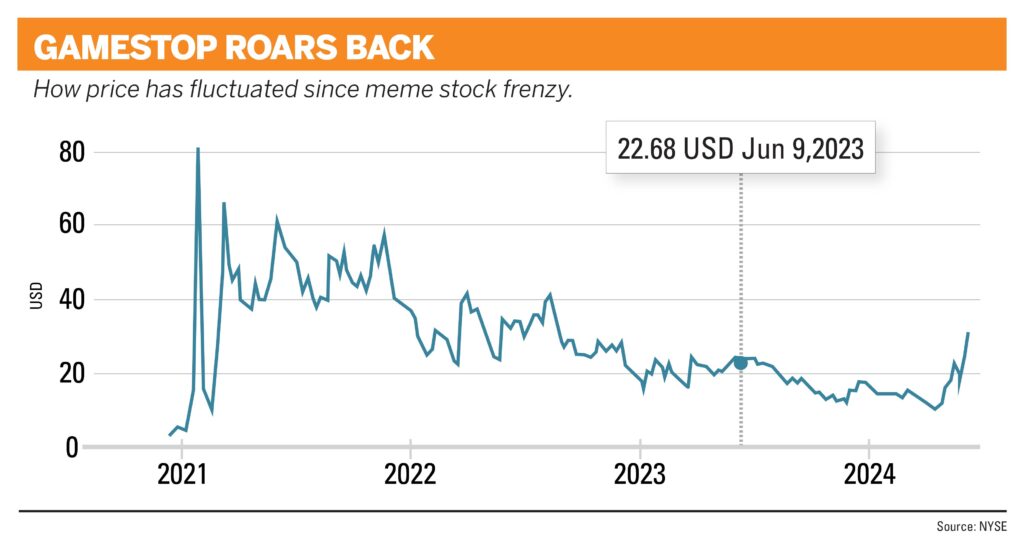
Shares of GameStop (Ticker: GME) opened more than 70 percent higher on Monday on enormous volume after individual investor Keith Gill shared a screenshot on Reddit showing a $175 million position in the video game seller. For those who may have already forgotten, Gill, aka Roaring Kitty, started the meme stock revolution in 2021, sending stocks like GameStop and AMC Entertainment skyward, much to the chagrin of the hedge fund elite who sold short the fundamentally challenged companies.
Yet while they would not quibble with the gains from an individual stock trade (who would?), fewer financial advisors are playing that particular game. Exchange-traded funds (ETFs) are financial planners’ top choice for the investment vehicle they most often use with clients, and their popularity does not appear to be weakening, according to the 2024 Trends in Investing survey, conducted by the Journal of Financial Planning and the Financial Planning Association.
The annual survey of 208 financial planners showed that ETFs continue to dominate investment portfolios, with over 89% of respondents currently using or recommending these diversified products. Furthermore, over 60% of those surveyed plan to increase their use of ETFs in the next 12 months, reflecting a strong preference for this investment vehicle over single stock buying.
Josh Branham, wealth manager at Savvy Advisors, does buy individual stock portfolios for clients, but solely for those who have the resources to properly diversify across many different asset classes and sectors. Otherwise, he tends to use ETFs and funds.
“I've historically recommended these individual stock portfolios for clients with $500,000 and up in liquid assets, and the proper risk tolerance,” said Branham. “This allows me to purchase at a minimum of 25 individual stocks which I believe to be the least amount of stocks and still be considered diversified.”
Meanwhile, Jerry Sneed, senior private wealth advisor at Procyon Partners, has not stopped recommending individual stock purchases for clients “under specific circumstances.” In his view, his role as an investment advisor is to capitalize on market dislocations, which can provide various opportunities for portfolio enhancement. Those different types of dislocations he considers include secular, technical, and stock-level.
“My partner, Frank McKiernan, and I have a unique advantage as former traders, enabling us to quickly synthesize large amounts of information and make informed decisions during periods of volatility,” said Sneed. “For individual stock purchases, staying attuned to various information flows is crucial. This allows us to take advantage of market overreactions to events such as light earnings forecasts or overall market corrections.”
For example, last week they purchased Salesforce (Ticker: CRM) for clients, due to their belief that the company is poised to dominate in AI given their vast amounts of data. A longer-term example is their purchase of NVIDIA (Ticker: NVDA) in 2018, based on their analysis of the growing demand for high-end chips in sectors like the metaverse, gaming, and autonomous driving.
“We recognized NVDA's strong market position and underappreciated developer platform early on, which has since proven to be a valuable investment for our clients,” said Sneed.
Finally, Mark Pearson, founder & CEO of Nepsis, only recommends investing in individual stocks because this approach provides “greater clarity and understanding of your investments” in his opinion.
“We don’t usually recommend ETFs or mutual funds as they often lack the transparency and control that come with owning specific companies,” said Pearson.

Elsewhere, Wells Fargo Advisors adds a $400 million Morgan Stanley veteran in Naples as an ex-Cetera advisor goes independent with LPL

According to a federal charges Bradley Heppner, 60, received more than $150 million in payments through funneling money from GWG Holdings to a shell company.

A $1B fund allegedly skimmed 30% off the top, then swapped cash for locked-up stock.

Insiders allegedly rewrote projections three times in four days.

TCI Wealth Advisors also has also tapped JIFFYAI to unify onboarding and servicing, while TradePMR adds ICE market data to its Fusion advisor platform
Knighthead Life entered the market with a competitive MYGA. A strong launch earned advisor confidence and paved the way for FIAs.
As AI makes financial information more accessible than ever, Lana Hock explains why human judgment, trust, and empathy remain the qualities clients value most in a financial advisor

